 EN — English
 TR — Türkçe
 DE — Deutsch
 RU — Русский
 FR — Français
 ES — Español
 AR — العربية
 SR — Српски
Mining Engineering
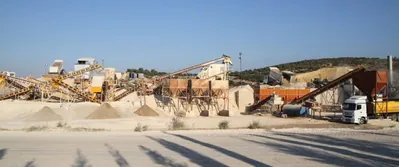
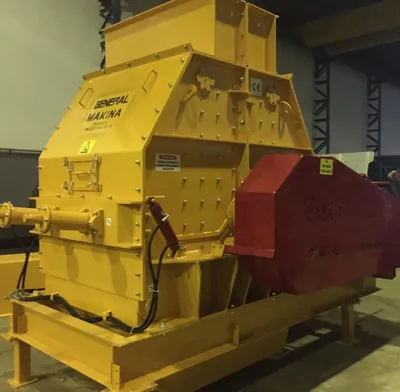
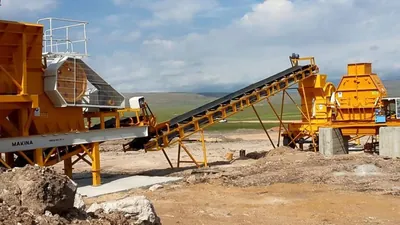
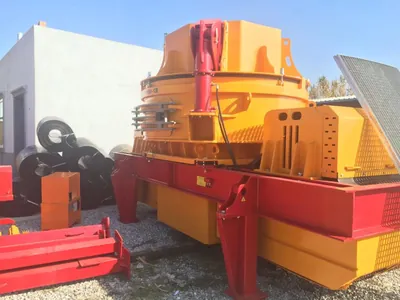
From the quarry face to a specified aggregate
The output of a crushing and screening plant is decided long before the first machine is switched on. It is fixed at the moment the blast pattern is designed, because the size distribution leaving the face is the input to every calculation that follows. A mining engineer therefore reads the plant as one continuous mass stream rather than as a row of separate machines: fragmentation feeds the primary opening, the primary product feeds the reduction ratio budget, that budget dictates how many stages exist, and the last stage has to land inside the grading limits written in the buyer's specification.
This section collects the arithmetic behind that chain. Feed size against crusher gape, reduction ratio per stage, circulating load inside a closed circuit, screen efficiency and screening area, annual tonnage converted into a nominal hourly rate, and the laboratory results that turn a pile of stone into a saleable product. None of it is exotic engineering; all of it is routinely skipped, which is why plants with adequate nameplate capacity finish the shift short of target.
Matching post-blast feed size to the crusher opening
Primary selection starts with the largest lump the face reliably produces. Established practice keeps the maximum feed lump at or below 80 per cent of the crusher gape. Where 800 mm boulders arrive regularly, a jaw crusher with an opening under 1000 mm will bridge instead of crush: the rock is never gripped by the nip angle, it simply sits across the mouth. The rule also runs in reverse. When the machine is already on site, the blast design — hole diameter, burden, spacing and delay sequence — is the variable that has to move.
Oversize ratio and grizzly aperture
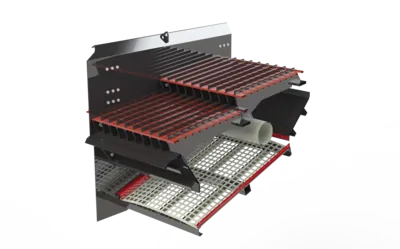
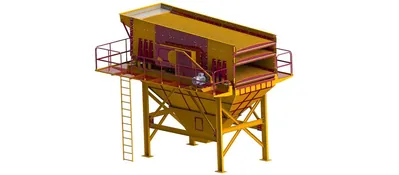
In day-to-day operation the expensive problem is not the single largest boulder but an unstable oversize fraction. Run-of-mine material passes across a vibrating rock feeder before it reaches the chamber, and the grizzly section of that feeder — or a separate grizzly screen — removes material that has no business being crushed at all. Setting the bar spacing close to the primary closed side setting measurably reduces the tonnage the crusher has to process, so the same installed power delivers more saleable output. Too narrow and the grizzly blinds; too wide and the primary spends energy re-crushing stone that was already product.
Choke feeding
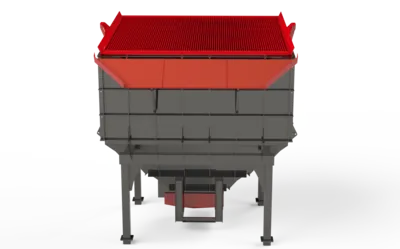
Keeping the chamber full — choke feeding — governs both particle shape and liner life. Intermittent feeding concentrates material on one side of the chamber, wears plates unevenly and pushes the flaky particle count up. What actually maintains continuity is not the crusher but the buffer in front of it, which is why the volume of an aggregate hopper is sized against truck cycle time rather than against crusher throughput.
Reduction ratio: how many stages does the circuit need?
Stage count is derived, not guessed. The aperture through which 80 per cent of the feed passes is F80; the equivalent figure for the product is P80, a convention that comes from Bond's third theory of comminution. Their ratio is the reduction ratio of that stage, and the total ratio of a circuit is the product of the individual stages. Going from an 800 mm F80 to a 20 mm P80 is a total ratio of 40:1, which no single machine delivers; the ratio has to be divided across stages.
| Crusher type | Typical stage reduction ratio | Breaking principle | Suited to |
|---|---|---|---|
| Jaw crusher (primary) | 6:1 - 8:1 | Compression | All rock types, including abrasive |
| Cone crusher (secondary/tertiary) | 4:1 - 8:1 | Compression | High strength, abrasive rock |
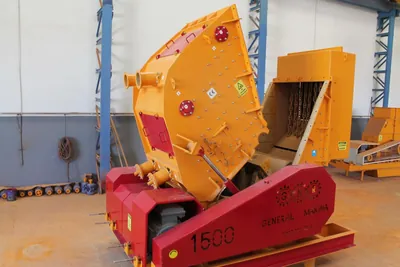
| Horizontal shaft impactor | 10:1 - 15:1 | Impact | Low abrasivity, medium strength rock |
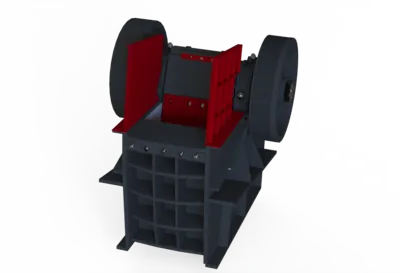
Read the table with both constraints in view. The impactor's high ratio removes a stage from the flowsheet, but in abrasive rock the blow bar consumption returns that saving as operating cost. Compression machines give a lower ratio with predictable, budgetable wear. The trade-off is worked through in the jaw, impact and cone crusher comparison, and the full crusher range shows where each principle sits.
Turning an annual target into a nominal hourly rate
The classic sizing error is dividing annual tonnage by calendar hours. Three factors have to be applied in sequence: days actually worked, hours per day, and mechanical availability. A quarry targeting 1,000,000 tonnes a year, working 250 days at 10 hours with 85 per cent availability, has 250 × 10 × 0.85 = 2,125 effective hours, so the nominal requirement is 1,000,000 / 2,125 ≈ 470 tonnes per hour. Drop availability to 75 per cent and the same target demands 533 tonnes per hour. That 63 tonne gap is usually one model step in the purchase decision, and it is the reason maintenance discipline belongs inside the capacity calculation rather than beside it.
Mass balance and circulating load
Once the nominal figure is set, it is distributed across the branches of the circuit. In a closed secondary or tertiary stage, screen oversize returns to the crusher and adds to the fresh feed; the ratio of returned tonnage to fresh feed is the circulating load. The consequence is the part that gets missed: a crusher inside a closed circuit must be sized for fresh feed plus recirculated load, not for the circuit's output. Skip that and the tertiary stage is permanently undersized, and the whole plant queues behind it.
Screen efficiency and screening area
Circulating load is largely set by screen efficiency, defined as the mass of undersize actually reporting to the throughs divided by the undersize present in the feed. When efficiency falls, product-sized material rides over the deck, returns to the crusher and loads the circuit for nothing. Sizing the deck means weighing aperture, bed depth, moisture and the angle at which material meets the surface together; on fine cuts a top driven banana screen achieves higher throughput from the same footprint. Whether the fine end should run dry or wet is a separate decision, examined in the dry versus wet screening selection.
How rock properties become an equipment decision
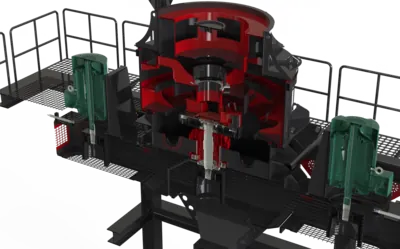
Uniaxial compressive strength and abrasivity are two different quantities and the decision needs both. Limestone is generally assessed in the 60-120 MPa band, granite and basalt in the 150-300 MPa band. Abrasivity, however, tracks silica content: as silica rises, rotor and blow bar consumption in impact machines climbs steeply, which is why a high-silica hard rock circuit is built from compression machines. The two extremes are illustrated by limestone crushing and screening and granite and hard rock crushing. For the secondary duty a cone crusher holds the abrasive case, while a tertiary crusher is the shape-driven answer in low abrasivity material.
Aggregate specification: the numbers the buyer actually checks
Material leaving the plant is not a product until it satisfies the test results in the purchaser's specification. EN 12620 covers aggregates for concrete, EN 13043 aggregates for bituminous mixtures and surface treatments, and EN 13242 aggregates for unbound and hydraulically bound materials; the Turkish adoption of EN 12620 is published as TS 706 EN 12620. The test methods behind those frameworks are separate standards. Particle size distribution is determined under EN 933-1 by washing and dry sieving, with material finer than 0.063 mm removed during the washing stage. Particle shape is quantified as the flakiness index under EN 933-3, and resistance to fragmentation by the Los Angeles test in EN 1097-2, where the sample is rotated with a steel ball charge for 500 revolutions and the percentage passing the 1.6 mm sieve gives the Los Angeles coefficient.
Each of those results maps back onto a plant setting. A high flakiness index is corrected at the last crushing stage and in feed continuity, not on the screen. A sieve analysis showing excess fines in one fraction points at the closed circuit setting or the deck aperture. Definitions of the terms used here are collected in the technical glossary.
Reading capacity against feed size
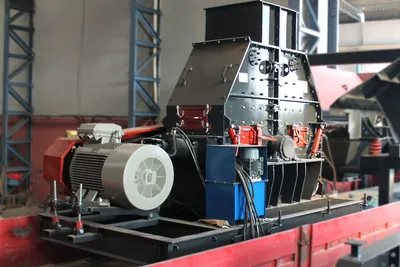
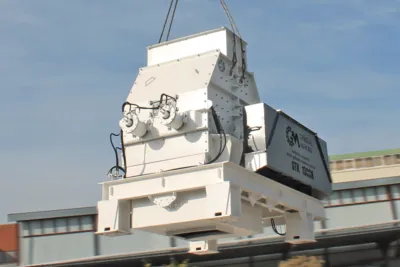
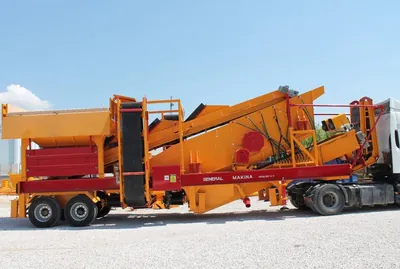
The figures below are General Makina's own mobile plant specifications, and they show why feed size and capacity have to be read as a pair rather than separately.
| Model | Maximum feed size | Output size setting | Capacity | Optional generator |
|---|---|---|---|---|
| General 640 | 500 mm | 0-100 mm | 40-70 t/h | 300 kVA |
| General 800 | 600 mm | 0-100 mm | 80-120 t/h | 450 kVA |
| General 01 | 700 mm | 0-100 mm | 120-180 t/h | 550 kVA |
| General 950 | 800 mm | 0-100 mm | 120-180 t/h | 600 kVA |
| General 02 | 1000 mm | 0-100 mm | 180-250 t/h | 660 kVA |
| General 03 | 900 mm | 0-100 mm | 250-350 t/h | 750 kVA |
The feed size column is a hard limit imposed on the quarry, not a preference: if the post-blast block distribution exceeds it, either the pattern changes or the next model up is selected. How to interpret the capacity bands is set out in the General 640, 800 and 950 capacity selection guide.
The order in which a flowsheet is built
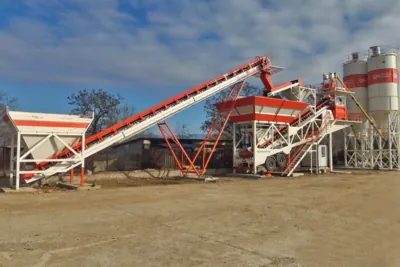
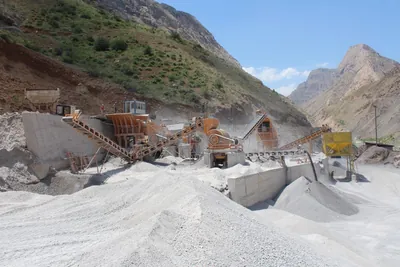
Build backwards from the sale. First the fractions to be sold and the share each takes of demand; then the final stage and screen configuration that produce those shares; then the secondary stage and the closed circuit decision; and only then the primary crusher and feeder. Reverse that order and the plant usually ends up correctly sized for the primary and wrongly sized for the product mix. In stationary installations, conveyor inclination, stockpile cone volume and truck turning space are part of the same drawing — the length and slope of conveyor belt runs fix haulage cost permanently. A stationary crushing plant and the layout described under quarry stationary plant are planned as one exercise.
Send the blast records, the rock test data and the product mix you are contracted to deliver, and the flowsheet can be built from those three inputs with the tonnage on every branch written out stage by stage.
Frequently Asked Questions
How large a boulder can the primary crusher actually accept?
Standard practice limits the largest feed lump to 80 per cent of the crusher gape. Above that the rock is never gripped by the nip angle and bridges across the opening instead of being drawn in. When the machine is fixed, the blast design has to be adjusted rather than the crusher.
Why is total reduction ratio a product rather than a sum?
Each stage divides its own F80 by its own P80, so the reductions multiply through the circuit. A circuit taking 800 mm F80 down to 20 mm P80 carries a total ratio of 40:1, which is reached by combining stages, not by pushing one machine beyond its practical range.
Should a crusher in a closed circuit be sized on circuit output?
No. It must be sized on fresh feed plus the oversize returning from the screen. That returning tonnage, expressed as a ratio to fresh feed, is the circulating load. Ignoring it is the usual reason a tertiary stage becomes the permanent bottleneck of a plant.
What does screen efficiency actually measure?
It is the mass of undersize that genuinely reports to the throughs divided by the undersize present in the feed. Low efficiency sends product-sized material back into the circuit as recirculating load, so the crusher works harder while saleable output stays flat.
Which standards define the tests a buyer will check?
Grading is determined under EN 933-1, particle shape as flakiness index under EN 933-3, and resistance to fragmentation by the Los Angeles test in EN 1097-2. The product frameworks are EN 12620 for concrete, EN 13043 for bituminous mixtures and EN 13242 for unbound and hydraulically bound materials.