EN — English
 TR — Türkçe
 DE — Deutsch
 RU — Русский
 FR — Français
 ES — Español
 AR — العربية
 SR — Српски
Screen efficiency and screen area sizing
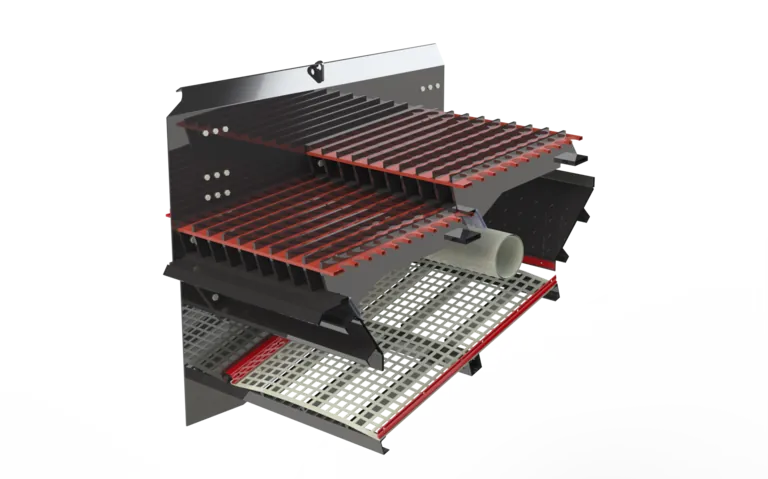
When a plant argues about a screening bottleneck, the usual verdict is that the screen is too small. That verdict cannot be tested without screen efficiency and screen area sizing, because the same machine delivers a completely different capacity once bed depth and near-size content change. The correct order is to measure the efficiency of the installed deck by sieve analysis, then calculate the area the target tonnage actually needs, and only then consider a larger machine or a different deck arrangement.
What screen efficiency and screen area sizing actually measure
Screening efficiency is a recovery figure: it states how much of the undersize present in the feed genuinely reported to the undersize product. It is calculated from sieve analyses of three streams, so no stream has to be weighed. The widely used two-product expression is E = c(f − u) ⁄ f(c − u), where f is the undersize fraction in the feed, c the undersize fraction in the undersize product and u the undersize fraction in the oversize product. The more fines escape into the oversize, the larger u becomes and the lower the efficiency falls.
| Symbol | Meaning | Sampling point | Interpretation |
|---|---|---|---|
| E | Screening efficiency, undersize recovery | Calculated | Design targets normally sit at the high end |
| f | Undersize fraction in the feed | Screen feed box | The smaller it is, the harder the duty |
| c | Undersize fraction in the undersize product | Deck discharge below | Drops noticeably when media is torn |
| u | Undersize fraction in the oversize product | Deck discharge above | Direct indicator of escaping fines |
The measurement should be repeated at the same points before and after any change. A single set of samples reflects only the moisture and feed rate of that moment, so a decision needs readings spread across several shifts.
Sizing the required screening area
The established industrial approach scales a basic capacity with a series of correction factors. The required area equals the tonnage of feed finer than the aperture divided by the basic capacity multiplied by all applicable factors. Basic capacity describes how much material a unit of area can pass at a given aperture under standard conditions; the factors express how far the real feed departs from those conditions.
| Factor | What it corrects | Effect on the result |
|---|---|---|
| Basic capacity | Capacity per unit area at a given aperture | Starting point of the calculation |
| Oversize factor | Actual share of feed coarser than the aperture | More oversize means more area |
| Half-size factor | Share of feed finer than half the aperture | More half-size makes passage easier |
| Deck location factor | Lower decks receive a pre-screened feed | Capacity falls towards the lower decks |
| Wet screening factor | Contribution of spray water to passage | Reduces area where the duty suits it |
| Bulk density factor | Departure from the standard material weight | Shifts the area requirement with density |
| Open area factor | Percentage of open area in the media | Less open area means more surface needed |
| Aperture shape factor | Slotted or rectangular instead of square | Eases passage but loosens size control |
| Efficiency factor | Target efficiency against the standard assumption | Higher target efficiency enlarges the area |
The value of the method is not that it produces one exact number but that it shows which variable pushes the result in which direction. The same tonnage may fit a modest machine with high open-area media, yet demand twice the surface with media prone to blinding.
Bed depth, the invisible limit
Even with the area calculation satisfied, a deck will not reach its design capacity if the material bed is too thick at the discharge end. Fines buried under the layer never touch the surface and leave with the oversize. Bed depth follows from feed rate, deck width, bulk density and travel speed. In practice the bottleneck is often not the total area but the feed width: material that enters without spreading across the full deck leaves part of the screen idle.
Near-size material and blinding
Particles close to the aperture are the hardest part of the duty. They either lodge in the opening or bounce several times and leave with the oversize. With damp, clay-bearing feed the lodged particles close the apertures and open area collapses. The answer then is not a bigger machine but different media, a different aperture or a different screening regime. For how the wet or dry decision changes capacity, see the comparison of dry and wet screening.
The machine side: motion, slope and decks
The second group of variables belongs to the machine. Inclined circular-motion screens take travel from gravity and remain the general aggregate workhorse; horizontal linear-motion screens take travel from the vibration angle, lower the plant profile and tighten size control. Stroke is increased to lift the bed on coarse duties, frequency is raised for fine separations. As decks are added, the feed to the lower decks depends on the efficiency of the upper one, so fines escaping above ruin the calculation below. For body sizes and configurations on the equipment side, the conventional vibrating screen page is the starting point.
Field causes of lost efficiency
If measured efficiency sits below expectation, work through the list in order: whether the feed spreads over the full width, whether the media is correctly tensioned and free of tears, whether apertures are blinded, whether springs and rubber buffers are seated, whether stroke measures equal at all four corners, whether the slope has shifted, and whether feed moisture has risen. Most of these cost nothing to correct, and a decision to buy a larger machine only becomes honest once all of them are eliminated.
Frequently asked questions
Which samples are enough for an efficiency check?
Three simultaneous samples — feed, undersize and oversize — are sufficient, provided they are taken in the same shift under a steady feed rate.
If capacity is short, what changes first?
Review open area and aperture shape first, because that change alters the area requirement without replacing the machine.
Is maximum efficiency always the goal?
No. Very high efficiency means more area and less tonnage. The target is the lowest efficiency that still satisfies the product specification.
Definitions of technical terms: Glossary