EN — English
 TR — Türkçe
 DE — Deutsch
 RU — Русский
 FR — Français
 ES — Español
 AR — العربية
 SR — Српски

Heavy-Duty Mobile Crushing and Screening Plants for Marble and Stone Quarries
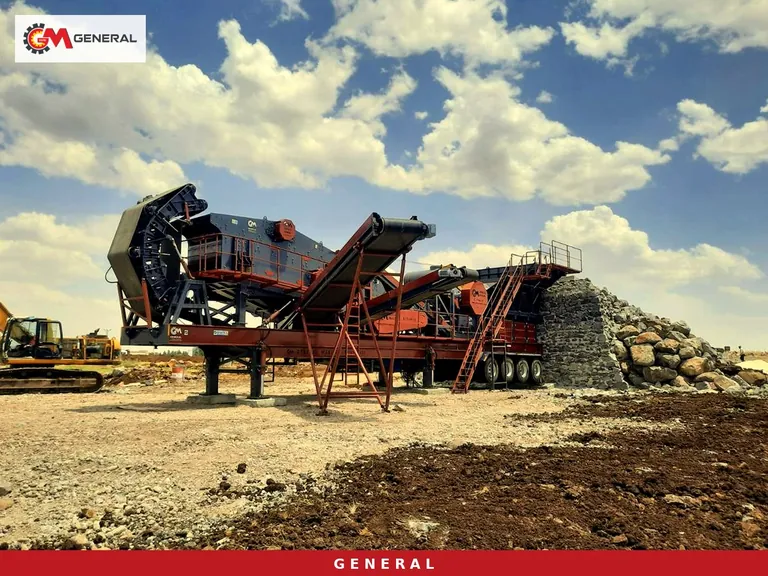
In a dimension-stone marble quarry, the saleable block is only part of the rock that is extracted. The rest piles up on the quarry floor as corner pieces, masses split along fractures, offcut slabs and overburden; these heaps take up working space and narrow the haul roads. The same waste is a raw material that a properly set up mobile crushing and screening plant turns into chippings and crushed sand. A similar picture applies to limestone quarries: as the face advances, keeping the crusher close to the face shortens the haul distance. This article explains which dimension decides what when choosing a mobile plant for marble waste and limestone, which concrete features the term "heavy-duty" corresponds to, and which of General Makina's wheeled models fits which quarry condition, from a field perspective.
Why are marble waste and limestone suited to impact crushers?
The abrasiveness of the stone decides the crusher type. The dividing line used on General Makina's crusher pages is this: material with more than 10% silica or a Bond abrasion index (Ai) above 0.15 counts as abrasive and wears down impact crusher blow bars quickly. The same pages give limestone an Ai of roughly 0.001–0.03, far below that threshold. Marble is a calcite-based rock, so in most quarries it behaves like limestone; some marble quarries, however, contain siliceous veins, quartz-rich interbeds or contamination from host rock. The decision should therefore rest on a silica analysis of a sample taken from the worst zone of the quarry.
At low abrasiveness, the impact crusher brings two concrete advantages. The first is a high reduction ratio in a single stage: GPS series impact crushers combine primary and secondary crushing in one body, which shortens the line. The second is cubical particle shape; flaky particles are unwanted in concrete and asphalt aggregate. We covered the wear difference between jaw and impact crushers in hard rock in detail in our hard rock and mining comparison; in marble and limestone the question is different: the impact crusher suits the stone, and the challenge is getting the quarry block into the opening.
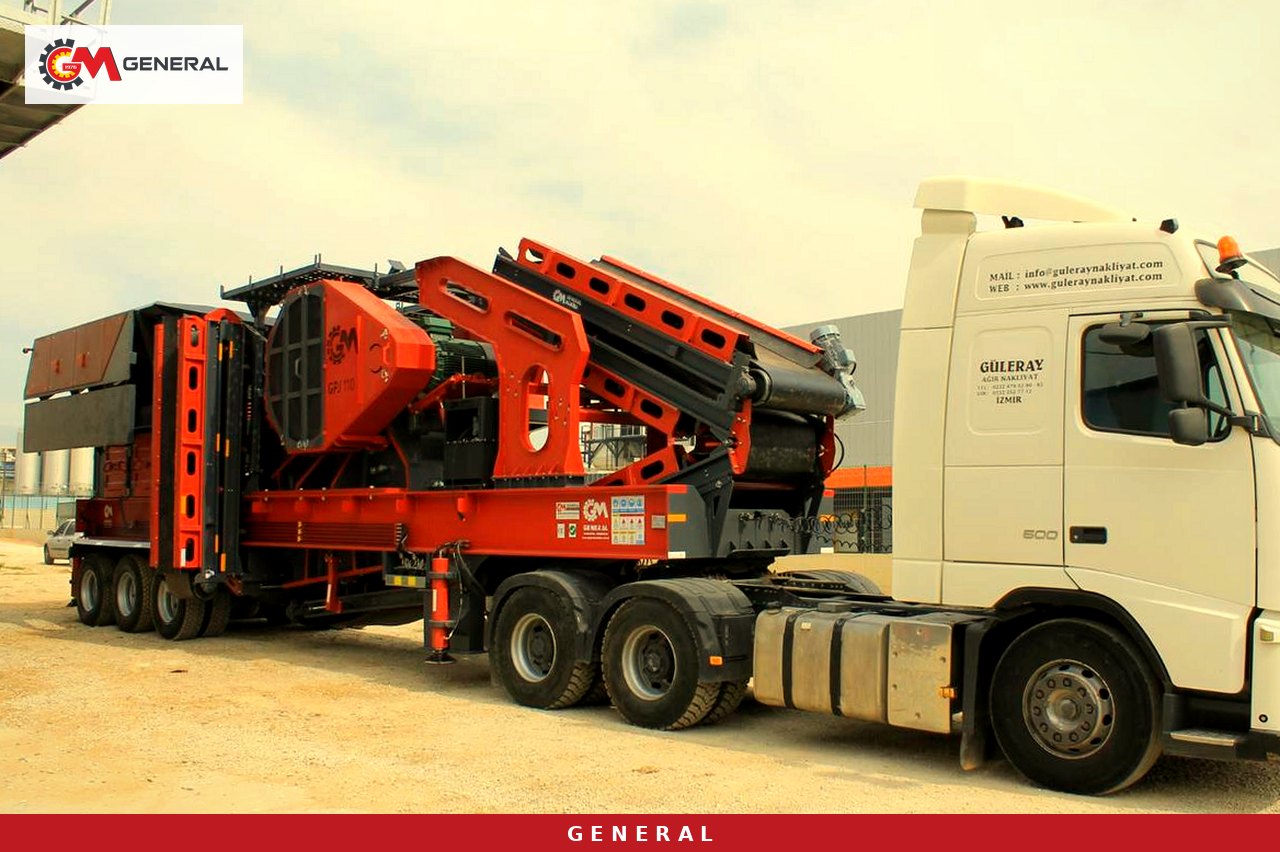
The deciding dimension for block waste: the feed opening
What separates marble quarry waste from sand-pit run-of-mine is piece size and shape. Pieces left over from cutting are often angular, long or slab-shaped. A slab entering the hopper can bridge across the crusher mouth because of its length, even if it is thin. So before capacity, the question to ask is: down to what size can the quarry's pre-breaking equipment (an excavator with a hydraulic breaker, for example) reduce the waste, and which model's opening does that size safely enter?
In the General range, the maximum feed sizes on the product pages are: 600 mm for the General 800, 700 mm for the General 01, 800 mm for the General 950, 900 mm for the General 03 and the GNR-MC110, and 1000 mm for the General 02. The General 02's 1000 mm opening is the widest in the family, meaning large block pieces need less pre-breaking. Every excavator hour spent on pre-breaking is a direct cost; the larger the opening, the smaller this item. The reverse also holds: if the quarry waste already arrives in small sizes, there is no need to invest extra in the widest opening.
The feed opening alone is not enough; the hopper and vibrating feeder must also deliver the blocks steadily. On the General 01, a vibrating feeder with a by-pass grizzly separates fines at the start. In marble quarries, removing the soil and cutting sludge mixed into the waste heap before it reaches the crusher both reduces rotor load and keeps the fine fraction clean.
What "heavy-duty" means: three measurable features
Heavy-duty should not remain a marketing adjective; it should be tied to values you can check in the quotation. Three features matter in a marble or limestone quarry:
- Wide feed opening: accepting large block pieces with less pre-breaking. 1000 mm on the General 02, 900 mm on the General 03 and the GNR-MC110.
- Strong chassis and load distribution: the product page gives the General 02's weight as 76,000 kg on a 2-axle chassis. The General 03 has a 4-axle chassis built to the international transport standard. The GNR-MC110 splits the weight across two platforms: the primary chassis measures 3000 × 13500 mm at 55,000 kg, the secondary chassis 4200 × 18300 mm at 55,000 kg.
- Large generator: the power unit that drives the crusher, screen and belts at the same time. 660 kVA on the General 02, 750 kVA on the General 03 and the GNR-MC110, 600 kVA on the General 950.
Screen area belongs on this list too, because if the screen cannot separate what the crusher produces, capacity stays on paper. The General 02 carries a 2000×5000 mm four-deck screen, the General 03 a 2400×5000 mm one and the GNR-MC110 a 2000×6000 mm one.
| Model | Crusher arrangement | Capacity | Max. feed | Screen | Generator | Chassis / weight |
|---|---|---|---|---|---|---|
| General 800 | PDK 1280 primary impact | 80-150 t/h | 600 mm | 1300×4000 mm, triple-deck | 450 kVA | Single chassis, 35,000 kg |
| General 02 | GPS 1413 primary impact | 250-300 t/h | 1000 mm | 2000×5000 mm, four-deck | 660 kVA | 2-axle, 76,000 kg |
| General 03 | GPS 1415 primary impact | 250-375 t/h | 900 mm | 2400×5000 mm, four-deck | 750 kVA | 4-axle, — |
| General 950 | GPJ 90 jaw + DMK01 impact | 120-180 t/h | 800 mm | 1600×5000 mm, triple-deck horizontal | 600 kVA | Single chassis, 70,000 kg |
| GNR-MC110 | GPJ 110 jaw + GS1215 / DMK03 impact | 200-300 t/h | 900 mm | 2000×6000 mm, four-deck | 750 kVA | Twin chassis, 55,000 kg + 55,000 kg |
Which configuration for which quarry condition?
Clean limestone and homogeneous marble waste
If the silica analysis stays below the threshold, single-chassis models with a primary impactor give the shortest line. The General 03, with its GPS 1415 primary impact crusher and 250-375 t/h range, is the highest-capacity member of the family; in a high-tonnage limestone quarry it delivers near-stationary output close to the face in a form you can still move. In a marble quarry where larger blocks arrive, the General 02's 1000 mm opening stands out. If the tonnage requirement is lower and the waste already comes in small sizes, the General 800 (80-150 t/h, 600 mm) is the model its product page recommends for limestone and low-abrasion stone.
Siliceous veins, chert bands or mixed host rock
If the sample exceeds the silica threshold, switching to a jaw crusher in the primary stage keeps blow bar consumption under control. The General 950 combines a GPJ 90 jaw primary with a DMK01 impact secondary on one chassis. The GNR-MC110 delivers 200-300 t/h with a GPJ 110 jaw primary, and its primary group can also run on its own; you can open a quarry with the primary only and bring the secondary group in later.
Mobility inside the quarry: the plant follows the face
In a marble quarry, waste does not collect at one point; it accumulates scattered below the cutting benches. In a limestone quarry, the face retreats every year. With a stationary plant, that distance comes back as truck trips; with a mobile plant, the crusher is brought closer to the heap. Three details make the difference:
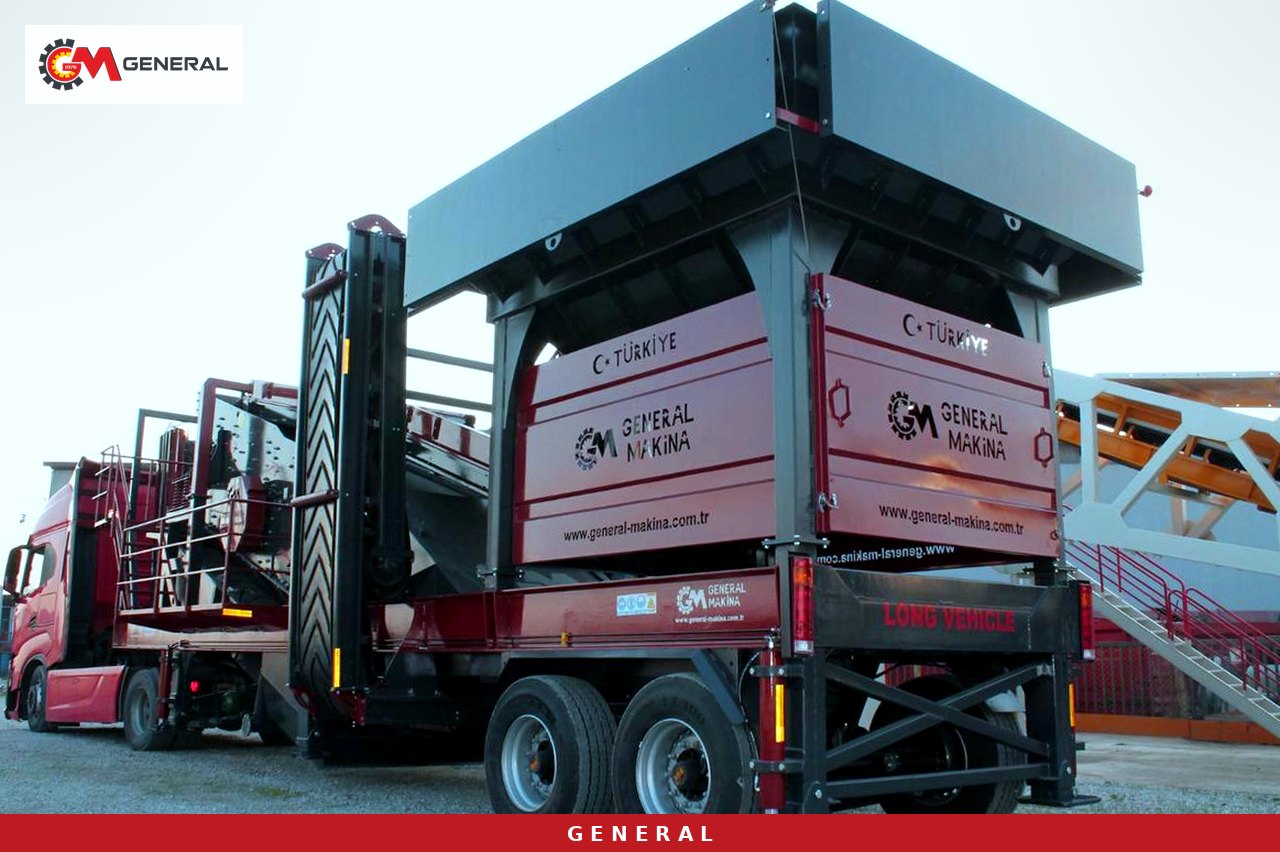
- Foundation needs at setup: on the General 03, folding hydraulic conveyors and support legs allow setup without excavation or a concrete foundation. On the General 800, folding hydraulic belts and support legs are likewise gathered on a single chassis.
- Number of transport units: according to its product page, the General 950 travels on a single truck and goes into operation in 30 minutes. On the GNR-MC110 the two groups are moved separately, which means two separate loads instead of one heavy piece on narrow quarry roads.
- Ground and gradient: wheeled chassis move up in-quarry ramps behind a tractor unit; ramp gradient and turning radius should be measured during the site survey. We set out the criteria for tracked versus wheeled in our article tracked or wheeled.
What products does the waste become?
On the product pages of the General 02, General 03, General 800 and GNR-MC110, the product fractions are listed as 0-5 / 5-12 / 12-19 / 19-40 mm; the General 950 separates 0-5 / 5-12 / 12-19 mm with its triple-deck screen. The output setting on all these models is 0-100 mm. In closed-circuit operation, oversize retained on the screen returns to the crusher on the return belt, so all of the waste is reduced to a saleable fraction. The 0-5 mm crushed sand and the 5-12 and 12-19 mm chippings obtained from marble and limestone waste are the classes concrete and asphalt producers ask for. Screen apertures and the final gradation are set for each order according to the stone to be processed, so tell the manufacturer at the survey stage which fraction the quarry sells most.
If finer, more cubical sand is the target, a tertiary stage can be added to the line: the GNR series tertiary crusher produces 0-5 mm crushed sand from 150 mm feed and is recommended for limestone and low-to-medium abrasive material. Crushing limestone and marble generates a high share of fines; plan dust control and whether washing is needed according to the specification the product will be sold under.
Checklist before requesting a quotation
- Has silica content, and if possible the Ai value, been measured on a sample from the worst zone of the quarry?
- Do you know the largest piece size and the longest slab length after pre-breaking?
- Does that size sit on the safe side of the chosen model's maximum feed size?
- Are the daily tonnage target, number of shifts and the ratio of fractions to be sold written down?
- Were in-quarry ramp gradients, turning areas and the ground at setup points seen during the survey?
- Will you use grid power or a generator, and is the generator scope clear in the quotation?
- Has the blow bar alloy been chosen to match the material in the sample?
- Does the quotation include the warranty scope (1 year at General Makina, wear parts excluded) and a spare parts list?
Frequently asked questions
Which model suits marble quarry waste best?
If the sample is below the silica threshold, models with a primary impactor are suitable. If block pieces arrive large, consider the General 02 with its 1000 mm opening; if tonnage is the priority, the General 03 in the 250-375 t/h range. If there are siliceous veins, the jaw-primary General 950 or GNR-MC110 is the safer choice.
Does every quarry need a heavy-duty plant?
No. If the waste can be pre-broken to a small size and the tonnage requirement is limited, a lighter model such as the General 800 may be enough. A wide opening, large generator and heavy chassis pay off when large blocks and high tonnage come together.
What determines the price?
The crusher arrangement (single-stage impact or jaw + impact), screen size and number of decks, generator scope, chassis type, an extra tertiary stage and transport conditions determine the price. There is no price list on the site; the quotation is prepared from your quarry data.
Can these plants be seen at marble fairs?
General Makina has taken part in the block marble fair in Afyonkarahisar. For model selection, however, the most reliable data is the sample and waste size information from your own quarry rather than the machine on the fair stand.
Conclusion
In marble and limestone quarries, choosing a mobile crushing and screening plant depends less on the crusher type than on block size, movement inside the quarry and the fractions to be sold. Low abrasiveness makes the impact crusher economical; the heavy-duty requirement is met by a wide feed opening, a chassis that carries the load and an adequate generator. You can compare all wheeled options on our mobile crushing plants page. Send your quarry sample data, waste size and tonnage target via our contact page, and with more than 50 years of experience we will prepare a quotation with the configuration that suits you.
Definitions of technical terms: Glossary