 EN — English
 TR — Türkçe
 DE — Deutsch
 RU — Русский
 FR — Français
 ES — Español
 AR — العربية
 SR — Српски
Automation & Control System | Crushing Plant and Concrete Batching Plant
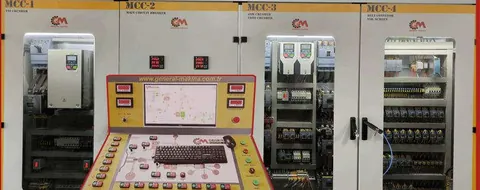
The complete computerized unit that enables crushing plants or concrete batching plants to be managed remotely or from within the control cabin is called an Automation & Control System.
In plants or batching stations it runs multiple pieces of equipment synchronously and executes commands for various functions at the same time.
How Does It Work?
Automatically through the automation, manually/automatically from the cabin, or by remote control, starting, stopping, capacity and flow control can be performed on crushing and concrete batching plants.
In this way, in the event of maintenance or a fault in the plant or equipment, repair time and machine damage are kept to a minimum.
System components
- PLC: The logic of the line runs on a programmable logic controller. Equipment start-up order, interlocks and shutdown scenarios are defined here.
- SCADA / operator panel: The plant diagram is displayed live on the touch screen in the cabin; the running state, current draw and alarms of every machine are monitored from a single screen.
- Field instrumentation: Level sensors, belt misalignment and speed switches, temperature and vibration sensors, load cells.
- Motor control centre: Starters, variable frequency drives and protection relays automatically balance feeder speed against crusher load.
Sequential start-up and interlocks
In crushing lines the equipment is started against the material flow, that is from the stockpile back towards the feeder. When one machine stops, every stage upstream of it stops automatically, which prevents starting under a loaded belt and conveyor blockages. When the crusher current approaches its threshold the feeder speed is reduced automatically and increased again once the current returns to normal.
Remote monitoring and reporting
Once the automation panel is connected to the network, shift reports, produced tonnage, downtime and alarm history are recorded. In the event of a fault the service team can review the alarm log over the connection and make a preliminary diagnosis without travelling to site, which shortens repair time.
Safety
Emergency stop buttons, pull-cord switches and guard sensors are wired directly into the safety circuit. When the safety circuit opens, the relevant equipment stops independently of any automation command; lock-out/tag-out practice during maintenance is supported through this circuit.
Wear and spare parts: Spare & Wear Parts
Definitions of technical terms: Glossary
Similar Machines
Related Content





Related Searches
Request a Quote for This Product
Fill in the form and our team will get back to you with a tailored quote.
ISO 9001:2015 · CE · EAC · Since 1976