EN — English
 TR — Türkçe
 DE — Deutsch
 RU — Русский
 FR — Français
 ES — Español
 AR — العربية
 SR — Српски
Oversize management and grizzly opening selection
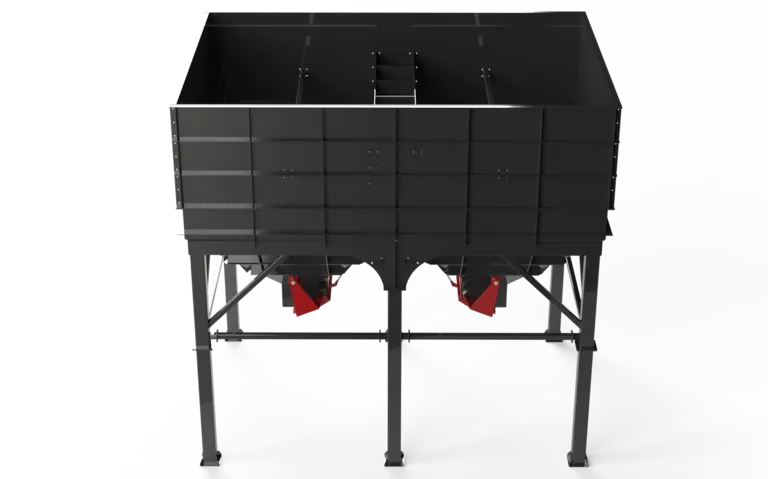
What usually limits output in a quarry is not the rated capacity of the crusher but the handful of oversized blocks that reach it. Oversize management and grizzly opening selection therefore belong among the first decisions taken after a blast: how much coarse material is allowed to form, which lumps get stopped at the feeder, and which material never enters the chamber at all are parts of the same calculation.
What counts as oversize
Oversize is material too large to pass a given point in the circuit, which makes it a relative figure rather than an absolute dimension. For a primary crusher the practical limit is well established: the largest lump in the feed should not exceed roughly eighty per cent of the feed opening. Above that, blocks bridge across the opening, sit in the cavity and starve the whole plant while it keeps turning.
Measuring the oversize fraction
Without measurement, oversize stays an anecdote about something that happens occasionally. Three site-practical methods exist: the loader operator tallies the blocks that could not be sent to the crusher during the shift; the coarse material stopped on the feeder is placed in a separate stockpile and weighed at the end of the day; and the muckpile is photographed from a fixed distance so fragmentation can be assessed. All three are coarse, but they give a trend. If the oversize share is growing, the fault usually lies in hole pattern, delay timing or charge, not in the crusher.
Measurement has a second benefit: it moves responsibility to the right place. Idle time at the crusher is usually logged as a maintenance issue when the cause sits in the blast design.
Oversize management and grizzly opening selection
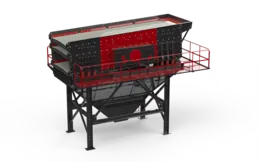
The grizzly section of the feeder does two jobs. It routes material already smaller than the product size around the crusher, and it presents coarse material to the chamber at a steady rate. The opening is therefore tied to the crusher closed side setting. The starting point is an opening equal to that setting; where the feed is dirty and fine the gap is narrowed, and where it is very clean and coarse it can be opened slightly.
| Feed character | Starting grizzly opening | Reason |
|---|---|---|
| Clean, dry, coarse run-of-mine | Equal to the crusher closed side setting or slightly above | Only genuinely fine material is bypassed and crusher capacity is not wasted |
| Standard quarry feed | Equal to the closed side setting | Material already below product size never enters the chamber |
| Dirty feed with fines and clay | Between 50 and 80 per cent of the closed side setting | Dust and soil leave the circuit early and packing in the cavity is avoided |
| Wet and sticky feed | Change the feeder type rather than the opening | Vibration smears wet fines into the gaps; a blinded grizzly is a chute, not a screen |
Narrowing the gap costs screen capacity, because more material now bypasses the crusher and lands on the decks. Opening it costs crusher work, because material that was already small enough is crushed again. The place to look when choosing between those costs is wear-part consumption compared against screen loading. Reaching that balance without a properly configured grizzly screen comes down to trial and error.
Blinding: right opening, wrong material
A correctly calculated gap can still fail on wet, clay-bearing feed. Vibration smears sticky fines between the bars, and once the gaps close the grizzly stops screening and becomes a chute. The first things to examine are bar geometry, vibration intensity and the seasonal swing in feed moisture. Stepped bar arrangements help, because material drops again at each step instead of sliding across a single plane.
Choosing the feeder type
For dry, clean rock a vibrating grizzly feeder is the simplest answer. Where the feed is persistently wet and clay-rich the decision belongs to the feeder type rather than the gap: feeders built from rotating elliptical shafts clean themselves because the bars move relative to one another, so sticky material cannot close the gaps. The same rotation tumbles clay-bound lumps apart and releases the fines.
What changes at the crusher
The purpose of the grizzly setting is to keep the crusher fed. A jaw running with a full cavity produces a more consistent product shape and wears its dies evenly, while intermittent, bouncing feed creates local wear and vibration. Managing oversize properly improves feed continuity and cuts the hours spent breaking blocks with the hydraulic hammer.
What to review after a setting change
Changing the grizzly gap or the closed side setting never affects one machine alone. The bypassed tonnage shifts, screen loads move with it, bed depth on the belts changes and the fraction split of the stockpiles drifts. After every adjustment, undersize tonnage and product mix should be watched for at least one full shift and the result written down; otherwise nobody can tell which change caused the next problem.
Frequently asked questions
Can the grizzly gap be widened without touching the crusher setting?
Not sensibly. The two values are coupled, and widening the gap while the closed side setting stays put simply sends product-sized material into the chamber.
At what oversize percentage should the blast design be revisited?
There is no universal threshold. The decision comes from comparing hydraulic hammer hours against the cost of a tighter blast pattern, and that comparison needs measurement.
Does the gap change as the bars wear?
It does. Worn bars lose both thickness and height, so the opening has to be re-measured on a regular schedule rather than assumed.
Blast design, feeder choice and crusher setting form a single chain; other articles under mining engineering address the pit planning end of that chain.
Definitions of technical terms: Glossary