 EN — English
 TR — Türkçe
 DE — Deutsch
 RU — Русский
 FR — Français
 ES — Español
 AR — العربية
 SR — Српски
GNRK Series Jaw Crusher (Primary)
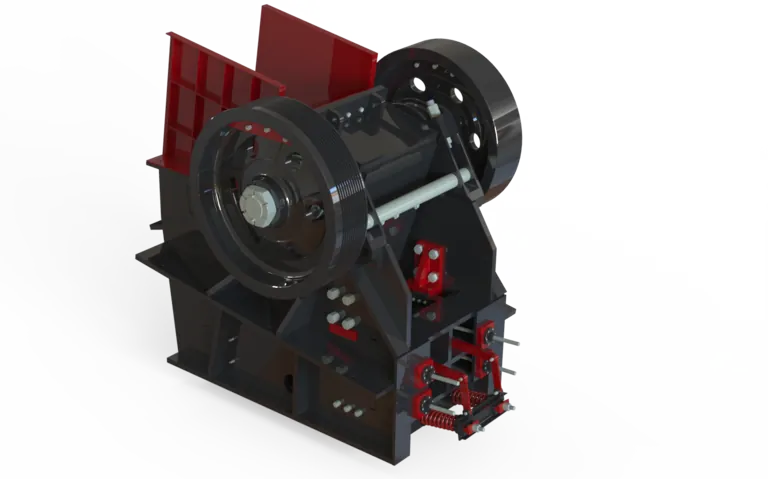
The GNRK series jaw crusher is a primary crusher that breaks rock by compression between a fixed jaw and an eccentric-driven swing jaw. It reduces coarse run-of-mine (ROM) feed to a manageable size in the first stage of the plant.
Technical data
| Model | Opening (mm) | Output (mm) | Motor (kW) | Weight (kg) | Capacity (tph) |
|---|---|---|---|---|---|
| GNRK 60 | 610×380 | 40–130 | 30/37 | 6,000 | 20–80 |
| GNRK 90 | 900×650 | 70–180 | 75/90 | 11,400 | 60–225 |
| GNRK 110 | 1100×850 | 150–225 | 110/132 | 33,000 | 200–350 |
| GNRK 130 | 1300×1000 | 125–250 | 160 | 42,500 | 400–500 |
| GNRK 140 | 1400×1100 | 135–300 | 200 | 47,000 | 500–600 |
| GNRK 900 (sec.) | 900×200 | 11–55 | 30 | 5,960 | 50–75 |
| GNRK 1100 (sec.) | 1100×350 | 20–110 | 75 | 11,000 | 100–150 |
Working principle
The cavity is wide at the top and narrows downward. The swing jaw oscillates on the eccentric shaft; material is progressively compressed and discharges by gravity through the CSS (closed-side setting). The stage is primary only; GNRK 900/1100 are narrow-opening secondary variants.
Material and application
Because it works by compression, the jaw crusher handles material above the abrasivity threshold (silica >10% or Bond Ai >0.15): granite, basalt, quartzite, river gravel and slag. Wet, sticky clay feed clogs the cavity and should be washed or scalped first.
Reduction and wear (TCO)
Typical reduction is 4:1–9:1 (up to ~8:1 in primary duty). Maximum feed is about 0.8–0.9 of the opening width. The main wear part is the jaw plates in austenitic manganese steel (Mn13/Mn18), which work-harden under impact; Mn18/Mn22 for high silica. Compression keeps metal wear and cost per tonne low.
The jaw crusher is the entry machine of a complete plant covering crushing, screening, washing and concrete batching, which we can supply from a single source.
Frequently Asked Questions
What is a jaw crusher used for?
Primary crushing of coarse run-of-mine rock; it is the first stage of the plant.
Which rock types is it suited to?
Hard, abrasive rock including granite, basalt, river stone and slag; compression protects the metal.
What is the reduction ratio?
Typically 4:1–9:1, up to ~8:1 in primary duty.
What is the maximum feed size?
About 0.8–0.9 of the opening width (roughly 1.1–1.25 m on the GNRK 140).
How can I get a quote?
Send us your capacity, material and model needs; we provide a project-specific quote and full-plant configuration.
Wear and spare parts: Spare & Wear Parts
Definitions of technical terms: Glossary
Video
Gallery


Similar Machines
Related Searches
Request a Quote for This Product
Fill in the form and our team will get back to you with a tailored quote.
ISO 9001:2015 · CE · EAC · Since 1976