EN — English
 TR — Türkçe
 DE — Deutsch
 RU — Русский
 FR — Français
 ES — Español
 AR — العربية
 SR — Српски
The Best Mobile Crushing Plant for Hard, Abrasive Rock (Basalt, Granite)
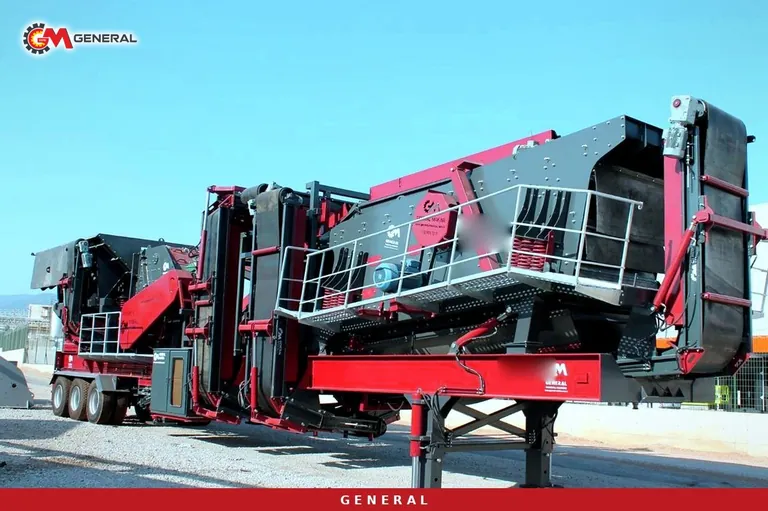
Most conversations about a mobile plant for basalt or granite open with "how many tonnes per hour?". On hard, abrasive rock that question comes in the wrong order. First you have to account for what the rock will take out of the plant: metal, energy and downtime hours. Only a configuration that can carry those three costs turns a tonnage figure into a real number. This article sets out the order in which a quarry operator or contractor should make the decision for basalt or granite, using the data published on the product pages of General Makina's wheeled and tracked models. The word "best" in the title does not point to one model: for two quarries in the same region, the right plant can differ depending on the abrasiveness of the sample, the largest block coming out of the face and the specification of the product you sell.
What basalt and granite demand from a mobile plant
The first property that separates these two rocks from limestone is how fast they consume metal. General Makina's cone crusher page gives the Bond abrasion index (Ai) as about 0.20 for basalt and about 0.55 for granite. The jaw crusher page classifies any material with more than 10% silica or an Ai above 0.15 as abrasive. On that scale basalt sits just above the threshold and granite far beyond it. That gap is why the same plant can give completely different liner life in two quarries.
Three requirements follow. First, crushing stages that break the rock by compression between two metal surfaces; in compression, rubbing between rock and metal stays far more limited than on the blow bar of a rotor turning at high speed. Second, an inlet that accepts large, irregular blocks without bridging; after blasting in hard-rock quarries, block size is scattered, and an undersized primary opening stops the feeder again and again. Third, a final stage that secures the particle shape of the product you sell, because concrete and asphalt aggregate specifications reject flaky grains.
Jaw and cone: how the stages share the work
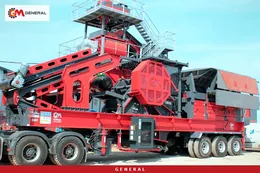
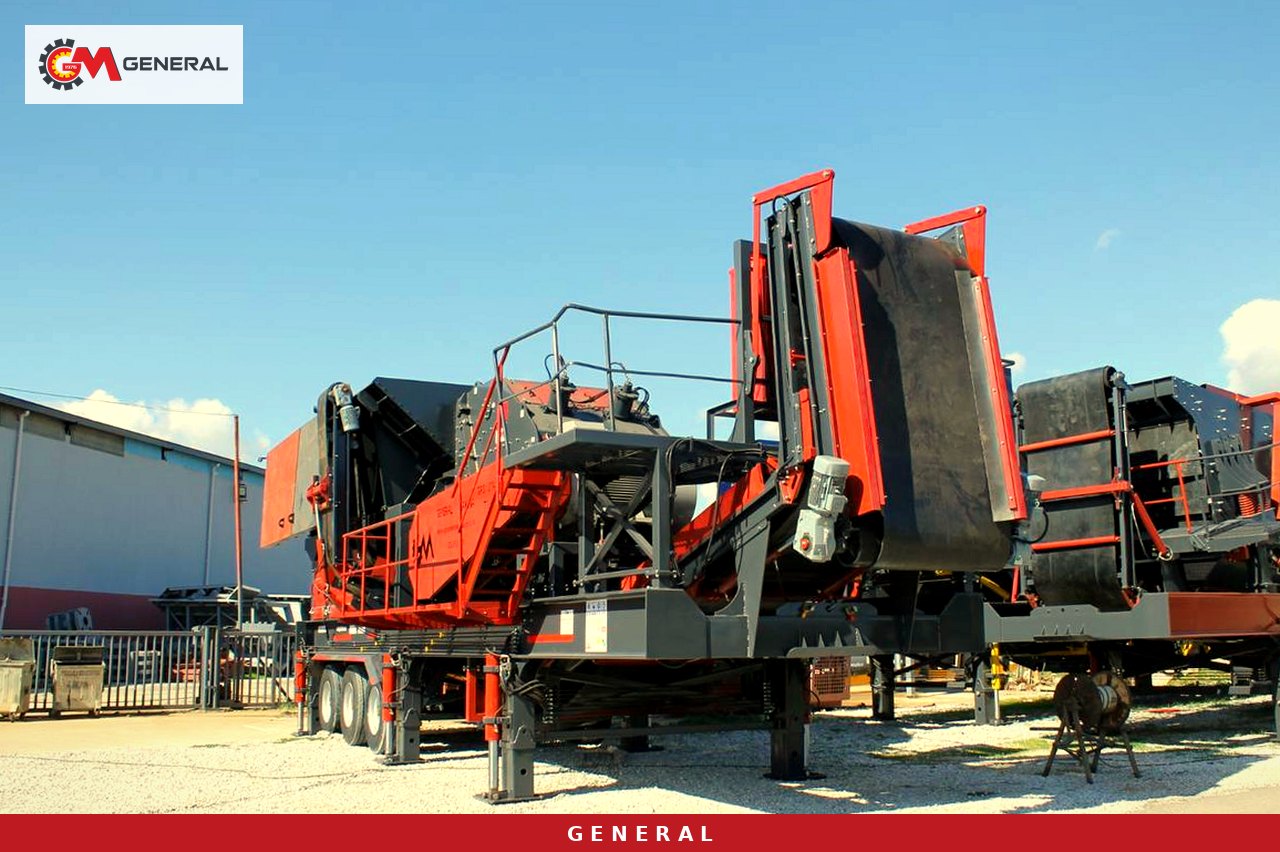
The established layout for a mobile hard-rock line is a jaw crusher in the primary and a cone crusher in the secondary. The General 944 mobile crushing and screening plant is the single-chassis version of that layout: the GPJ 90 jaw primary takes run-of-mine feed up to 800 mm and the GM430 cone secondary reduces it by compression. The output is split on a 1600×5000 mm, 3-deck horizontal screen into 0-5 / 5-12 / 12-19 mm fractions, with an output setting range of 0-100 mm.
The jaw's advantage here is metallurgical. The jaw plates of the GNRK series are austenitic manganese steel (Mn13/Mn18), which work-hardens on the surface under impact and pressure while the core stays tough; as silica rises, Mn18/Mn22 becomes the option. On the cone side the wear parts are the mantle and concave liners, and the product page points to high-chrome liners for high-silica rock. The cone's reduction ratio in the secondary stage is in the 6:1–8:1 range; product size is changed with the hydraulic CSS adjustment, and a hydraulic cylinder protects the crusher when uncrushable material enters.
The condition for getting a cubical product from a cone is keeping the crushing chamber full. The cone crusher page names choke feeding as the preferred operating mode. On site this means: if the flow between the jaw and the cone is unbalanced, the cone runs half empty, the product turns flaky and the liners wear unevenly. In the 944's closed-circuit layout, oversize returning from the screen for re-crushing supports both the particle shape and a full crushing chamber.
Model comparison: which plant fits which quarry scale
The table below places side by side the values published on the product pages of five General Makina models that can be considered for hard, abrasive rock. We did not fill any missing value with an estimate; settings such as screen apertures and grading are fixed for each order according to the rock to be processed.
| Model | Crusher layout | Capacity | Max. feed | Screen | Power | Weight | Role on hard rock |
|---|---|---|---|---|---|---|---|
| General 640 | GPJ 60 jaw + GNR 50 impactor | 60-100 t/h | 500 mm | 1200×4000 mm, 3-deck | 300 kVA (optional generator) | 38,000 kg | Small quarry; moderate tonnage slows liner wear |
| General 944 | GPJ 90 jaw + GM430 cone | 120-180 t/h | 800 mm | 1600×5000 mm, 3-deck | 550 kVA | 70,000 kg | Main candidate on abrasive rock; long metal life |
| General 950 | GPJ 90 jaw + DMK01 impactor | 120-180 t/h | 800 mm | 1600×5000 mm, 3-deck | 600 kVA | 70,000 kg | When high reduction and cubical product come first |
| GNR-MC110 | GPJ 110 jaw + GS1215/DMK03 impactor, twin chassis | 200-300 t/h | 900 mm | 2000×6000 mm, 4-deck | 750 kVA | 55,000 kg + 55,000 kg | High tonnage; primary can also run alone |
| GM 90JP (tracked) | GNR 90 jaw, 95 kW (primary only) | 70-180 t/h | 700 mm | 1000×2000 mm, 2-deck | 250 kVA | 35,000 kg | Primary that follows the face; secondary planned separately |
The first lesson from the table: on hard rock, tonnage and layout must be read together. The GNR-MC110 delivers the highest jaw-primary capacity in the family, but its secondary is an impactor; on a highly abrasive rock such as granite, blow bar consumption in that stage can take back part of the tonnage advantage. Its strength on hard rock is modularity: because the primary chassis and the secondary chassis run independently, an operator can install the primary group first and choose the secondary stage after seeing how the quarry actually behaves.
Second lesson: the General 640 is an entry model that can process hard rock including basalt while staying at moderate tonnage. Its product page notes that controlled tonnage helps jaw and rotor liners wear more slowly. In a small quarry, running long hours at low tonnage can give a more balanced result than running a large plant at partial load. The whole wheeled family is listed under mobile stone crushers.
944 for granite; 944 or 950 for basalt?
The General 944 and General 950 share the same GPJ 90 jaw primary, the same 800 mm feed, the same 120-180 t/h capacity range and the same 70,000 kg weight. The only difference is the secondary: the 944 carries a GM430 cone, the 950 a DMK01 impact crusher. The decision therefore rests on which costs the operation more: the rock's abrasiveness or the product's shape.
On granite the picture is clear. With an Ai of about 0.55, the impact secondary's blow bars are changed often, and every change stops the whole line. In these quarries the 944 is the natural choice. Basalt needs finer judgement. Its Ai of about 0.20 is just above the threshold; the 950's product page lists basalt among the rocks it handles and states that the impact secondary gives high reduction and a cubical product. If you sell basalt aggregate into a concrete or asphalt specification with tight shape control and you find the blow bar change interval acceptable, the 950 is worth evaluating. If your priority is to keep wear cost per tonne low, the 944 is the safer starting point.
If cubicity needs a further boost with the 944, a shaping stage can be added to the line. General Makina's mobile cubitzer series is designed for basalt lines: inner liner Hardox 500, final product 0-25 mm; the GNR MK100 is listed at 90-130 t/h and 132 kW, the GNR MK110 at 160-250 t/h and 200 kW. The product page advises monitoring liner life on jobs with high free quartz. Our jaw vs impact crusher comparison for hard rock gives the background on how impact and compression differ in wear.
Site conditions: power, transport and ground
Hard-rock quarries are often far from the grid, on slopes or with scattered faces, so the power plan must be made together with the model choice. According to the product pages, generator power is 550 kVA for the General 944, 600 kVA for the General 950, 750 kVA for the GNR-MC110 and 250 kVA for the GM 90JP; the General 640 can run off-grid with an optional 300 kVA generator. If a grid connection is possible, confirm connection capacity, cable route and permit procedures with the relevant local authority.
On transport, the loading dimensions of the 944 and 950 are given as 4130×20350×4500 mm; the 950's page states that it travels on one truck and starts producing in 30 minutes. The General 640 is compact enough for a single truck and is positioned on hydraulic legs. Where the face moves often within the quarry, the tracked option comes forward: the GM 90JP drives itself on Strickland tracks, comes with a 10 m³ hopper and a grizzly vibrating feeder, and needs no concrete foundation. A tracked primary breaks the hard rock at the foot of the face, while the secondary and screening can stay at a fixed point. Evaluate that layout together with the model family on the track-mounted mobile crushers page.
Capacity is also set by site conditions. On hard rock, liner changes and setting stops enter the schedule more often than on limestone. Build the required hourly capacity with this formula: Required capacity = Annual target tonnes ÷ (working days × net operating hours per day × availability). On abrasive rock, keep availability realistic according to your liner change plan. Track wear cost per tonne as Wear cost = Liner set cost ÷ tonnes crushed over liner life; you can try both variables with your own data in the energy and wear cost calculator.
Checklist before you request a quotation
- Have the sample tested for silica content and, if possible, the Bond abrasion index; also sample the hardest vein in the quarry.
- Measure the largest block after blasting and size the primary opening to it (500 mm on the General 640, 700 mm on the GM 90JP, 800 mm on the 944/950, 900 mm on the GNR-MC110).
- Put the fractions you will sell and the particle-shape requirement in writing; the 944/950 give 0-5 / 5-12 / 12-19 mm, the GNR-MC110 adds a 19-40 mm fraction.
- Fix the annual target tonnage and realistic operating hours; calculate capacity with the formula above.
- Clarify the power source: grid or generator; if generator, use the model's kVA value as the basis.
- Decide how often the plant will relocate inside the quarry; frequent moves favour tracks, rare moves favour wheels.
- Plan spare stock for jaw plates, cone liners and blow bars; the warranty is 1 year and does not cover wear parts.
- Confirm local rules on dust, water and noise with the relevant authority.
Frequently asked questions
Can basalt not be crushed in a plant with an impact secondary?
It can. The General 950 is set up for basalt and granite with a DMK01 impact secondary and gives high reduction with a cubical product. The decision should weigh the effect of blow bar change frequency on cost per tonne against the gain in particle shape. On granite this calculation usually favours a cone secondary.
Which capacity range should I look at for a granite quarry?
According to the product pages, the General 640 runs at 60-100 t/h, the General 944 and 950 at 120-180 t/h and the GNR-MC110 at 200-300 t/h. The right range is calculated from your annual target and the availability you can realistically achieve on hard rock.
Should I choose tracks or wheels?
In quarries where the face moves often and the ground is rough, a tracked primary such as the GM 90JP shortens positioning time. For an operation that will work at one spot for a long time and wants primary and secondary on one chassis, a wheeled plant such as the 944 is the more complete solution.
What determines the price?
The secondary crusher type, generator power, screen size and number of decks, extra stages such as a cubitzer, the spare parts package and the transport scope determine the price. With your rock type, block size and target product you can get a project-specific quotation.
Conclusion: the decision starts with the rock, not the tonnage
To find the right mobile plant for basalt and granite, the order is: abrasiveness of the sample first, then the largest block, then the product specification, and tonnage last. On granite and high-silica basalt the jaw + cone layout (General 944) stands out; on basalt jobs where cubicity leads, jaw + impactor (General 950); for high tonnage and staged investment, the GNR-MC110; and for a primary that follows the face, the GM 90JP. General Makina has built crushing and screening plants in İzmir since 1976, with ISO 9001 and CE certification. Contact us with your sample data and production target, and we will work out the right layout for your quarry together.
Definitions of technical terms: Glossary