EN — English
 TR — Türkçe
 DE — Deutsch
 RU — Русский
 FR — Français
 ES — Español
 AR — العربية
 SR — Српски
Sand Making with a VSI Crusher
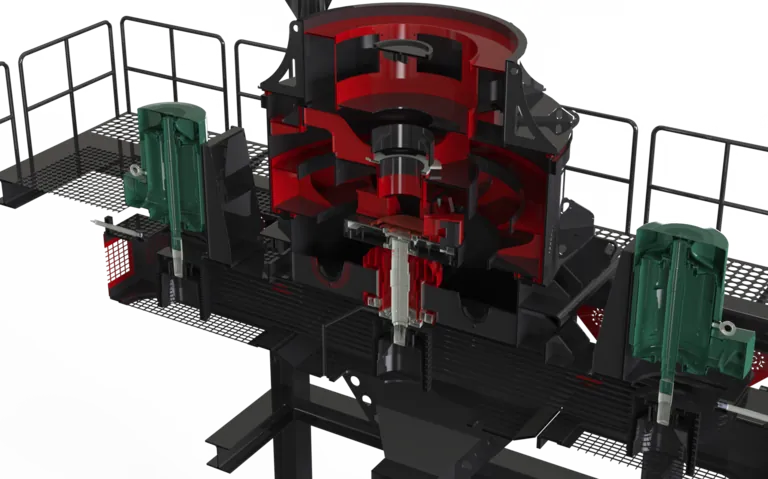
Manufactured sand (artificial sand) forms the basis of concrete and asphalt production in regions where natural sand sources are running out. In this article we explain how the vertical shaft impact crusher (VSI) makes sand and which figure to look at when selecting a model, using General Makina's actual technical values.
How a VSI works: throwing stone against stone
In a vertical shaft impact crusher, material is fed from above into the centre of a rotor turning at high speed. The rotor throws the pieces outwards with centrifugal force; the pieces are crushed by striking either the anvil plates in the housing or the bed of accumulated material (stone-on-stone principle).
What sets this mechanism apart from other crushers is this: breakage occurs along the piece's own natural planes of weakness. The result is a near-cube (cubical) grain shape — exactly what concrete specifications require. The flaky and elongated grains seen at the outlet of jaw or impact crushers are rounded off in the VSI stage.
Feed limit: the VSI's most critical figure
In the VSI series table, the column to watch is the feed size:
| Model | Rotor Size (mm) | Max. Feed Material (mm) | Capacity (t/s) | Motor (kW) |
|---|---|---|---|---|
| GNR 700 | 700 | 25-35 | 45~135 | 90-132 |
| GNR 800 | 800 | 40-50 | 55~160 | 132-160 |
| GNR 900 | 900 | 50-55 | 80~210 | 2 x 200 |
Even the largest model accepts only 50-55 mm. For comparison: the primary jaw GNRK 90 has a 900 x 650 mm opening, and the secondary impact DMK series takes up to 800 mm. In other words, the VSI works at the very end of the chain and must have at least two crushing stages ahead of it. Feeding material straight from the quarry into a VSI is not possible.
Twin motors: the distinguishing feature of the GNR 900
There is a detail in the table that is easy to miss: while the GNR 700 and 800 run on a single motor (90-160 kW), the GNR 900 has 2 x 200 kW, that is, twin motors. As the rotor goes from 800 to 900 mm, the power demand rises from 160 kW to 400 kW — close to two and a half times.
The reason lies in the nature of sand production: the energy needed to crush material increases as the particle size gets smaller. The sand stage is the most energy-intensive step of a plant. In the investment calculation, the electrical infrastructure must be sized according to this stage.
An alternative for cubical shape: the cubitizer
If the aim is not sand but only correcting the grain shape, the cubitizer series accepts a wider feed:
| Model | Rotor (mm) | Feed (mm) | Capacity (t/s) | Motor (kW) |
|---|---|---|---|---|
| GNR K50 | 1000 x 750 | 120 | 45~80 | 45 |
| GNR K100 | 1550 x 1200 | 180 | 90~130 | 90 |
| GNR K110 | 1550 x 1800 | 210 | 160~250 | 160 |
The comparison is clear: the cubitizer accepts 120-210 mm while the VSI takes only 25-55 mm. The cubitizer shapes coarser material and draws less power (the K50 only 45 kW); the VSI, on the other hand, produces fine fractions and sand. The two are not competitors but have different jobs — in many plants they run one after the other.
Mobile VSI
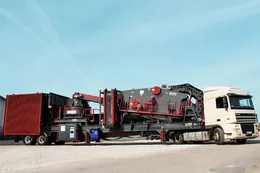
For installations that will be moved from site to site, the mobile VSI group comes on a single chassis:
| Model | Loading Dimensions W x L x H (mm) | Weight (kg) | Capacity (t/s) |
|---|---|---|---|
| GNR-MVSI 900 | 4100 x 16200 x 4500 | 42.000 | 90~180 |
| Mobile Tertiary (Sand Machine) | 3000 x 16000 x 4500 | 38.000 | 60~250 |
Comparing the stationary GNR 900 with the mobile MVSI 900, capacity drops from 80~210 to 90~180 t/s — since the feeder and conveyor share the same platform on a mobile chassis, the upper limit comes down somewhat. The gain is in installation time.
The order when selecting a model
- What is your feed size? For 25-35 mm the GNR 700, for 40-50 mm the 800, for 50-55 mm the 900. If it is above this limit, a tertiary stage is needed first.
- Target tonnage per hour? Look at the 45-135 / 55-160 / 80-210 t/s bands.
- Electrical infrastructure? The GNR 900 has twin motors (2 x 200 kW) — check the transformer capacity.
- Sand or shape? If only cubical grain is wanted, a cubitizer may be more economical.
Related pages
Definitions of technical terms: Glossary