 EN — English
 TR — Türkçe
 DE — Deutsch
 RU — Русский
 FR — Français
 ES — Español
 AR — العربية
 SR — Српски

Twin Vibrating Screen for High-Tonnage Plants
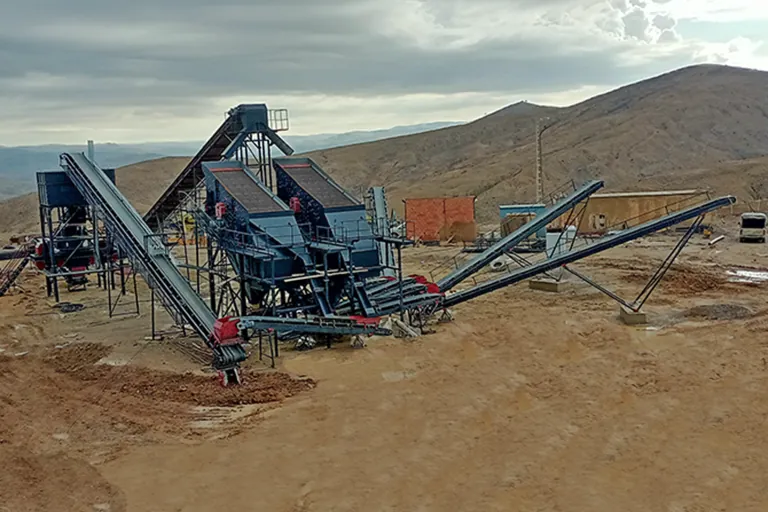
The twin vibrating screen runs two screen bodies together and has a capacity of 100-500 tph. It is used in high-tonnage stationary crushing plants to separate material even at flow rates where a single screen chokes. The double surface doubles the screening area; stratification is maintained at high feed and the recirculating load drops. The body is entirely bolted and weldless; screen media strip out fast and Stone-box chutes shield the feed zone.
Why a double screen surface
The twin screen uses the same circular vibration principle as the conventional screen; the difference is the double screen surface.
- Surface area 2× → double screening capacity in the same footprint.
- At high feed rate the bed-depth rule (3-4 times the aperture at discharge) is not exceeded → efficiency is maintained.
- Where a single screen chokes, the twin screen lowers the recirculating load.
Model and motor data
| Model | Screen size (mm) | Motor (kW/rpm) | Weight (kg) |
|---|---|---|---|
| GNR 1020 | 1000×2000 | 4/1500 | 1100-1800 |
| GNR 1025 | 1000×2500 | 4/1500 | 1500-2200 |
| GNR 1030 | 1000×3000 | 5.5/1500 | 1500-2700 |
| GNR 1230 | 1200×3000 | 7.5/1500 | 2200-3100 |
| GNR 1540 | 1500×4000 | 11/1500 | 5400-6600 |
| GNR 1650 | 1600×5000 | 15/1500 | 6400-8100 |
| GNR 2050 | 2000×5000 | 18.5/1500 | 8350-11000 |
| GNR 2060 | 2000×6000 | 18.5/1500 | 12700-13000 |
| GNR 2460 | 2400×6000 | 22/1500 | 14500-15200 |
| GNR 2470 | 2400×7000 | 30/1500 | 16800 |
The model table is the same as the conventional screen; the difference is capacity: the twin configuration is 100-500 tph (100-400 tph on the conventional screen). Deck count is typically 2-4; mesh apertures are chosen per project to suit the target output.
Where it is used
Stationary crushing plants of hundreds of tons per hour, high-capacity aggregate production. Where a single screen is insufficient and the deck chokes at high flow, the twin screen passes more product without choking in the same footprint.
Line integration
You can plan the twin screen not on its own but as part of a full production line. General Makina brings crushers, washing units, conveyors and the batching plant together in one project, so supply, installation and spare parts run from a single desk across your high-tonnage plant.
Frequently Asked Questions
Why choose a twin screen?
In high-tonnage plants where a single screen chokes, the twin screen's double surface screens material without choking and lowers the recirculating load.
What is its capacity?
It ranges from 100-500 tph; the twin configuration is used for higher tonnage than the conventional screen.
How does it differ from a single screen?
Two screen surfaces work together; the screening area doubles, stratification is maintained at high flow and recirculation drops.
How many decks does it have?
Typically 2-4 decks. Deck count is chosen by product-fraction need; each successive deck reduces capacity somewhat.
Where is it used?
In large stationary crushing plants of hundreds of tons per hour and in high-capacity aggregate production.
Wear and spare parts: Spare & Wear Parts
Definitions of technical terms: Glossary
Video
Similar Machines
Related Searches
Production capacity may vary depending on the type and hardness of the material, feed size, target product size and operating conditions.
Request a Quote for This Product
Fill in the form and press the button; your request reaches us directly on WhatsApp together with the product details.
ISO 9001:2015 · CE · EAC · Since 1976
What information do we need for a quotation?
- Type and hardness of the material (limestone, basalt, granite, river gravel, etc.)
- Maximum feed size (mm)
- Required product sizes / fractions (e.g. 0-5, 5-12, 12-19 mm)
- Target capacity (t/h) and daily operating hours
- Whether grid electricity is available on site
- Installation country and city