EN — English
 TR — Türkçe
 DE — Deutsch
 RU — Русский
 FR — Français
 ES — Español
 AR — العربية
 SR — Српски
Closed Circuit Circulating Load Crushing: Sizing the Real Feed
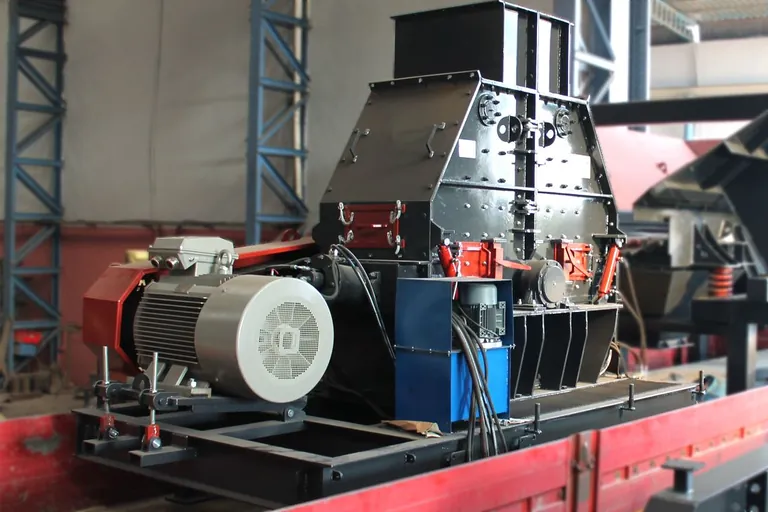
If a plant delivers 200 t/h of product, assuming the secondary or tertiary machine is fed 200 t/h is a common and expensive mistake. In a closed circuit the screen oversize goes back to the crusher, which then processes both the fresh feed and the returning stream. Closed circuit circulating load crushing calculations express that returning stream as a ratio to fresh feed, and the ratio drives machine size, installed power, conveyor width and wear part consumption.
The mass balance is a single equation
At steady state the plant discharges as much product as fresh feed enters. Call x the fraction of crusher discharge that remains above the screen cut, and E the efficiency with which the screen removes undersize. The total feed T reaching the crusher, expressed as a multiple of fresh feed, is T = 1 / [E × (1 − x)], and the circulating load is that multiple minus one. With x = 0.40 and E = 0.90 the crusher sees 1.85 times the fresh feed, a circulating load of 85 per cent. For a 200 t/h circuit that means 370 t/h through the chamber.
What closed circuit circulating load crushing does to the numbers
| Oversize fraction in crusher discharge x | Screen efficiency E | Total crusher feed (multiple of fresh feed) | Circulating load % |
|---|---|---|---|
| 0.20 | 1.00 | 1.25 | 25 |
| 0.20 | 0.90 | 1.39 | 39 |
| 0.30 | 1.00 | 1.43 | 43 |
| 0.30 | 0.90 | 1.59 | 59 |
| 0.40 | 0.90 | 1.85 | 85 |
| 0.40 | 0.80 | 2.08 | 108 |
| 0.50 | 0.90 | 2.22 | 122 |
| 0.50 | 0.80 | 2.50 | 150 |
The two extremes in the table differ by more than a factor of two. For the same fresh feed, one case demands 1.25 times the machine capacity and the other 2.50 times. Matching a crusher's nominal rating to the plant rating in a closed stage therefore fills the screen and chokes the chamber within the first shift.
Why screen efficiency distorts the result
When efficiency drops, fines that belong in the product stay on the deck and travel back to the crusher. The machine grinds that material a second time, which is wasted energy and wasted liner life. The x = 0.30 rows make the point: moving efficiency from 1.00 to 0.90 lifts circulating load from 43 to 59 per cent. The usual causes are blinded apertures, an excessive bed depth, the wrong deck angle and worn cloth openings. Enlarging the crusher before fixing those four is solving the problem from the expensive end.
The same error repeats on conveyors and motors
Circulating load is not only a crusher issue. The return conveyor, the screen feed conveyor and the deck area all scale with the same multiplier. At 100 per cent circulating load the screen classifies twice the plant tonnage. A return belt sized on product tonnage becomes the bottleneck even though the crusher has headroom. On the drive side, peak load rather than average power governs: recirculated rock is generally harder and more cubical than fresh feed, because the easily broken particles already reported to product on the first pass.
Measuring the circuit instead of guessing
Three sample points are enough: crusher discharge, screen undersize product and the returning oversize. Comparing the percentage passing the same aperture in each stream gives the circulating load directly. Samples must be cut from the full cross section with the belt stopped; a scoop taken from a moving belt over-represents coarse particles and biases the answer. Repeating the exercise at the start of a shift and again just after a media change shows how quickly efficiency is decaying.
What this means when specifying machines
In a closed stage the crusher is selected against calculated total feed, not fresh feed, with an allowance on top for feed surges. Where cubical product is the target, a tertiary crusher normally runs at a high circulating load, so what looks like oversizing is simply the design working as intended. The circuit choices that depend on rock type and target gradation are covered further under mining engineering.
Questions we are asked
Is there an ideal circulating load?
No single figure applies; the target gradation and the available deck area decide it. If the load runs far above expectation, look at screen efficiency first and crusher setting second.
Does opening the crusher setting reduce the load?
Opening the setting increases oversize and raises the load; closing it lowers the load but raises power draw and wear. The decision follows the product curve, not the ammeter.
Does open circuit remove the problem?
It removes the recirculation but gives up control of top size. Where the specification caps top size, a closed circuit is unavoidable.
Share your screen analysis and target gradation and we will work out the circulating load in your circuit and review the stage-by-stage capacity balance with you.
Definitions of technical terms: Glossary