EN — English
 TR — Türkçe
 DE — Deutsch
 RU — Русский
 FR — Français
 ES — Español
 AR — العربية
 SR — Српски
Most Effective Crushing Plants for Hard Rock and Mining: Jaw vs Impact Crusher Comparison
In a quarry or a mine there is no such thing as "the most effective crusher"; there is only the right crusher and the wrong one. The same impact crusher that turns out cheap, cubical product in limestone can wear through its blow bars within a few shifts in basalt. This article compares jaw and impact crushers for hard, abrasive rock (basalt, granite, quartzite, iron and chrome ore) and for soft-to-medium rock (limestone, dolomite) in terms of wear parts, feed opening, capacity and particle shape, using General Makina's own model tables. We covered the general type-selection criteria in an earlier post, Impact or Jaw? Crusher Type Selection Criteria; here the focus is on matching the machine to the material.
The material decides what is "most effective", not the catalogue
Effectiveness should be measured by wear cost per tonne, by the number of crushing stages needed to reach the target fraction and by whether the product meets the specification. All three depend on how abrasive the rock is. The threshold used on General Makina product pages gives a practical dividing line: material with more than 10% silica, or a Bond abrasion index (Ai) above 0.15, counts as abrasive. The reference values quoted on those pages make the gap obvious: limestone at roughly Ai 0.001–0.03, basalt around 0.20, granite around 0.55. Granite is many times more abrasive than limestone, so the same crushing principle cannot be expected to behave the same way in both.
The first job is therefore to have a sample from the site tested for silica content and, where possible, abrasion index. If quality varies along the quarry face, size the plant for the worst zone; the plant will have to crush that zone too.
Wear parts: jaw plates and blow bars do not wear the same way
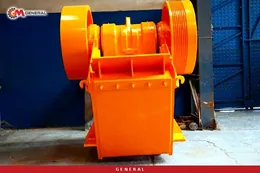
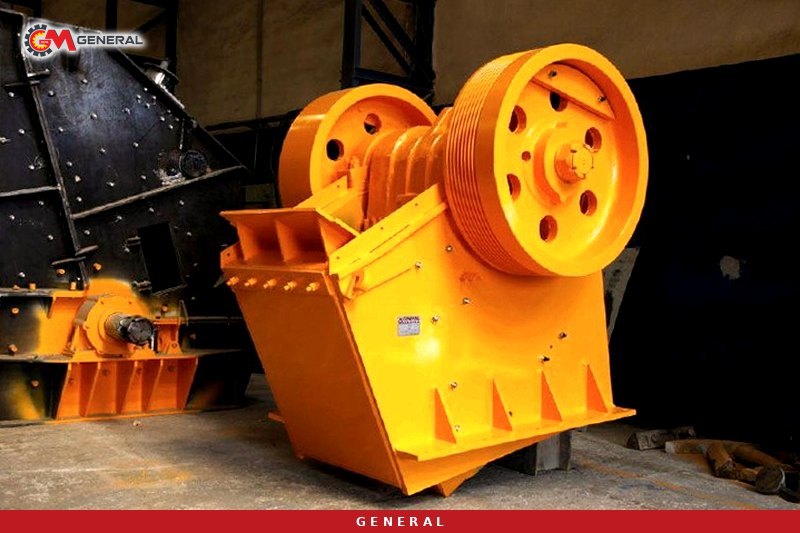
In a jaw crusher the rock is compressed between a fixed jaw and a swing jaw driven by an eccentric shaft. On the GNRK series the jaw plates are austenitic manganese steel (Mn13/Mn18). This steel work-hardens at the surface under impact and pressure: the face gets harder as it crushes hard rock while the body stays tough. That is why a jaw crusher can protect its metal life in hard stone.
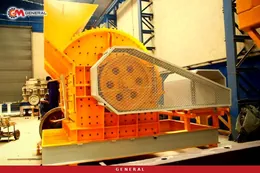
In an impact crusher the blow bars on a fast-spinning rotor strike the rock and throw it against the front and rear breaker plates (aprons). Wear concentrates on the edges, and every impact takes material off the bar. According to the GNR PDK page, high-chrome white iron bars (about 700–800 HB) are used for clean, abrasive feed; tougher manganese or martensitic bars are preferred in concrete recycling because of tramp iron; ceramic-insert composite bars are an option for very high silica. The same page states plainly that granite, basalt, quartzite and river gravel above the threshold can consume blow bars within hours, and that a jaw plus cone layout is preferred for these rocks.
The practical consequence: in limestone, choosing the right blow bar alloy sets the impact crusher's cost per tonne. In basalt, alloy choice does not solve the problem; the crushing principle has to change.
Side by side: GNRK, GPS, GNR PDK and GNR DMK model tables
The table below shows only the value ranges published on the product pages of the four series. Figures refer to the smallest and largest model in each series; check the product page for the intermediate models.
| Series | Principle and stage | Feed size | Capacity | Motor | Main wear part | Suitable material |
|---|---|---|---|---|---|---|
| GNRK jaw (GNRK 60 – GNRK 140) | Compression, primary | Opening 610×380 mm – 1400×1100 mm | 20–80 t/h – 500–600 t/h | 30/37 kW – 200 kW | Mn13/Mn18 jaw plates | Granite, basalt, quartzite, river gravel, slag and all hard rock |
| GPS primary-secondary impact (GPS-1210 – GPS-1415) | Impact, primary + secondary in one body | 600 mm – 1000 mm | 100–250 t/h – 150–400 t/h | 160 kW – 315 kW | Blow bars + aprons | Limestone, dolomite, non-abrasive rock, demolition waste |
| GNR PDK primary impact (PDK02 – PDK03) | Impact, primary | 900 mm – 1300 mm | 200–300 t/h – 500–900 t/h | 200 kW – 500 kW | Blow bars + breaker plates | Limestone, dolomite, concrete recycling |
| GNR DMK secondary impact (DMK01 – DMK05) | Impact, secondary/tertiary | 800 mm | 120–180 t/h – 250–500 t/h | 160 kW – 500 kW | Blow bars + apron liners | Limestone, dolomite, asphalt and demolition recycling |
The first lesson of the table is that capacity alone cannot drive the decision. The 500–900 t/h range of the GNR PDK03 exceeds the 500–600 t/h of the GNRK 140, but that difference only matters if the material in the last column fits. In a granite quarry, the PDK03's higher throughput disappears into hours stopped for blow bar changes. Second point: the feed value for the jaw series is an opening size (width × depth), while for the impact series it is the largest accepted lump. Convert one into the other before comparing them directly.
Feed opening and capacity: select backwards from the largest block
According to the GNRK page, the largest block a jaw crusher will take is about 0.8–0.9 times the width of the opening. Oversize blocks bridge, the feeder stops and the rated capacity stays on paper.
Hypothetical example: assume that the largest blocks the excavator drops into the hopper in a granite quarry are 750 mm. The GNRK 90 has a 900 mm wide opening; with the 0.8–0.9 factor the acceptable block is 720–810 mm. A 750 mm block falls inside that range but close to the lower end, so bridging can be expected on days when blasting goes badly. The 1100 mm opening of the GNRK 110 gives 880–990 mm by the same calculation and leaves a margin. The decision here depends not only on the required tonnage but also on how consistent the blasting is.
On large hard-rock and ore sites, the GNRK 130 (1300×1000 mm, 160 kW, 400–500 t/h) and GNRK 140 (1400×1100 mm, 200 kW, 500–600 t/h) handle coarse run-of-mine in one stage. In limestone, the big-block problem is solved on the impact side: the GNR PDK03 accepts feed up to 1300 mm and, according to its product page, reaches a reduction ratio of up to 20:1 in a single stage on limestone. The typical reduction ratio of a jaw crusher is 4:1–9:1. That is where the primary impact crusher's ability to cut the number of stages in limestone comes from.
Particle shape: at which stage is cubicity won?
Concrete and asphalt specifications limit flaky and elongated particles. An impact crusher splits rock along its natural fracture planes and so produces cubical product; the GNR DMK page highlights the secondary impact crusher's shape quality, but also notes that it can produce slightly flakier grains than a vertical shaft impactor and that an additional VSI stage improves cubicity.
In hard rock, cubicity is won with a cone crusher, not an impact crusher. In the General cone crusher, material is squeezed several times between the eccentrically gyrating head and the concave until it passes the set gap. This multi-directional compression gives cubical product with low wear-part cost in abrasive rock; hydraulic CSS adjustment controls product size and hydraulic cylinder protection handles sudden blockages. The product page gives the order of magnitude for the secondary stage as 50–250 mm feed and 0–60 mm product; capacity and power by model are quoted per project.
Reference layout for hard rock: jaw primary + cone secondary
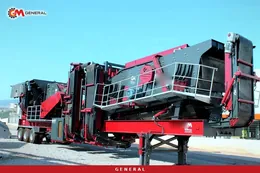
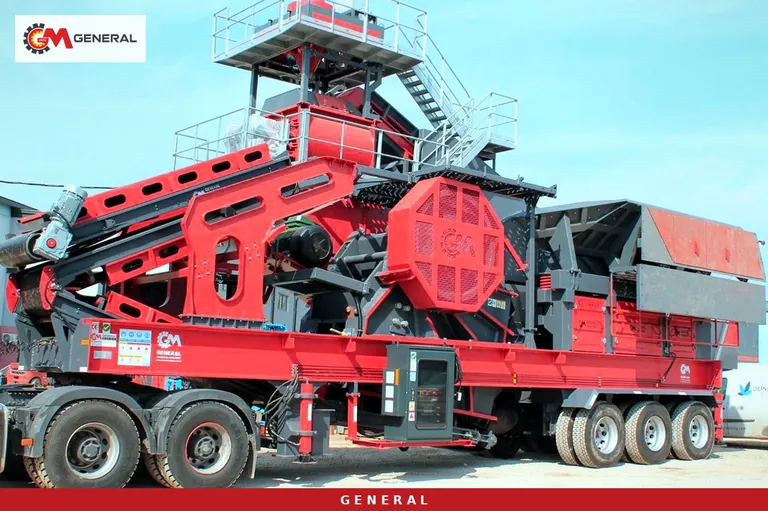
The field version of this approach is the General 944 mobile crushing and screening plant: a GPJ 90 primary jaw and a GM430 secondary cone work on the same wheeled plant. It takes 800 mm feed and produces 120-180 t/h; a 1600×5000 mm three-deck horizontal screen splits the product into 0-5, 5-12 and 12-19 mm fractions, and power comes from a 550 kVA generator. The product page positions it for basalt, granite, iron ore, chrome and quartz and stresses that the cone secondary is the main difference from the General 950, which uses the same primary with an impact secondary (DMK01). For medium-hard stone with silica close to the threshold, an impact-secondary layout like the 950 can be discussed; in stone clearly above the threshold the cone secondary keeps metal consumption under control.
Reference layout for soft-to-medium rock: an all-impact chain
In limestone and dolomite the impact crusher gives both reduction and shape. Where the capacity target is high, a GNR PDK primary impact crusher is combined with a GNR DMK secondary; the DMK01 delivers 120–180 t/h at 160 kW, the DMK05 250–500 t/h at 500 kW, and the typical reduction ratio of the secondary impact crusher is around 10:1. On medium-scale lines where fewer stages are wanted, the GPS series does primary and secondary work in one body; the GPS-1415, for example, delivers 150–400 t/h with 1000 mm feed. One body means one wear set and one motor, and the approach only pays off in non-abrasive stone.
Material matching checklist
- Sample analysis: does silica exceed 10% or Ai exceed 0.15? If so, start from a jaw primary and a cone secondary.
- Largest block: does the measured block fit within 0.8–0.9 times the jaw opening width, and is it below the maximum feed value on the impact crusher's product page?
- Clay and moisture: wet, sticky clay feed chokes the jaw cavity; plan scalping or washing.
- Tramp iron risk: on recycling or ore sites with foreign metal, confirm the blow bar alloy (tough manganese/martensitic) and the cone crusher's overload protection.
- Specification: if concrete or asphalt requires cubicity, the last stage should be a cone (hard rock) or impact/VSI (soft rock).
- Capacity chain: primary, secondary and screen must be sized for the same tonnage; the narrowest stage sets the capacity of the whole line.
- Wear budget: compare wear-part cost per tonne produced, not per machine.
Our article on plant selection for basalt crushing and screening shows how this list is applied in the field.
Frequently asked questions
Can a primary impact crusher be used on basalt or granite?
Mechanically it will crush them, but our product pages do not recommend it. Basalt has an Ai of about 0.20 and granite about 0.55, both above the 0.15 threshold, and blow bar consumption pushes the cost per tonne above that of a jaw plus cone layout.
Is a jaw primary the wrong choice for limestone?
No. The GNRK series jaw crusher crushes limestone without difficulty and, with scalping, is a safe start for clayey, dirty feed. The trade-off is that an impact secondary has to be added for cubical product; in clean limestone a primary impact crusher does the same job with fewer stages.
Which layout is recommended for crushing ore?
For abrasive ores such as iron, chrome and quartz, a jaw primary and a cone secondary crusher are the standard starting point. The cone model is selected per project according to feed size, target product and tonnage, so a quotation should be requested with sample data and target fractions.
Which factors set the price in a quotation?
The crusher model and number of stages, the number of screen decks, mobile or stationary design, generator or grid connection and the wear-part alloy are the main factors. A price given before the material analysis is clear is the price of the wrong layout.
Conclusion: the right match is the most effective plant
In hard, abrasive rock and ore, a jaw primary plus cone secondary keeps metal consumption under control and still delivers cubical product. In limestone and dolomite, a primary impact crusher or a single-body impact solution such as the GPS provides high reduction and shape quality with fewer stages. General Makina has been building crushing plants since 1976; we prepare the right layout from your sample analysis, largest block size and target fractions, and all our machines carry a 1-year warranty. Send us your material data and request a quotation.
Definitions of technical terms: Glossary