 EN — English
 TR — Türkçe
 DE — Deutsch
 RU — Русский
 FR — Français
 ES — Español
 AR — العربية
 SR — Српски
Environment and Dust Control

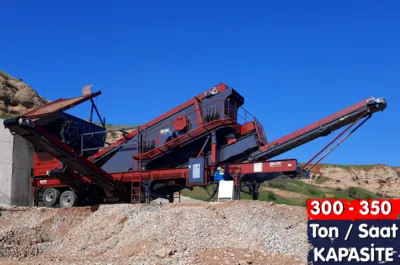

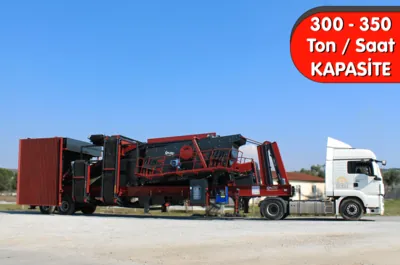
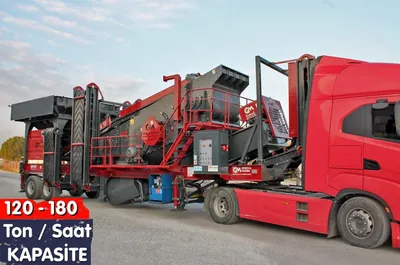
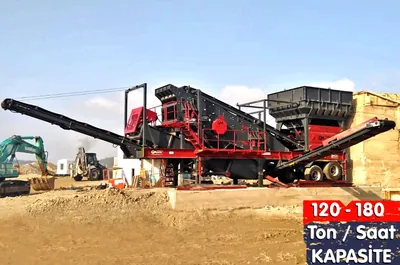
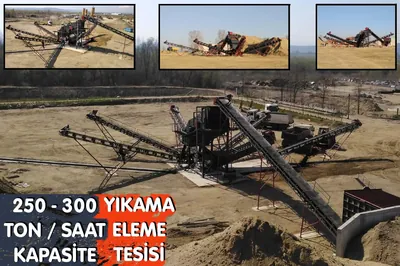
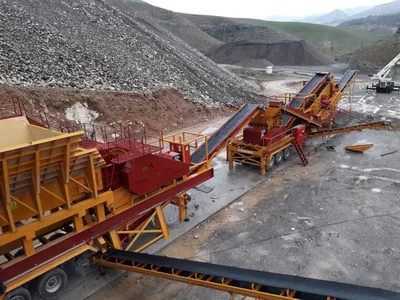
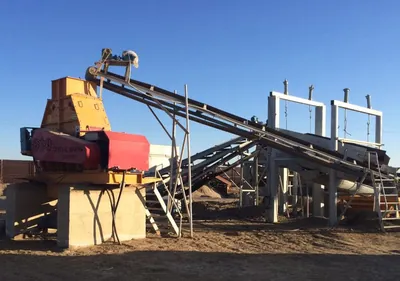

What an environmental case for a crushing plant actually contains
Regulators and neighbours judge an aggregate plant on four measurable quantities: the dust that leaves the site, the noise level at the nearest sensitive receiver, the volume of fresh water drawn into the process, and the energy burned per tonne produced. None of the four can be optimised on its own. Wetting the feed to kill dust raises water use and slurry volume; switching to extraction and filtration substitutes fan and compressor power for that water. The engineering task is to choose the trade-off deliberately and then be able to prove the choice with records. This hub gathers dust suppression, emission monitoring, noise, permitting, water recycling and carbon accounting for stationary crushing plants and mobile layouts; the articles below work each topic down to numbers.
Start with a source inventory, not an equipment list
Dust does not come from one place. On a typical crushing and screening line the dominant releases are hopper tipping, the primary crusher inlet, every conveyor transfer, the screen decks, the free-fall drop onto the stockpile cone, and haul road traffic. The first five are point sources that can be enclosed. The last two are fugitive: they cannot be enclosed and are controlled only by operating discipline. In practice, most enforcement findings come from stockpiles and roads rather than from the enclosable points. A credible dust programme therefore begins with an inventory that records, for every source, the material throughput, its natural moisture, the drop height and its wind exposure. Nozzles installed without that inventory tend to spray where access is easy rather than where dust is generated.
Wet suppression: droplet diameter decides the outcome
The variable that governs spray performance is droplet size, not litres per hour. Coarse sprays wet the body of the material so that fines never become airborne, while very fine fog is used to capture dust already suspended in air, and does so with far less water. Added moisture is normally kept between roughly half a percent and two percent by weight, and for some materials up to around four percent. Going beyond that band causes belt slip, chute blockage and screen blinding, and in cold climates raises the risk of frozen build-up. This is why spray banks are interlocked to material presence rather than left running: an automation and control system driven by belt sensors is the cheapest way to stop watering an empty conveyor.
| Method | Droplet range | Primary function | Main weakness |
|---|---|---|---|
| Coarse spray bars | roughly 200-500 µm | Wetting the material body | Highest water use and slurry load |
| Fine fog / dry fog | roughly 1-150 µm | Capturing airborne dust | Drifts in wind, needs enclosure |
| Fog cannon | per manufacturer data | Stockyards and open areas | Very wind sensitive, needs power and water |
| Water plus surfactant | as coarse spray | Improving wetting efficiency | Chemical cost and discharge compliance |
Dry collection: sizing a pulse-jet baghouse
Where added product moisture is unacceptable, extraction with a fabric filter is the alternative. In a pulse-jet baghouse the governing design figure is filtration velocity, often called the air-to-cloth ratio. Industrial practice commonly sits between 0.9 and 1.5 metres per minute, and fine or sticky dusts are deliberately handled at the lower end; cement-type duties are frequently designed nearer 0.8 to 1.0 metres per minute. Pushing the velocity up shrinks the housing but raises pressure drop, cleaning frequency and compressed-air consumption while shortening bag life. Hood and duct placement matters as much as the filter itself: dust that escapes capture at the hood never reaches the stack, it reaches the yard.
Measurement and reporting is the compliance evidence
The part of a dust programme that survives an inspection is the record. Fugitive dust is commonly quantified with deposition gauges sampled monthly and averaged over the year, while respirable crystalline silica is measured by personal sampling across a full shift. Limit values differ by jurisdiction, and assuming otherwise is the expensive mistake. The table below places several verifiable reference thresholds side by side; what binds your site is the figure written in your own permit and national rules.
| Quantity | Reference framework | Value | Averaging period |
|---|---|---|---|
| Dust deposition | German air quality technical instruction | 0.35 g/(m²·day) | Annual mean |
| Deposition, negligible contribution | Same framework | 10.5 mg/(m²·day) | Annual mean, three percent of the limit |
| Dust deposition | Turkish industrial air pollution rules | 390 mg/(m²·day) short term; 210 mg/(m²·day) long term | Daily and period mean |
| Ambient PM10 | European Union, regime in force | 40 µg/m³ annual; 50 µg/m³ daily with 35 exceedances | Annual and daily |
| Ambient PM10 | European Union, value adopted for 2030 | 20 µg/m³ | Annual mean |
| Respirable crystalline silica | European Union binding occupational limit | 0.1 mg/m³ | Eight-hour weighted average |
| Respirable crystalline silica | United States occupational safety rules | 0.05 mg/m³ limit; 0.025 mg/m³ action level | Eight-hour weighted average |
Noise is assessed by land use and by hour
There is no single universal noise ceiling. Assessment depends on the zoning of the area containing the nearest sensitive receiver and on the split between day and night. The German framework for industrial noise is the clearest illustration of that logic: 70 dB(A) day and night in industrial zones; 65 and 50 dB(A) in commercial zones; 60 and 45 dB(A) in mixed and village areas; 55 and 40 dB(A) in general residential areas; 50 and 35 dB(A) in purely residential areas; and 45 and 35 dB(A) around spas and hospitals. Night runs from 22:00 to 06:00 and is judged on the loudest hour, with separate allowances for short peaks by day and by night. The practical consequence is that a night shift is constrained by the night figure, so crusher placement, earth bunds and acoustic screens have to be settled before the shift pattern is promised.
Permitting thresholds are national, not universal
The same plant follows different administrative routes in different countries. In France, crushing and screening has its own heading in the classified installations list and the trigger is the combined installed power of fixed machines able to run simultaneously: permanent installations above 40 kW and up to 200 kW file a declaration, above 200 kW they fall under the registration regime, and for temporary installations of up to six months the threshold is applied at 350 kW, with anything below 40 kW outside the heading altogether. Elsewhere the deciding metric may instead be annual output, site area, or the plant's link to a mining licence. So the first question when building an investment schedule is not which machine, but which threshold and which document apply in that country; quarry stationary plant configuration sets the technical basis for that answer.
Closed-circuit water and slurry handling
Once a washing stage exists, the environmental risk moves from air to water. The intended arrangement is simple: turbid water from the washers goes to a settling stage, clarified overflow is pumped back into the process, and fresh water only replaces what leaves as evaporation, product moisture and slurry cake. The settling stage sets the limit of the whole circuit. Thickener underflow typically carries about 50 to 65 percent solids and is still a pumpable slurry, whereas filter press cake reaches roughly 75 to 85 percent solids, meaning 15 to 25 percent moisture, and can be loaded onto a truck and stacked. The difference shows up as land area, flocculant consumption and capital cost. The choice between a fine material screw washer and a bucket wheel sand washer changes the same balance, and the whole mining washers range works on the same circuit logic.
| Stage | Output solids | Operating mode | Fits when |
|---|---|---|---|
| Settling pond | Depends on material and retention time | Continuous, cleaned in campaigns | Land is available, no stackable cake needed |
| Thickener | about 50-65 percent solids | Continuous | Water recovery is the goal and slurry will be pumped |
| Filter press | about 75-85 percent solids, 15-25 percent moisture | Batch, cyclic | Land is tight and cake must be stacked or hauled |
Stockyards and haul roads produce most of the complaints
Controlling fugitive sources has little to do with buying equipment. Road watering does not deliver a fixed percentage: effectiveness moves with application rate, the interval between passes, traffic volume, vehicle weight and weather. Authorities in practice work with efficiency assumptions in the region of 50 to 75 percent, with the upper end reserved for programmes watering several times a day, while chemical binders form a longer-lasting surface and give a higher, steadier reduction. In many jurisdictions the enforceable test is not a calculated efficiency at all but observable plume opacity. Three operating rules go alongside the water truck: cut stockpile height and free-fall distance, place wind fences across the prevailing wind, and match conveyor belt speed and discharge height to the material.
Energy, carbon and cost come from one dataset
Environmental scope now reaches beyond dust and noise, because many European tenders ask for greenhouse gas intensity per tonne. The skeleton of that calculation is short: diesel is metered in litres and converted with published factors, grid electricity is metered in kilowatt-hours and multiplied by the national grid factor. A widely used diesel figure is about 2.68 kg carbon dioxide equivalent per litre; the factor set is reissued annually and road diesel and gas oil appear on separate lines. Grid factors, by contrast, vary several-fold between countries, so the claim that an electric plant is always lower carbon does not hold as a general statement. Measure, apply your own country's factor, report per tonne. If you feed the same meter readings into the operating cost calculator, the cost report and the carbon report come from one dataset.
Where to go next
Environmental compliance is part of the layout, not an accessory bolted on after commissioning. Spray lines, extraction ducts, a settling pond and an acoustic screen all become expensive and inadequate when they are squeezed in later. The articles in this section take each topic down to calculation level; if you want the plant configuration first, begin with the river gravel washing and screening layout and the dry versus wet screening comparison. Send us your site constraints, material type and target capacity and we will develop the layout with the dust, water and noise items priced in from the start.
Frequently Asked Questions
How much water does dust suppression on a crushing plant need?
The governing figure is added moisture, not litres per hour. Practice targets roughly half a percent to two percent by weight, and up to about four percent for some materials. Above that band you get belt slip, blocked chutes and blinded screen media.
Fog cannon or spray nozzles: which one works?
They do different jobs. Coarse nozzles wet the material body so fines never become airborne, while very fine fog captures dust already suspended in air and uses far less water. A sound design usually combines both, chosen source by source.
What sets the size of a pulse-jet baghouse?
Filtration velocity, also called the air-to-cloth ratio. Industrial practice commonly runs from 0.9 to 1.5 metres per minute; fine or sticky dusts are handled at the lower end and cement-type duties are often designed nearer 0.8 to 1.0 metres per minute.
How is fugitive dust measured, and against which value?
Deposition gauges are placed around the boundary, sampled monthly and averaged over the year. The binding value depends on jurisdiction: the German technical instruction works with an annual mean of 0.35 g/(m²·day), while Turkish rules use short and long term figures in the region of 390 and 210 mg/(m²·day).
Does a night shift change the noise constraint?
Yes, because assessment splits day from night and the night figure is always lower. In the German framework a general residential area is judged at 55 dB(A) by day and 40 dB(A) by night, with night running from 22:00 to 06:00. That single number often dictates crusher placement and screening.
What do we do with the slurry from a wash plant?
Two routes. Thickener underflow holds about 50 to 65 percent solids and stays pumpable; filter press cake reaches roughly 75 to 85 percent solids, meaning 15 to 25 percent moisture, and can be stacked. Presses win when land is tight, ponds and thickeners when it is not.