EN — English
 TR — Türkçe
 DE — Deutsch
 RU — Русский
 FR — Français
 ES — Español
 AR — العربية
 SR — Српски

Heavy-Duty Mobile Crushers for Marble Quarries and Mines
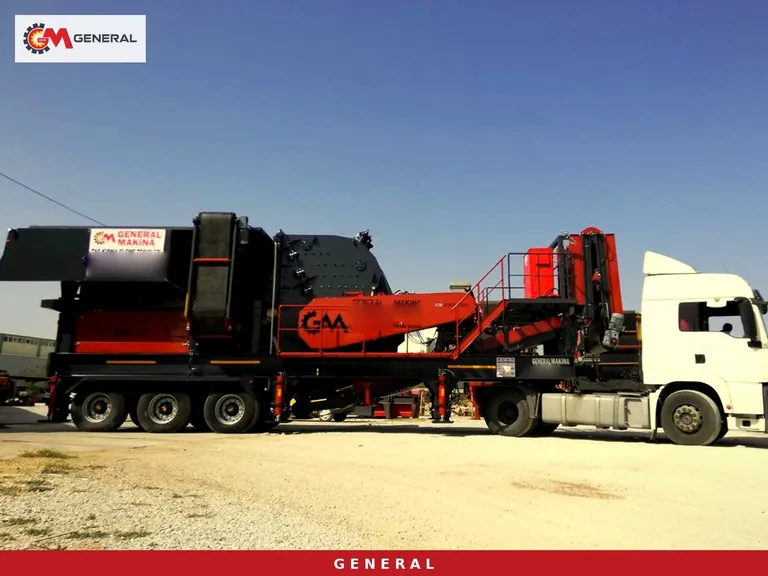
In a dimension-stone marble quarry, the ratio between saleable blocks and what stays on the quarry floor — corner pieces, sawing offcuts and overburden — quietly sets the haulage budget. In a mine the same picture repeats with stripping waste and barren side rock. On both sites, moving the crusher towards the loading point instead of trucking rock a long way and crushing it there shortens the truck cycle and reduces the maintenance load on haul roads. We compared complete wheeled plants model by model in heavy-duty mobile crushing and screening plants for marble and stone quarries. This article answers a different question: how do you place single-chassis portable crusher units in the in-pit haulage chain, which unit does the shape of block waste force on you, and what does "heavy-duty" actually mean on a quotation sheet?
The in-pit haulage chain: where should the crusher sit?
Material in a quarry passes three points: the face or block-cutting bench, an intermediate loading area, and the stockpile/dispatch yard. Where the crusher sits in that chain decides what the trucks carry. With the crusher in the stockpile yard, trucks haul coarse, irregular run-of-mine rock. Angular block pieces batter the body plates, voids remain between pieces, and the truck carries little tonnage for its volume. Once the crusher moves closer to the face, primary product drops to a size a belt can take; the truck cycle shortens or part of it is handed over to conveyors.
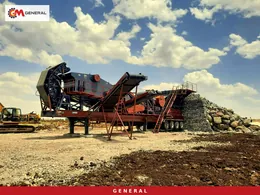
Here two product-page values connect. The portable primary jaw unit (GNR series) delivers a 0-250 mm product, and the maximum feed accepted by General Makina belt conveyors is also 0-250 mm. So the jaw unit's output can go straight onto a belt line. Conveyors are built in seven widths from 500 to 1200 mm, to any required length, for 50-1000 t/h. The portable primary impact unit (M-PDK) delivers 0-70 mm, which rides more easily on a belt but must then go to a screening stage.
Before deciding on crusher position, put your own site values into two relationships:
- Daily truck trips = daily tonnage ÷ average payload per trip. With coarse run-of-mine rock the body fill is poor, so payload per trip stays below that of crushed material.
- Cost per trip = (fuel consumption × trip time × fuel unit price) + tyre and maintenance allowance + operator hours.
Moving the crusher towards the face cuts trip time; hauling crushed material cuts trip count. A unit chosen without measuring these two variables produces a line sized to the truck fleet rather than to the crusher.
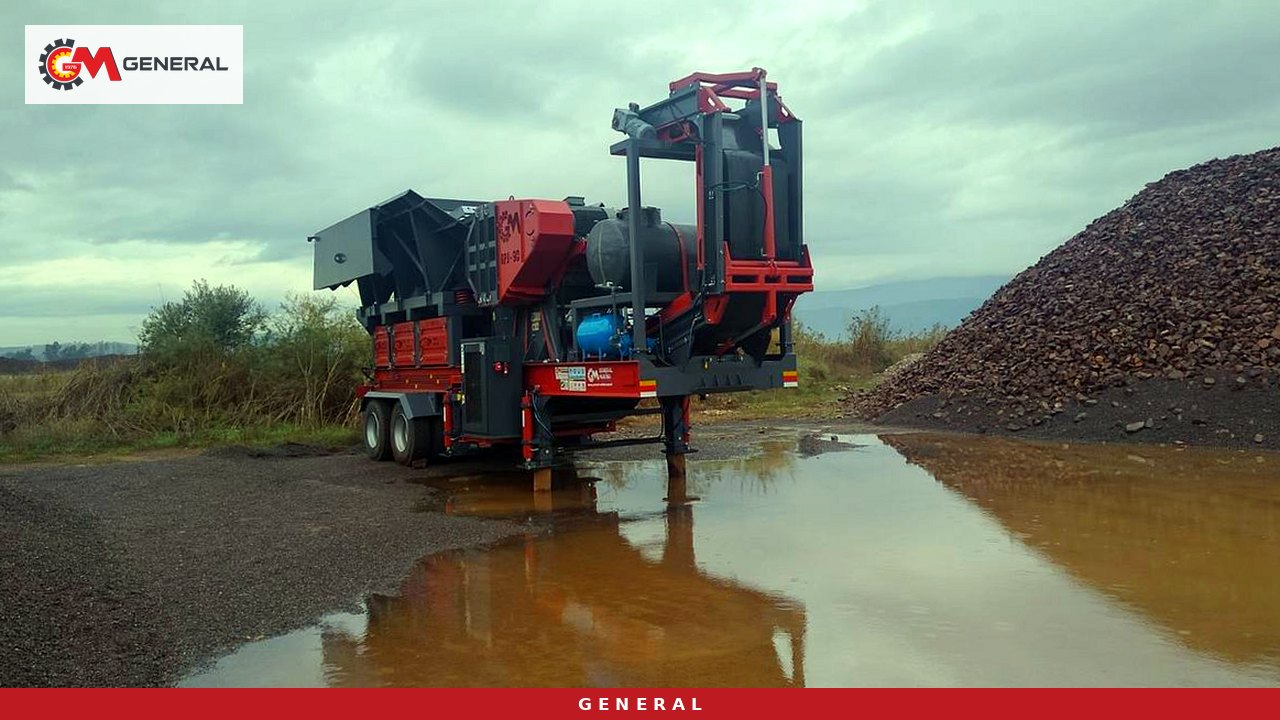
The shape of block waste: feed opening, feeder and pre-breaking
Marble sawing waste behaves differently from blasted run-of-mine rock. Thin but long slabs, flat-faced corner blocks and prisms split along joints slide down the feeder pan without rolling and can bridge the crusher mouth. The deciding dimension is therefore not the thickness of a piece but its longest edge.
Feed limits on the product pages are as follows: the M-PDK portable primary impact unit accepts 0-1200 mm and the GNR portable primary jaw unit accepts 0-1100 mm. On the vibrating grizzly feeder the maximum feed size is 1500 mm and hopper capacity ranges from 15 to 100 m³. Block pieces above these limits are reduced in the quarry by an excavator with a hydraulic breaker. The machine hours spent on pre-breaking do not appear in the crusher quotation, but they add directly to cost per tonne.
On the portable jaw unit an armour-lined feeder, replaceable armour plates and raisable side boards are standard. When a loader drops block waste into the hopper, the armour takes the first impact, and the raisable side boards limit long pieces spilling over the hopper. If you state your longest piece size and bucket volume at quotation stage, hopper details can be finalised accordingly.
What "heavy-duty" means on a quotation sheet
Do not read "heavy-duty" as a capacity or service-life promise. In marble and mining quarries the term should be tied to four mechanisms: a feed opening that takes large, angular pieces; a hopper and feeder armoured against impact; a crushing principle and wear-part alloy chosen for the abrasiveness of the rock; and pre-screening that keeps fines and soil out of the crusher. What you gain under which condition depends on the material; the same unit wears differently in clean limestone and in marble with siliceous veins.
The crushing principle is decided with a sample. According to the M-PDK product page, the unit's ideal field is low-silica, brittle rock such as limestone and dolomite; the impactor gives up to 20:1 reduction in limestone. In high free-quartz basalt and granite the impactor works, but wear accelerates sharply. In mines, the side rock that comes with the ore often falls into this second group; in that case a compression-type jaw primary is the right starting point. The jaw unit's typical reduction is 4:1-9:1, so a second stage is needed behind it for finer product.
Portable primary unit matrix by rock and site type
| Site / material condition | Unit | Capacity | Feed | Product | Motor | Weight |
|---|---|---|---|---|---|---|
| Clean marble waste, limestone, dolomite; high tonnage | M-PDK01 | 250-500 t/h | 0-1200 mm | 0-70 mm | 315 kW | 50,000 kg |
| Same material; medium tonnage | M-PDK02 | 200-300 t/h | 0-1200 mm | 0-70 mm | 250 kW | 45,000 kg |
| Marble with siliceous veins, abrasive mine waste | GNR 110 (GNRK 110 jaw) | 180-300 t/h | 0-1100 mm | 0-250 mm | — | 55,000 kg |
| Small quarry or pilot production; abrasive rock | GNR 90 (GNRK 90 jaw) | 70-180 t/h | 0-1100 mm | 0-250 mm | — | 25,000 kg |
| Clayey, wet stripping mix | Jaw unit with wobbler feeder | 250-450 t/h | — | — | — | — |
The last row covers a situation common in mines: while overburden is removed, clay and wet soil mix with the rock and the bars of a grizzly feeder blind. On a wobbler feeder the material tumbles over rotating shafts, so clay and fines separate; cleaner material reaches the jaw and plate life is extended.
A modular line: pairing primary and secondary on separate chassis
What separates portable units from a complete plant is that each stage sits on its own chassis. As the quarry advances you can leave the primary at the face and keep the secondary near the stockpile, or start with a primary only and add stages as needed. The whole family is on the portable rock crushers page.
Check two rules when pairing. First, size compatibility: the M-DMK portable secondary impact unit accepts 0-350 mm feed and delivers 0-50 mm; the 0-250 mm output of the GNR jaw primary enters that mouth comfortably. Second, tonnage compatibility: two units whose capacity ranges do not overlap pull the line down to the speed of the smaller one. Based on the product-page ranges, sensible pairings are:
- GNR 110 jaw primary (180-300 t/h) + M-DMK 03 secondary (175-300 t/h, 250 kW, 45,000 kg)
- GNR 90 jaw primary (70-180 t/h) + M-DMK 01 secondary (120-180 t/h, 160 kW, 32,000 kg)
- For intermediate tonnage, M-DMK 02 (150-250 t/h, 200 kW, 38,000 kg)
The M-DMK feeder table carries a screen and a by-pass conveyor, so soily fines are sent to stock before entering the crusher. The unit stands out in producing road sub-base and stabilised material from limestone and marble waste. In highly abrasive rock such as basalt, blow-bar life shortens and the page recommends a cone or cubicizer alternative. If the line needs full gradation and screening at a single point, a screened complete mobile crushing and screening plant may be the shorter solution than portable units.
Transport, set-up and relocation inside the quarry
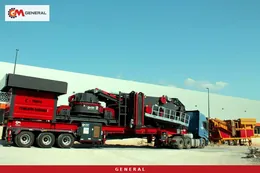
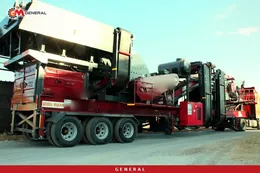
The M-PDK and the GNR jaw unit sit on a single chassis and are towed by one truck. The jaw unit is commissioned without foundations using hydraulic cylinders. Weights on the product pages are 50,000 kg for the M-PDK01, 45,000 kg for the M-PDK02 and 55,000 kg for the GNR 110. These values govern bridges, culverts and ramp gradients on the haul road. Road transport permits and weight limits vary by country; confirm local regulations with the relevant authority.
In quarries where the crusher moves several times a week, the tracked option deserves a look. The GM 90JP tracked jaw crusher works at 70-180 t/h with a GNR 90 jaw (95 kW), accepts feed up to 700 mm, and has a 10 m³ hopper, a 250 kVA power unit and a weight of 35,000 kg; it needs no ground preparation or concrete foundation. There is a trade-off: the 700 mm feed limit means more pre-breaking of block waste than with wheeled portable units. Decide on the balance between relocation frequency and pre-breaking hours.
Wear parts and tramp metal in mining quarries
In a mine, more than rock enters the crusher: drill bit fragments, broken bucket teeth and wire rope scraps can mix with run-of-mine feed. The M-PDK product page separates blow-bar choice accordingly: high-chrome white iron for clean, abrasive feed; manganese or martensitic alloy where tramp iron is a risk. A marble quarry working clean material and a mining operation with metal risk in its waste should order the same unit with different alloys.
On the jaw unit, the jaw plates are austenitic manganese steel (Mn13/Mn18) that work-hardens under impact, which suits a jaw handling large, angular block waste. There is also a distinction on the belt below an impactor: the conveyor page lists standard belting as EP 100 – 4 ply and EP 125 – 4 ply under impact crushers. Check in the quotation that the first belt at the crusher discharge is of that class.
Read warranty cover with the same eye: General Makina products carry ISO 9001 and CE certification and a 1-year warranty; wear parts are excluded. What really determines blow-bar, jaw plate and grizzly bar life is your material and your alloy choice.
Checklist before requesting a quotation
- Have a silica analysis done on a sample taken from the worst zone of the quarry; it decides impact or jaw.
- Measure the longest edge of your block waste and the excavator's pre-breaking capacity.
- Put daily target tonnage, truck trip time and payload per trip into the relationships above.
- Determine the clay and moisture content of stripping material; grizzly versus wobbler feeder depends on it.
- Record whether the waste carries a tramp-metal risk; blow-bar alloy is chosen accordingly.
- Clarify how often the crusher will relocate; wheeled versus tracked follows from that.
- State the target product: 0-70 mm primary product, 0-50 mm sub-base, or a full gradation requiring screening?
- Check haul road gradients, bridge and culvert limits, and road permit conditions.
Frequently asked questions
Should marble sawing waste go through an impact unit or a jaw unit?
In calcite-based marble without siliceous veins, an impact unit gives high reduction and cubical product in a single stage. If the sample shows quartz bands or mixed side rock, starting with a jaw primary lowers the wear risk.
Portable units or a complete mobile plant?
If you want to keep the primary at the face and the secondary near the stockpile, or add stages over time, portable units fit. If you need full gradation including screening at one point, a screened complete plant does the same job with less equipment.
Can road material be produced from mine waste?
The M-DMK secondary unit is aimed at sub-base and road material production. But whether the product meets the specification is set by the material, not the crusher; confirm it with laboratory testing.
What determines the price?
Unit type and model, feeder and hopper details, wear-part alloy, number and length of belts, power source and transport conditions. A project-specific quotation is prepared from your site data.
Conclusion
In marble and mining quarries, crusher selection starts with the truck cycle and the geometry of block waste; the capacity table only makes sense after those two data points. M-PDK for clean calcitic material, the GNR jaw unit for abrasive or metal-contaminated waste, and the wobbler-fed jaw unit for clayey stripping are logical starting points. Send your sample analysis, piece size and target tonnage through our contact page, and we will work out the unit configuration and quotation for your site together.
Definitions of technical terms: Glossary