EN — English
 TR — Türkçe
 DE — Deutsch
 RU — Русский
 FR — Français
 ES — Español
 AR — العربية
 SR — Српски
Blast fragmentation crusher feed size: getting the pit and the primary to agree
Throughput is decided at the face, not on the nameplate
Plants that fall short of their rating are rarely sized wrongly. They are fed wrongly. Blast fragmentation crusher feed size governs how many tonnes the primary actually sees, how long the wear parts survive and how often the chamber has to be cleared by hand. While drill-and-blast is judged on cost per drilled metre and the plant is judged on availability, nobody owns the number that connects them: the size distribution of the muckpile.
This article runs the chain in the correct direction. Establish the largest lump the plant can tolerate, choose the feeder and the intake opening that accept it, and only then design the shot so the tolerance holds. Run it backwards and the outcome is familiar: an idle primary, a queued excavator and a hydraulic breaker working all day.
Eighty percent of the opening, and why the rule holds
Standard practice limits the largest lump entering a primary jaw to roughly 80 percent of the gape, the distance between the dies at the feed opening. Parts of the engineering literature accept a band of 80 to 90 percent, but continuous production is safer at the lower figure. The reason is geometric rather than metallurgical: a lump close to the opening bridges across it instead of being drawn down, and everything behind it stops moving.
| Feed opening | 80% limit | 90% upper band | Typical duty |
|---|---|---|---|
| 600 mm | 480 mm | 540 mm | Small quarry, demolition feed |
| 800 mm | 640 mm | 720 mm | Mid-size aggregate operation |
| 1000 mm | 800 mm | 900 mm | Hard rock, coarse fragmentation |
| 1200 mm | 960 mm | 1080 mm | High tonnage stationary plant |
Read the 80 percent column as a ceiling, not a target. The bulk of the muckpile should sit well below it, with only occasional lumps approaching the limit. Distribution matters more than any single measurement: one 900 mm boulder costs a shift, a steady diet of 700 mm boulders costs a month.
The intake opening is not the closed side setting
The gape is an intake dimension. The closed side setting controls the product. They answer different questions, one about what the pit sends and one about what the next stage will accept. Verifying both separately before a jaw crusher is ordered removes half the surprises a new circuit produces in its first week.
How the shot shifts the curve
Mean fragment size moves inversely with powder factor: more explosive energy per cubic metre of rock generally produces a finer mean. The empirical fragmentation models used in mining estimate that relationship from explosive energy, a rock factor and the blasted volume. They remain approximations, and they are weakest exactly where the plant cares most, at the coarse tail where boulders live. Treat model output as a hypothesis and calibrate it against measured muckpiles.
The practical levers are burden and spacing, hole diameter, delay timing, stemming length and explosive choice. Opening the pattern saves drilling money that returns downstream as secondary breaking, reduced feed rate and faster jaw plate consumption. The trade only makes sense when both cost lines are added together.
When the rock mass decides for you
Bedding, jointing and natural fracture spacing frequently dominate the outcome. If in-situ block size is fixed by joint spacing, raising the powder factor mostly increases ground vibration and flyrock without moving the coarse tail. The right response is then not a harder shot but a feeding and scalping arrangement sized for the boulders the ground insists on producing.
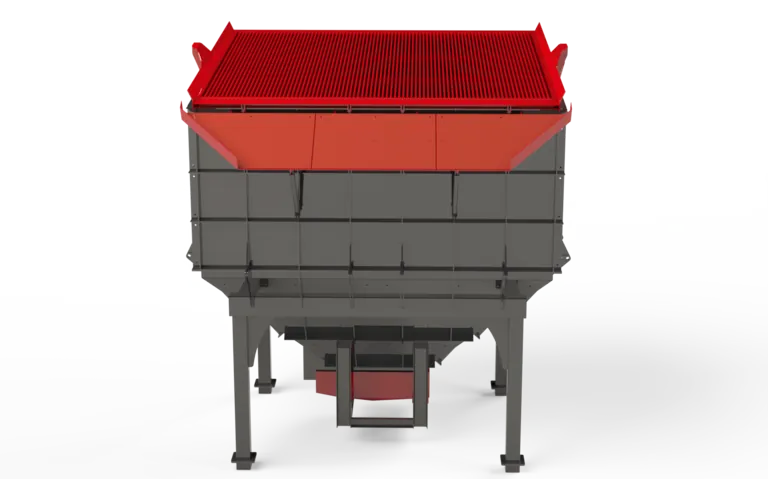
Grizzly spacing, the first filter in front of the chamber
The grizzly section of a feeder removes material that already meets product size. Common practice sets bar spacing equal to, or slightly below, the crusher closed side setting. Spacing wider than the setting sends finished material into the chamber, wasting energy, liner life and capacity that should be reserved for rock still needing reduction. Static grizzlies blind more readily; a vibrating grizzly section does the same job with fewer stoppages.
The scalped fraction varies by site and directly reduces the load reaching the crusher. Until it is measured, plant capacity cannot be calculated honestly, because tonnes tipped into the feeder and tonnes entering the chamber are different numbers.
Feed limits across the mobile range
The figures below come from series product specifications and set the ceiling the pit has to respect.
| Model | Maximum feed size | Capacity | Output setting |
|---|---|---|---|
| General 640 | 500 mm | 40-70 t/h | 0-100 mm |
| General 800 | 600 mm | 80-120 t/h | 0-100 mm |
| General 01 | 700 mm | 120-180 t/h | 0-100 mm |
| General 950 | 800 mm | 120-180 t/h | 0-100 mm |
| GNR-MC110 | 900 mm | 200-300 t/h | 0-100 mm |
| General 02 | 1000 mm | 180-250 t/h | 0-100 mm |
The table reads both ways. A pit routinely producing boulders above 800 mm will choke a 500 mm machine every shift. A pit whose muckpile stays under 400 mm has overbought if it specifies a 1000 mm intake, and pays for that twice, once in capital and again in energy.
Measuring instead of estimating
Photographic image analysis of the muckpile is the usual measurement route. Photographs taken with a scaled reference object, combined with a boulder count per bucket load, give a workable picture. Repeating the same method after every shot is worth more than one very precise measurement.
Three indicators deserve a log: breaker hours spent on secondary reduction, primary stoppages attributable to bridging, and shift-to-shift variability in feeder rate. When all three drift together, the cause sits at the face rather than in the chamber. Related plant-side decisions are collected under mining engineering.
The order of decisions
Define the product range, set the closed side setting, size the grizzly to that setting, choose an intake at least 1.25 times the largest lump the pit can realistically produce, then tune the shot so the ceiling is respected. Follow that order and the primary spends its hours crushing rock rather than clearing itself.
Common questions
What boulder percentage counts as a problem?
There is no universal threshold. Judge it by breaker hours plus primary downtime attributable to oversize. Once those two together disturb the shift plan, the proportion is too high.
Does a larger machine solve oversize?
It raises the ceiling but leaves the distribution untouched, so the bottleneck stays and the capital grows. Upsizing without fixing the face is usually the most expensive answer available.
Will more explosive always give finer rock?
No. Where joint spacing controls block size, additional energy leaves the bench as vibration and flyrock rather than as smaller fragments.
What if grizzly spacing sits below the closed side setting?
Crusher load drops, but everything scalped goes straight to the product stream. Confirm the screens and the fines specification can absorb it before making that choice.
Definitions of technical terms: Glossary