 EN — English
 TR — Türkçe
 DE — Deutsch
 RU — Русский
 FR — Français
 ES — Español
 AR — العربية
 SR — Српски
General Cone Crusher (Secondary/Tertiary)
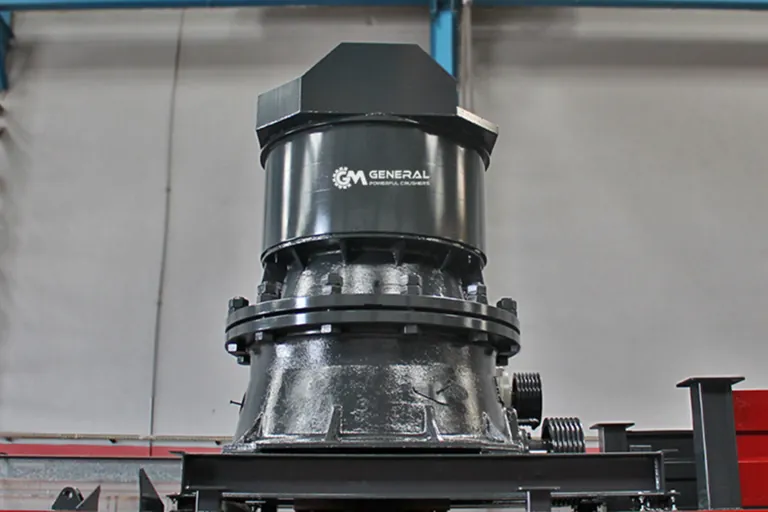
The General cone crusher breaks material by multi-directional compression between a vertically gyrating conical head and a concave liner, as a secondary/tertiary crusher. On hard, abrasive material such as basalt, granite, river stone and ore it gives cubical product at low part cost, with far lower operating cost than an impactor.
Working principle
Material is crushed several times between the concave and the eccentrically gyrating head until it passes the set minimum opening, moving down by gravity. Product size is set by the hydraulic CSS; a hydraulic cylinder protects against sudden packing. Stage: secondary/tertiary/quaternary.
Configuration and technical values
A standard liner suits the secondary stage, a short-head liner the tertiary/quaternary stage; choke feeding is preferred. Order-of-magnitude: secondary reduction 6:1–8:1, tertiary ~10:1; feed 50–250(300) mm; product 0–60(75) mm; power 90–500 kW. Model-specific capacity/power/weight/CSS tables are provided per project; request a quote for exact values.
Material and application
Best for: basalt (Ai~0.20), granite (Ai~0.55), river gravel, ore and slag — any high-silica, abrasive material where an impactor is uneconomical. Compression lowers dust and wear. Less suited: very soft limestone, where an impactor gives higher reduction.
Wear parts and TCO
Wear parts are the mantle and concave (cone liners), usually manganese steel, or high-chrome for high silica. Compression means less wear, lower spare-part cost and low cost per tonne — the core of the cone-vs-HSI TCO case on abrasive rock.
The cone crusher is the secondary core of a full plant with a jaw primary and VSI cubical finish; we supply the complete line and concrete batching from a single source.
Frequently Asked Questions
What is a cone crusher used for?
Secondary/tertiary crushing of hard, abrasive rock such as basalt, granite and gravel.
Why a cone instead of an impactor?
Compression protects the metal; wear and spare-part cost are far lower.
What is the reduction ratio?
Secondary 6:1–8:1, tertiary ~10:1.
How is the CSS set?
By the hydraulic setting mechanism; a hydraulic cylinder protects against sudden packing.
How can I get a quote?
Send us your capacity and material; we provide model tables and a project-specific quote with a full-plant solution.
Wear and spare parts: Spare & Wear Parts
Definitions of technical terms: Glossary
Gallery


Similar Machines
Related Searches
Request a Quote for This Product
Fill in the form and our team will get back to you with a tailored quote.
ISO 9001:2015 · CE · EAC · Since 1976