EN — English
 TR — Türkçe
 DE — Deutsch
 RU — Русский
 FR — Français
 ES — Español
 AR — العربية
 SR — Српски

Choosing the Crusher Type for a Crushing Plant: Jaw, Impact and Cone Crusher Differences
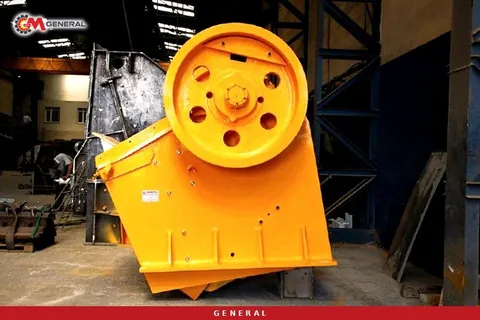
In a crushing and screening plant, crusher type is not a single-machine decision; it is a decision about the chain of stages that runs from the feed hopper to the stockpile. Jaw, impact and cone crushers break the same rock with three different forces, and each fits a different link in that chain. Rather than praising each type in turn, this article looks at which site data makes a given type unavoidable, what changes when two plants of identical capacity use different secondary crushers, and which questions you should settle before asking for a quotation. All models are listed together in the crushers category.
Three crushers, three breaking forces
A jaw crusher squeezes rock between a fixed jaw and a moving jaw swung by an eccentric shaft. The cavity is wide at the top and narrow at the bottom; rock moves a little lower with every stroke and drops out by gravity once it is small enough to pass the closed side setting (CSS). This geometry exists to accept large run-of-mine rock, which is why the jaw is almost always the first machine in the line.
An impact crusher does not squeeze; it throws. Blow bars on a horizontal rotor strike the material and fling it against breaker plates, where it shatters. Because particles split along their weakest planes, the product comes out cubical and a high reduction is achieved in one pass. The price is that wear concentrates on the blow-bar edges.
A cone crusher also crushes by compression, but in a circular chamber and from several directions: the conical head gyrates eccentrically inside the concave liner, and material is crushed repeatedly until it passes the set minimum opening. A cone is therefore not a primary machine; it takes the jaw's coarse product and refines it in the second and third stages. The General cone crusher page defines its stage as secondary, tertiary and quaternary.
Five pieces of site data that start the selection
Before opening a catalogue, collect the following from the site. Crusher type emerges where these data intersect, not from habit or from what the neighbouring quarry runs.
- Top feed size: the largest block delivered by blasting or the excavator. On a jaw crusher the largest accepted lump is roughly 0.8–0.9 times the feed opening width, and the primary machine is sized from that ratio.
- Abrasiveness: silica content and the Bond abrasion index (Ai). Take the sample from the hardest part of the quarry face; the plant will have to crush that section too.
- Product specification: which fractions, with what cubicity requirement? In concrete and asphalt aggregate, a flakiness limit can change the type of the second stage.
- Clay and moisture: wet, sticky feed packs a jaw cavity. In that case plan scalping or washing ahead of the crusher.
- Tonnage and operating pattern: target hourly output and whether the plant stays on one site or moves between sites. This question also brings the stationary-versus-mobile decision with it.
The stage chain: primary output must match secondary input
The point most often skipped in type selection is the interface between two machines. If the primary's output range does not fit the feed range of the secondary, the second machine either starves or chokes. On the GNRK series jaw crushers the output ranges are 40–130 mm for the GNRK 60, 70–180 mm for the GNRK 90 and 150–225 mm for the GNRK 110.
The cone crusher's feed range is of the order of 50–250 (300) mm. The GNRK 90 output sits comfortably within it. The GNRK 110 output approaches the upper part of the range, so with that pairing the jaw setting and the cone liner type have to be considered together. On the secondary impact side, the GNR DMK series accepts a maximum feed of 800 mm and therefore takes the same jaw output with a much wider tolerance. A cone, on the other hand, performs best when choke-fed with a full cavity, so the surge hopper and conveyor between the stages must be sized to keep that feed continuous.
Reduction ratios also guide the chain. A jaw crusher typically gives 4:1–9:1. A cone gives 6:1–8:1 in the secondary stage and about 10:1 in the tertiary stage. The DMK secondary impactor delivers about 10:1, while the PDK primary impactor can reach up to 20:1 on limestone. In short, reaching fine fractions in hard rock usually takes one more stage; in soft rock the impactor's high reduction can remove a stage.
Same capacity, different secondary: General 944 and General 950
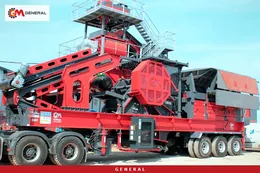
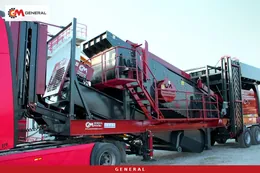
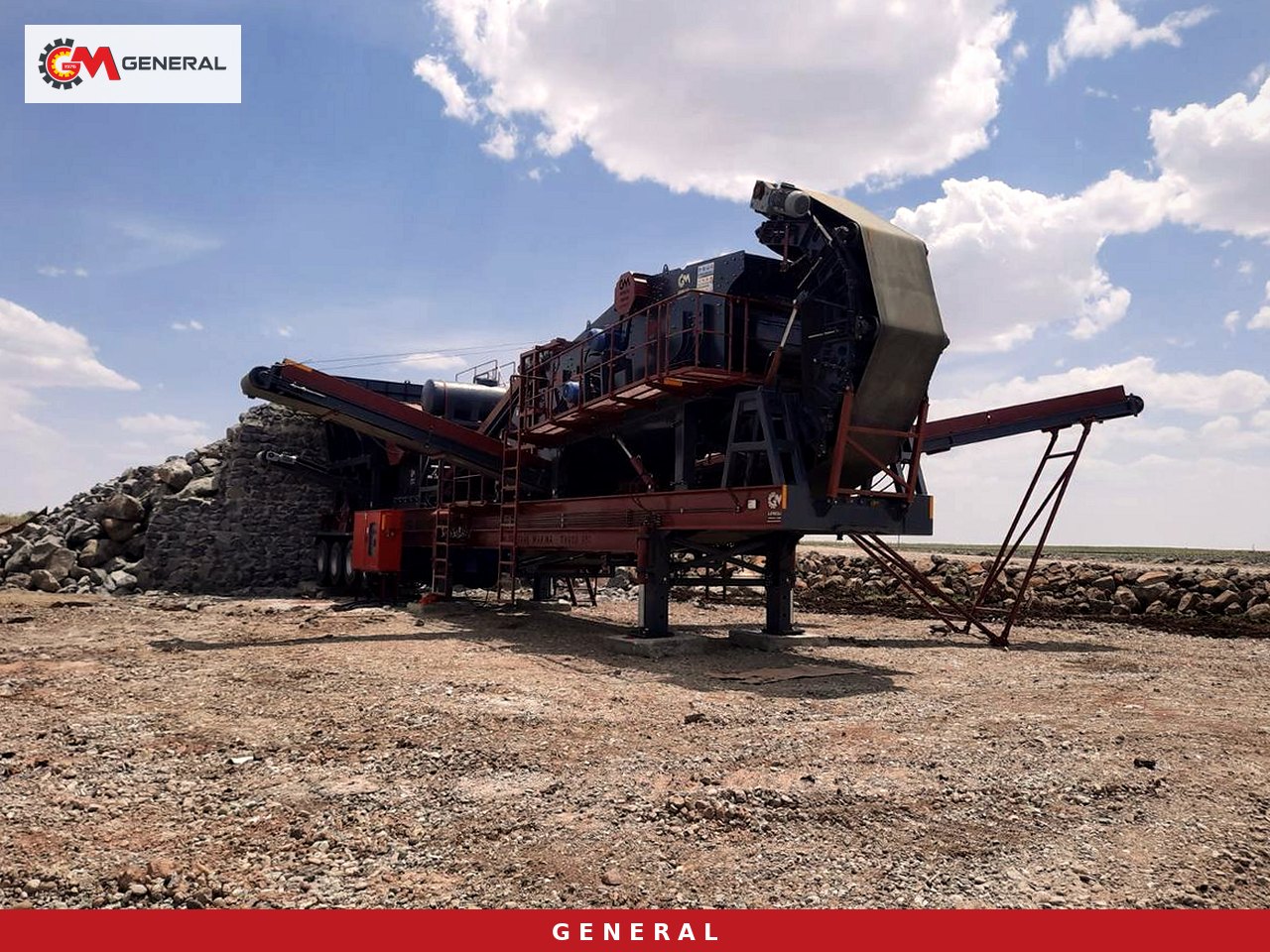
The clearest illustration of the type difference is two mobile plants carrying the same primary crusher. Both the General 944 and the General 950 use a GPJ 90 jaw as primary; both have 120–180 t/h capacity, 800 mm maximum feed and a weight of 70,000 kg. The difference is in the secondary: the 944 runs a GM430 cone, the 950 a DMK01 impact crusher. We added the General 800, which works with a single primary impactor, for comparison.
| Parameter | General 944 | General 950 | General 800 |
|---|---|---|---|
| Primary crusher | GPJ 90 jaw | GPJ 90 jaw | PDK 1280 primary impact |
| Secondary crusher | GM430 cone | DMK01 impact | — |
| Capacity | 120–180 t/h | 120–180 t/h | 80–150 t/h |
| Maximum feed | 800 mm | 800 mm | 600 mm |
| Screen | 1600×5000 mm, 3 decks | 1600×5000 mm, 3 decks | 1300×4000 mm, 3 decks |
| Generator | 550 kVA | 600 kVA | 450 kVA |
| Weight | 70,000 kg | 70,000 kg | 35,000 kg |
| Key strength | Long metal life in abrasive rock | High reduction, cubical product | Cubical product in limestone, light plant |
On paper the 944 and the 950 seem to do the same job. According to the product pages both are configured for hard rock; the difference is one of priority. The 944's cone stage uses compression to extend metal life in high-silica rock, while the 950's impact stage gives stronger reduction and a more cubical grain. If silica content is high and the wear-part budget decides, the 944 comes first; if the particle-shape specification dominates, the 950 does. The gap in generator rating (550 kVA versus 600 kVA) belongs in the energy plan as well. The General 800 produces 80–150 t/h with a single crusher and suits those looking for a lighter solution on low-abrasion rock such as limestone. You can compare other configurations on the mobile crushing plants page.
Cone or impactor in the second stage?
Since the primary is almost always a jaw, the real type decision is made at the secondary. The two options have different conditions that must be met for them to work properly.
Three operating conditions for a cone crusher
- Choke feed: if the cavity runs half-empty, particle shape suffers and the liners wear unevenly. A surge bin or a steady feed conveyor should sit in front of it.
- Correct liner: a standard liner is for the secondary stage, a short-head liner for the tertiary and quaternary stages. The liner is chosen by top feed size and target fraction.
- Hydraulic CSS monitoring: product size is set with the hydraulic CSS adjustment, and a hydraulic cylinder protects against sudden packing. As the liners wear thin, the setting must be checked again for the same product.
Cone crusher power is of the order of 90–500 kW; model-specific capacity, power, weight and CSS values are provided per project. So when you request a quotation for a line that includes a cone, always attach the material analysis and the target fractions.
When does a secondary impactor win?
The impact type is strong on low-abrasion rock: the product pages give Ai of about 0.001–0.03 for limestone. On such material blow-bar life is predictable and reduction is high. The GNR DMK secondary impact crusher series is offered at 120–180 t/h and 160 kW for the DMK01 and 250–500 t/h and 500 kW for the DMK05. The DMK can produce slightly flakier grain than a VSI; if the cubicity requirement is very tight, a VSI stage is added after it. On rock whose silica content exceeds 10% or whose Ai exceeds 0.15, a cone is recommended instead of a secondary impactor. In concrete (C&D) recycling, tough manganese or martensitic blow bars are chosen against the risk of tramp metal.
Decision matrix: which type under which conditions?
| Criterion | Jaw | Impact | Cone |
|---|---|---|---|
| Stage | Primary | Primary (PDK) and secondary (DMK) | Secondary, tertiary, quaternary |
| Breaking principle | Compression | Impact | Multi-directional compression |
| Typical reduction | 4:1–9:1 | DMK ~10:1; PDK up to 20:1 on limestone | Secondary 6:1–8:1, tertiary ~10:1 |
| Granite, basalt | Suitable | Not recommended | Suitable |
| Limestone, dolomite | Suitable | Very suitable | Less suitable |
| Main wear part | Jaw plates | Blow bars and aprons | Mantle and concave |
| Critical setting | CSS | Apron gap | Hydraulic CSS and choke feed |
The matrix does not decide on its own; where a row shows two “suitable” entries, the product specification and the wear budget per tonne settle it. If the material changes along the quarry face, base the design on the values of the most difficult section.
What drives the cost
Expressing the price effect of crusher type as a single figure would mislead. A quotation is shaped by machine type, number of stages, drive power, the scope of screens and conveyors, and the metallurgy of the wear parts. When comparing two configurations, look at the operating cost per tonne alongside the purchase price:
Crushing cost per tonne = (A ÷ TA) + (P × E ÷ Q) + D
Here A is the cost of a wear-part set, TA the tonnes that set crushes over its life, P the power drawn, E the unit energy price, Q hourly output and D the share of maintenance downtime per tonne. The first term shows the effect of type selection most clearly: in abrasive rock the impactor's blow bars are changed often and the term grows; with the compression principle of jaw and cone it shrinks. In soft rock, by contrast, the impactor's high reduction can eliminate a stage, lowering P and the investment together. For long-term, single-site work the same calculation applies to stationary crushing plants. General Makina machines carry ISO 9001 and CE certification and a 1-year warranty; since the warranty excludes wear parts, term A must be planned as a separate line in the operating budget.
Frequently asked questions
Can a cone crusher be used as a primary?
No. A cone crusher's feed range is of the order of 50–250 (300) mm and it does not accept large blocks straight from the face. A jaw or impact primary goes in front of it.
Is an impact crusher never used on granite?
It can break granite, but high silica consumes the blow bars quickly and the wear cost per tonne rises. For granite and basalt a jaw + cone chain is recommended; where the particle-shape requirement is strict, a jaw + impact configuration is also considered.
Which type gives a more cubical product?
An impact crusher produces cubical grain; a cone also gives cubical product when choke-fed. If the specification is very tight, a VSI is added as the final stage.
What information should I send for a quotation?
Rock type and any analysis report, maximum feed size, target fractions, hourly tonnage, stationary or mobile preference, and the power source. Price and delivery are calculated per project from these data.
In short: for coarse, abrasive rock a jaw + cone chain comes first; for soft rock and strict particle-shape requirements a jaw + impact or a straight primary-impact configuration leads, and the sample analysis makes the final call. General Makina has been building crushers and plants in Izmir since 1976. Send us your material data and target fractions through our contact page, and we will define the stage chain and suitable models together.
Definitions of technical terms: Glossary