EN — English
 TR — Türkçe
 DE — Deutsch
 RU — Русский
 FR — Français
 ES — Español
 AR — العربية
 SR — Српски
Dust suppression system design for crushing plant
Why dust suppression system design for crushing plant work starts with a survey
Every effective installation begins with an inventory of where dust is actually born, not with a supplier catalogue. The dust generated at a primary feeder mouth is coarse and heavy; the dust liberated on a dry screen deck is fine and buoyant; the dust pushed out of a transfer chute is driven by induced air that the falling material drags with it. Three different mechanisms need three different answers, and a single spray bar bought for the whole plant will fail at least two of them.
For each point, record tonnes per hour, the moisture the material already carries, whether the release volume is enclosed or open, and how close operators stand. That table is the design brief. Skipping it produces one of two outcomes: too little coverage where it matters, or too much water everywhere.
Too much water is a defect, not a safety margin
Excess moisture blinds screen media, builds up inside crushing chambers, causes belt slip, and adds handling cost downstream. Where the product feeds a thermal process, the water has to be evaporated later and carries an energy penalty. The governing principle across the industry is to apply the smallest quantity of water that agglomerates the dust, then stop.
Three families, separated by pressure and droplet size
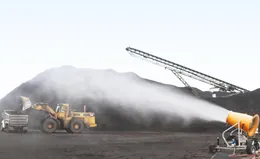
Capture efficiency rises as droplet size approaches particle size. That single fact separates the technologies.
| Family | Typical working pressure | Droplet character | Best applied at | Moisture added to product |
|---|---|---|---|---|
| Low-pressure spray bar | Below about 4 bar | Coarse droplets, wetting action | Feeder mouth, coarse transfer | High |
| Medium-pressure spray line | Roughly 10-60 bar | Medium droplets, wide cone | Belt transfer points, screen feed | Moderate |
| High-pressure fog | Above 60 bar | Mist in the tens-of-microns range | Enclosed hoppers, crusher discharge, fines | Low |
Sizing nozzles: coverage beats raw flow
A nozzle is specified by flow and spray angle together, because what matters is the footprint on the material stream. At a transfer point the cones must overlap across the full belt width, with no dry corridor at the edges. Many small nozzles mounted close to the stream outperform a few large ones mounted high: the large nozzle drives water into the product, the small one intercepts dust in the air.
Inside an enclosure, resist the urge to raise pressure. A hard jet inside a closed chute pressurises the volume and pushes dust out through every gap. There the correct answer is modest pressure combined with skirting and baffles that slow the induced air down.
Pump, pipework and the hydraulic reality
Total the flow of every nozzle that can be open simultaneously, add friction loss along the longest run and any static lift, and select the pump against that worst case. Then size the pipe so the last nozzle sees essentially the pressure the first one does. The classic field failure is a correctly chosen pump feeding an undersized line, leaving the far end of the plant dribbling instead of atomising.
If the system recirculates, the settling pond volume, the suspended solids load and the return pump belong in the same calculation. On a water-scarce site, high-pressure fog repays its higher capital cost quickly because it reaches comparable dust reduction with markedly less water.
When a wetting agent earns its place
On some rock, plain water beads and rolls off the dust particle instead of wetting it. Surfactants lower surface tension and are dosed at low concentration so the same suppression is achieved with less total volume. Treat dosage as an experimental result: measure the same point with and without the additive before writing a number into the operating procedure.
Control logic and commissioning
Running every nozzle continuously wastes water and energy. Interlock the spray valves with material presence so they open on flow and close when the stream stops. The signals already exist in the plant control panel that drives the crushers and the conveyor belt, so the addition is usually a wiring and programming task rather than a new panel.
Commission point by point. Open one branch at a time, read the gauge, confirm the cone geometry visually, and clean the strainer that is already partly blocked from construction debris. Only after that should baseline dust measurements be taken.
Maintenance is where these systems die
Most suppression systems stop working through neglect rather than failure. Coarse strainers get a weekly check, fine filters a fortnightly one, and in hard water the tips are removed and descaled on a fixed interval. Drain valves prevent freeze damage in winter. Without a written schedule the installation quietly degrades into decoration within a season.
Common questions
Does suppression replace a baghouse
No. Water-based suppression binds dust at the source; a baghouse collects dust from a ventilated volume. Enclosed plants use both, and the design document should state which point belongs to which system.
How much moisture will the product gain
It depends on the family chosen and the point treated; there is no universal percentage. Measure product moisture at feed and at dispatch, and read the acceptable ceiling from the supply contract.
Can it be retrofitted to an existing plant
Yes. Build the source inventory, measure what the existing water main can actually deliver, and commission the two or three highest-contribution points first. Further reading on the same trade-offs sits under the environment and dust control topic.
Definitions of technical terms: Glossary