EN — English
 TR — Türkçe
 DE — Deutsch
 RU — Русский
 FR — Français
 ES — Español
 AR — العربية
 SR — Српски
Fog Cannon vs Water Spray Dust Suppression
Fog cannon vs water spray dust suppression: three criteria decide it
When a crushing and screening site sets aside budget for dust control, the first question is always fog cannon vs water spray dust suppression. The answer does not lie in a brand name but in three criteria: the particle size of the dust you must capture, the volume of water the site can actually spend, and the climate the plant works in. Equipment bought before those three are settled either fails to touch airborne fines or soaks the screen underflow into unsellable mud.
Why droplet size governs the outcome
Water-based dust control works by agglomeration: a droplet collides with a dust particle, the pair becomes heavy enough to lose its suspension, and gravity brings it down. When the droplet is far larger than the particle, the airflow pushed ahead of the droplet carries the light particle around it and the collision never happens. This slipstream effect explains why a coarse hose spray does nothing for fine airborne dust. At the opposite extreme, a droplet that is too small evaporates before the captured particle settles, and the dust returns to the air. The productive band is the one where droplet size is brought close to the target dust size.
The selection question is therefore not which machine is more powerful. Respirable fines call for systems producing ultra-fine droplets; visible dust at a transfer point calls for mid-range pressurised nozzles; a wide stockpile yard calls for a cannon that carries droplets on a fan-generated air stream.
Comparison table
| Criterion | Fog cannon (fan assisted) | Nozzle spray line | Dry fog (ultrasonic) |
|---|---|---|---|
| Typical droplet range | 10-200 micron | 30-200 micron | Below 10 micron |
| Target dust | Visible airborne dust | Visible dust at the source | Respirable fines (PM10 and below) |
| Point of use | Stockyard, crusher surroundings, haul road | Feeder mouth, transfer point, screen feed box | Enclosed chute, hopper mouth |
| Water consumption | High; grows with throw distance | Moderate; local and measurable | Low; barely changes product moisture |
| Sensitivity to wind | High; drift losses are visible | Low; works close to the source | High; needs an enclosed volume |
| Compressed air requirement | Usually none | Model dependent | Required |
| Freeze protection | Drain tank and fan housing | Drain lines and purge with air | Trace heating and air drying |
Where the cannon wins and where it loses
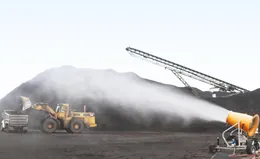
Because a cannon carries droplets on an air stream, one unit can sweep a wide area. Around a crusher discharge, at a truck tipping pocket or across an open stockyard, a single machine produces a visible result. Its weakness is drift: as crosswind builds, a large share of the mist misses the target, water is wasted and the plume can cross the site boundary. Oscillation angle and mounting height therefore matter as much as the equipment itself.
Where the nozzle line wins and where it loses
A nozzle line suppresses dust where it is generated. Nozzles set at the feeder mouth, the belt transfer point and the screen feed box wet the material surface before dust becomes airborne. Consumption is local, so it is measurable and low: each nozzle has a known flow rate and the plant total can be calculated. The weakness is maintenance. Fine orifices block with suspended solids and scale, and a line without filter servicing loses its effect within weeks.
Water consumption and the product moisture ceiling
Water is not a free input, and excess water damages the product directly. In washed sand and fine fractions, rising moisture makes material stick to belts, bridge at the silo outlet and upset the mix water calculation at a concrete plant. The practical rule is to stay at the lowest volume that still knocks the dust down. That is why local nozzles are commissioned first and wide-area equipment is added only for the residual diffuse cloud. On sites running a closed water circuit, the suspended-solids content of water returning from the settling pond dictates nozzle choice: dirty water demands large-orifice nozzles or fan-assisted equipment.
Wind, evaporation and positioning
In hot dry air small droplets evaporate before they settle, so the same equipment on the same site does measurably less work at midday than at dawn. Positioning is therefore not a one-off decision. Units are placed upwind of the dust source so that the plume covers the release point. If the wind has turned at shift start, the equipment angle must turn with it, and that step belongs in the written operating instruction. On installations that move often, trailer-mounted units are more practical than fixed pipework and fit a mobile jobsite layout without rework.
Freezing risk and winter operation
On sites that drop below zero, the water line is the most fragile part of the installation. A frozen nozzle line does not merely stop working; expanding water splits couplings, manifolds and pumps. Three measures go in before winter. First, fall: every line is laid with a slope toward a drain point and a valve at the lowest elevation. Second, purging: lines are blown down with compressed air at the end of the shift. Third, insulation: the pump room and main manifold move into a heated enclosure. Where those three cannot be delivered, winter planning should shift from water toward enclosure and extraction.
Site checklist
Six answers should be written down before the order is placed. Is the target visible dust or respirable dust? What is the flow rate and suspended-solids content of mains or pond water? When during the day does the prevailing wind change direction and speed? What is the acceptable upper moisture limit for the product? How many days per year does the site stay below freezing? Do power and compressed air actually reach the intended mounting point? Those six answers usually settle the choice on their own, and on most sites the honest answer is both: nozzles at the source, fan-assisted equipment for the residual cloud.
Definitions of technical terms: Glossary