EN — English
 TR — Türkçe
 DE — Deutsch
 RU — Русский
 FR — Français
 ES — Español
 AR — العربية
 SR — Српски
Crushing plant environmental noise limits and barriers
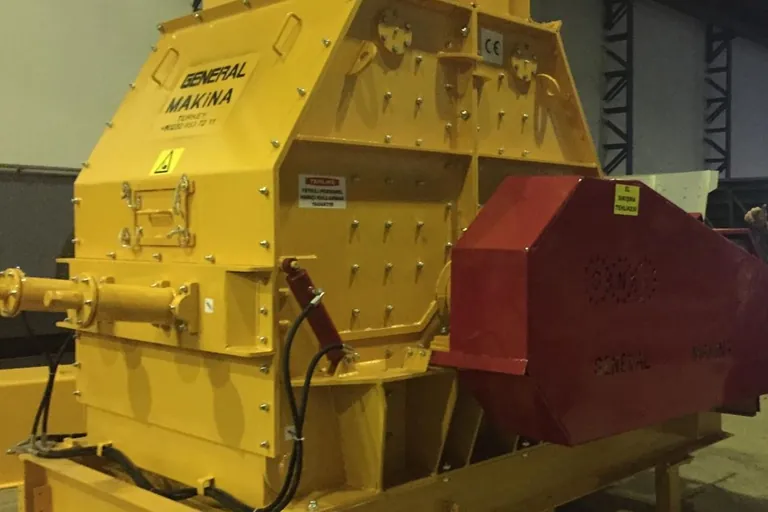
Of the two issues that put a crushing and screening plant at odds with its neighbours, one is dust and the other is sound. Crushing plant environmental noise limits and barriers is the section of a permit file that comes back for revision most often, because compliance is measured at the facade of the nearest sensitive building rather than beside the machine, and the number that applies there is not the sound power level printed in the datasheet.
Where the limit applies and what is measured
Regulations protect the receiver, not the equipment. The assessment point is therefore the dwelling, school or hospital, and the applicable value depends on how that location is zoned. The second variable is time of day: separate values are set for daytime and night, and the night figure is markedly lower. The third is the quantity itself; rules are normally written around an equivalent continuous sound level, with a separate ceiling for short peaks.
Frameworks and limit values by market
The table below places four different regulatory logics side by side as they appear in the markets we export to. The values apply at the receiver point outside the building.
| Country / framework | Area type | Daytime | Night |
|---|---|---|---|
| Germany, TA Lärm | Industrial area | 70 dB(A) | 70 dB(A) |
| Germany, TA Lärm | Commercial area | 65 dB(A) | 50 dB(A) |
| Germany, TA Lärm | Mixed area | 60 dB(A) | 45 dB(A) |
| Germany, TA Lärm | General residential area | 55 dB(A) | 40 dB(A) |
| Serbia, noise indicator regulation | Purely residential zone | 55 dB(A) | 45 dB(A) |
| Serbia, noise indicator regulation | Mixed business and residential zone | 60 dB(A) | 50 dB(A) |
| Russia, SanPiN 1.2.3685-21 | Land adjoining housing, equivalent level | 55 dB(A) | 45 dB(A) |
| Russia, SanPiN 1.2.3685-21 | Same location, maximum level | 70 dB(A) | 60 dB(A) |
Turkey follows a different logic. The environmental noise control regulation published in 2022 requires an acoustic report and an assessment of the plant's effect on noise-sensitive uses around it, instead of a single fixed table for industrial facilities. In practice the project is built around measurement and modelling rather than one threshold number. The Serbian regulation likewise gives no separate ceiling for industrial and storage zones: at the zone boundary the value of the neighbouring zone governs, so an industrial plot next to housing is effectively held to the residential figure.
What distance alone buys you
In free field conditions the sound pressure level of a point source falls by six decibels each time the distance doubles. The table below expresses that geometric spreading with the level at ten metres taken as the reference; it covers propagation only, not ground effect or air absorption.
| Receiver distance | Attenuation relative to 10 m |
|---|---|
| 10 m | 0 dB |
| 20 m | -6 dB |
| 40 m | -12 dB |
| 80 m | -18 dB |
| 160 m | -24 dB |
| 320 m | -30 dB |
The practical reading is straightforward: on a plot close to housing, moving the plant fifty metres further back usually delivers more than any wall. Layout is therefore the first and cheapest step of the acoustic design, and when a stationary plant is laid out for long-term production, deciding which end of the site carries the crushing and screening groups matters more than anything retrofitted later.
Three rules of barrier design
The first rule is line of sight. A barrier gives no meaningful benefit until it blocks the direct view between source and receiver; the moment it does, an initial reduction in the order of five decibels is typical, and the gain grows with height. The second rule concerns flanking: sound travelling around the ends of the wall, leaking through gaps at panel joints, or reflecting off a nearby surface will erase on site the benefit that appeared in the calculation. The third rule is mass, because a panel that is not heavy and sealed simply transmits sound through itself. Even with all three satisfied, the practical outdoor benefit is generally confined to a band of fifteen to twenty decibels, since ground effect and weather set the ceiling.
Treating the source is always cheaper
A barrier placed close to the source can be shorter and cheaper than one placed near the boundary. Reducing drop heights, lining steel chutes with wear rubber, isolating the screen body from its support structure and running conveyors no faster than the duty requires all lower the level at the measurement point without building anything. Because dust and sound are usually born at the same transfer points, these measures belong in the same budget as the environment and dust control package.
Frequently asked questions
Under what conditions should measurement be taken
Measure while the plant runs in its normal production regime and record the background level separately. If background sits close to the measured value, the plant's contribution cannot be separated and the report becomes contestable.
Earth bund or panel barrier
An earth bund solves the mass requirement inherently and needs no maintenance, but its base width consumes a great deal of space. A panel barrier buys height on a narrow footprint, yet sealing the joints becomes a permanent maintenance item.
What changes for night operation
Night limits are considerably lower, so a layout accepted for daytime may fail at night. If night shifts are planned, build the acoustic case directly on the night value rather than deriving it from the daytime figure.
A noise file is cheap to resolve while the layout is still on paper and expensive once the plant is standing. Send us your plot boundary, the distance to the nearest sensitive building and the planned shift pattern, and we will work through the layout and the required acoustic measures with you.
Definitions of technical terms: Glossary