EN — English
 TR — Türkçe
 DE — Deutsch
 RU — Русский
 FR — Français
 ES — Español
 AR — العربية
 SR — Српски

Respirable crystalline silica exposure monitoring program
Why a respirable crystalline silica exposure monitoring program stands on its own
The dust cloud you can see on site is not the part that matters most to health. The real risk sits in the fine fraction nobody notices: particles small enough to reach the gas exchange region of the lung. A respirable crystalline silica exposure monitoring program makes that invisible portion measurable, because owning a suppression system is not evidence of compliance — a personal sampling result is. How suppression hardware is selected belongs to environment and dust control; what follows here is the measurement and compliance chain.
What counts as the respirable fraction
The international sampling convention defines the respirable fraction through a curve with a 50 per cent cut point at 4 micrometres aerodynamic diameter. Cyclones and parallel particle impactors are built to follow that curve and must be run at the flow rate validated for the specific head. Turkish dust legislation describes respirable dust as crystalline or amorphous particles of 0.1 to 5.0 micron aerodynamic equivalent diameter. Sampling is taken in the worker's breathing zone; a static area reading never substitutes for personal exposure.
The limit is not one universal number
Different jurisdictions treat quartz differently, and a plant exporting or operating abroad has to check the rule that applies where the work happens.
| Framework | Quantity | Value | Note |
|---|---|---|---|
| Türkiye, dust control regulation | Quartz, respirable | 10 ÷ (%SiO2 + 2) mg/m³ | Eight-hour time-weighted average |
| Türkiye, same regulation | Quartz, total dust | 30 ÷ (%SiO2 + 2) mg/m³ | Half the calculated value for cristobalite and tridymite |
| Türkiye, same regulation | Inert or nuisance dust | 5 mg/m³ respirable, 15 mg/m³ total | Applies where no crystalline silica is present |
| European Union, Directive 2017/2398 | Respirable crystalline silica | 0.1 mg/m³ | Binding limit, eight-hour average |
| United States, OSHA | Respirable crystalline silica | 50 µg/m³ limit, 25 µg/m³ action level | The action level triggers monitoring and medical surveillance |
One worked example shows how the formula behaves: if the laboratory reports 30 per cent crystalline SiO2 in the respirable dust, the threshold becomes 10 ÷ (30 + 2) = 0.31 mg/m³. Change the feed material and the percentage changes with it, which is why no threshold can be fixed before the content is measured.
Six steps that make a program
- Define similar exposure groups: a crusher operator, a screen fitter, a loader driver and a weighbridge clerk do not belong in one group.
- Take personal samples in the breathing zone, over a period long enough to represent the shift.
- Calibrate the pump with the sampling head in line, both before and after the measurement.
- Weigh the filter gravimetrically, then have an accredited laboratory determine the crystalline SiO2 percentage.
- Compare the result against the threshold calculated for your own material, and never conclude from a single sample.
- Record the result together with the machines running that day and the controls in place.
Frequency and records
Periodic measurements follow an annual program built on the risk assessment. Legislation fixes minimum intervals; a site may sample more often where its own risk demands it.
| Area | Minimum frequency | Records |
|---|---|---|
| Underground production faces | Monthly | Results retained |
| Gallery driving | Every two months | Results retained |
| Other underground sections | Every four months | Results retained |
| Surface sections such as crushing and screening | Annually | Results retained |
Where quartz-bearing dust may occur, chest radiographs to the ILO classification standard are taken before employment starts and at least once a year during employment. Health surveillance is repeated at least every two years in light of the measurement results. The employer keeps records of the work performed, working periods, dust measurements and personal health files for ten years after employment ends.
When a result comes back high
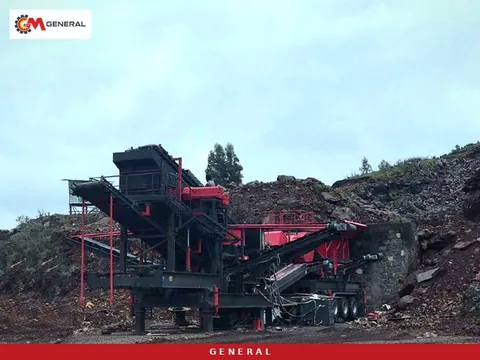
Production work may not continue in a section measured above the limit. Controls that prevent dust generation, capture it at source or suppress it are applied first; the measurement is then repeated, and work resumes once the value is documented below the threshold. Quartz operations carry extra duties: holes are drilled with water injection, and crushing, screening, grinding, cyclone and transfer sections handling fine material run as fully enclosed systems with dust collection. Enclosing a vibrating screen body and sealing transfer chutes are the details that move a sampling result more than any policy document.
Frequently asked questions
Is area monitoring enough?
Compliance is assessed on personal exposure. Area readings are valuable for locating sources but do not replace personal sampling.
We issue respirators, do we still have to sample?
Yes. Protective equipment supports controls applied at source, does not remove the monitoring duty, and only works when the filtration performance of the mask is actually known.
Why must the SiO2 percentage be re-determined?
Because the threshold depends directly on it. When the face, the blend or the product mix changes, the percentage changes and the old threshold no longer applies.
When you put this year's program into the calendar, write three columns: exposure group, sampling date, responsible person. For the enclosure work on your crushing and screening line, our team can review the existing layout and produce a point-by-point sealing list.
Definitions of technical terms: Glossary