EN — English
 TR — Türkçe
 DE — Deutsch
 RU — Русский
 FR — Français
 ES — Español
 AR — العربية
 SR — Српски

PLC Automation for a 150-375 TPH Stone Crushing Plant
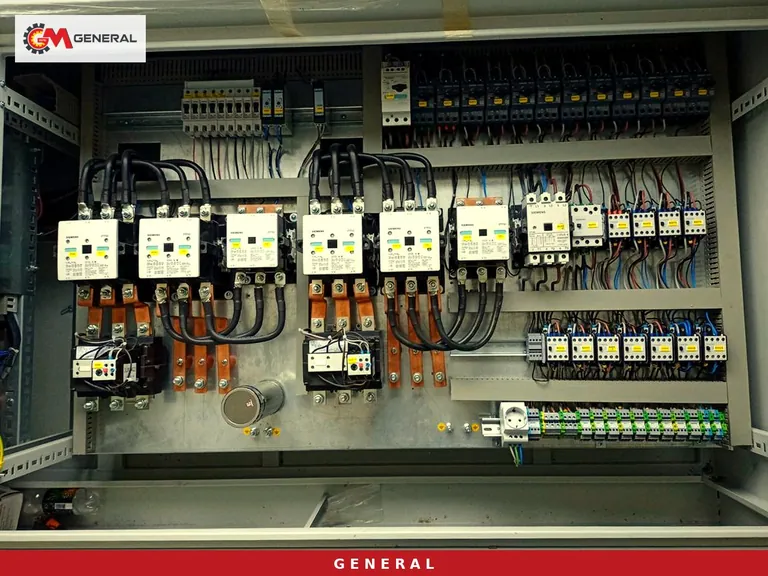
On a crushing and screening plant running anywhere from 150 to 375 TPH, one operator cannot watch the feeder, two crusher amp readings, the conveyors under the screen and the stockpile cones at the same time. The bigger the line, the bigger the margin for error: a conveyor started out of sequence, material dropping into a full secondary crusher or an unnoticed belt drift can cost hours of downtime. This article treats PLC automation as the logic of the machine layout on site rather than as a software package. Using real models, it shows where each signal comes from, which motor stops on what condition and what belongs in the automation specification at order stage.
Line logic starts on paper: start-up order and interlock table
The first document of an automation project is a table, not a drawing. The rows list every motor on the line (feeder, primary crusher, secondary crusher, screen, each conveyor, any washing unit); the columns state which motor has to be running before that one may start. On crushing lines, start-up runs against the direction of material flow: stockpile conveyors first, then the screen, the secondary crusher, the primary crusher and finally the feeder. Shutdown follows the same logic; when one machine stops, every stage before it stops on its own. No belt ever starts under load and no material falls onto a choked crusher.
This table is the skeleton of the PLC program. If it is incomplete, for example if a side conveyor is left off the interlock list, undersize material piles up on a stopped belt and the morning shift starts with shovels. The table should be signed by both manufacturer and operator together with the plant layout, and each row is tested one by one during commissioning.
Machine selection and automation scope for 150-375 TPH
No single machine covers the range in the title. Single-chassis jaw lines work at the lower end; large wheeled plants with a primary impactor, or a fixed line, work at the top. Automation scope changes with them: a single-crusher line has one current value to watch, while a jaw plus secondary layout links two crusher currents and the conveyor between them. Figures in the table below come from the product pages of the models listed.
| Model / line | Capacity | Crusher layout | Power source | Main signals tied together by the automation |
|---|---|---|---|---|
| General 944 | 120-180 t/h | GPJ 90 jaw + GM430 cone | 550 kVA generator | Two crusher currents, feeder speed, three-deck screen |
| General 950 | 120-180 t/h | GPJ 90 jaw + DMK01 impactor | 600 kVA generator | Two crusher currents, feeder speed, transfer conveyor |
| GNR-MC110 | 200-300 t/h | GPJ 110 jaw + DMK03 impactor, two chassis | 750 kVA generator | Primary and secondary groups able to run separately |
| General 02 | 250-300 t/h | GPS 1413 primary impactor | 660 kVA generator | Rotor current, feeder ahead of the 1000 mm inlet |
| General 03 | 250-375 t/h | GPS 1415 primary impactor | 750 kVA generator | Rotor current, 2400×5000 mm four-deck screen, folding conveyors |
| Fixed line | GNR PDK01: 250-500 t/h | GNR 140 feeder + GNR PDK01 primary impactor | — | 315 kW crusher motor, 2x9.2 kW feeder, many stockpile conveyors |
For 150-180 TPH the General 944 and 950 are the candidates, and the choice between them depends on the rock more than on automation (cone secondary for abrasive stone, impact secondary for cubical product and high reduction). Between 200 and 300 TPH the twin-chassis GNR-MC110 brings an extra benefit on the control side: because the primary group can run alone, the PLC program is written as two independent groups plus one linking interlock. Up to 375 TPH the General 03 does the job on a single chassis. If higher tonnage and eight or more product sizes are required, fixed crushing plants come into play, and the number of panels and the cable routes become part of the project. All wheeled options are listed under wheeled mobile crushing plants.
Feeder, crusher current and bin level: how they are linked
Feed regularity is one of the biggest variables in a crushing line's output. A choke-fed crusher mouth gives better particle shape and even liner wear. A crusher running empty or overloaded spoils both the product and the liners. This is where automation pays back most.
Feed rate set by the current threshold
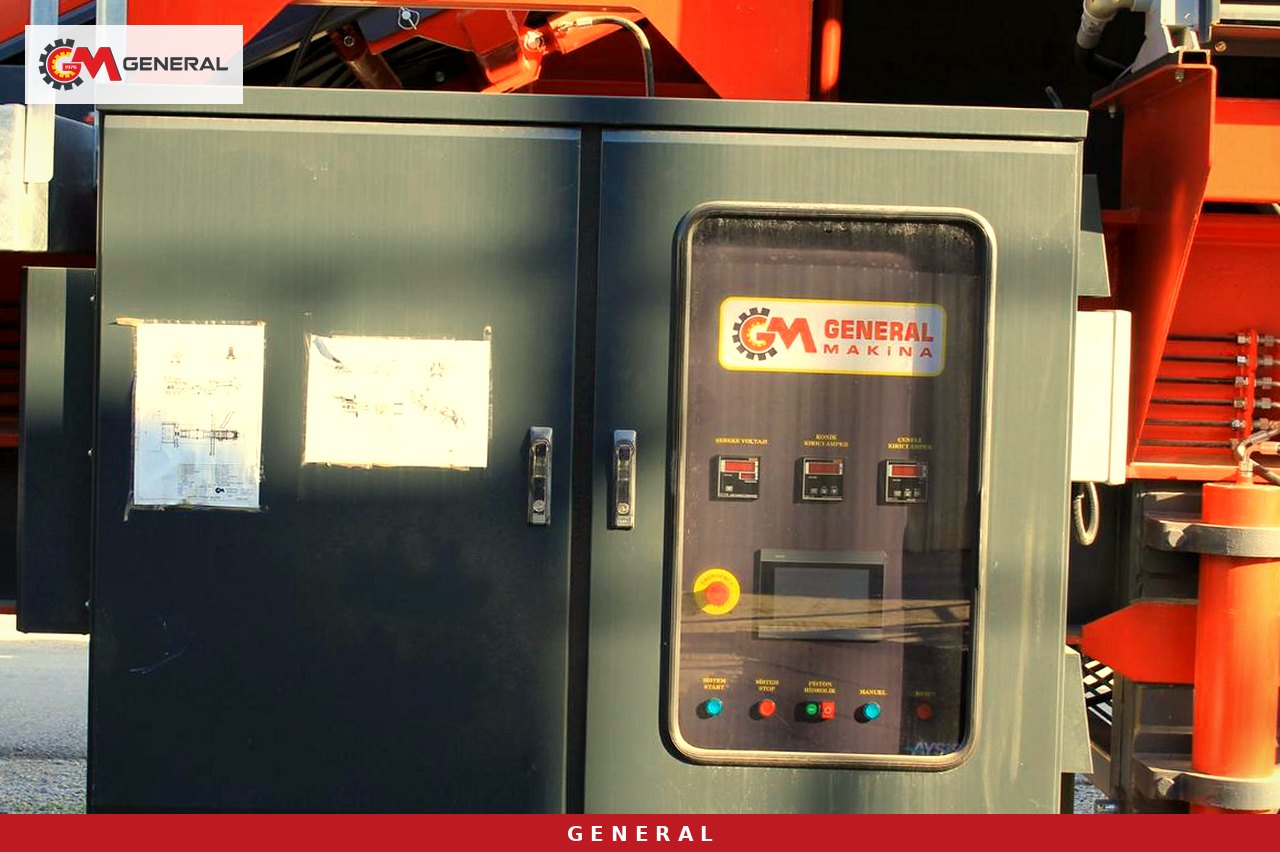
The variable frequency drive (VFD) in the motor control centre adjusts feeder speed to the current drawn by the crusher. As crusher current approaches its threshold the feeder slows down; once current is back to normal the feed rate rises again. When this loop is closed between a jaw crusher and a vibrating grizzly feeder such as the GNR 110 (200-300 t/h, 2x7.5 kW), the operator stops fiddling with the potentiometer. Thresholds differ by crusher type and are tuned with real material during commissioning; the catalogue current is a starting point, not the final word.
Surge bin and secondary crusher
In a jaw plus secondary layout the primary and secondary crushers do not run at the same rate. A level sensor in the bin or on the conveyor between them tells the PLC that the secondary is full; the PLC slows the feeder first and stops it if needed. Without that signal the primary floods the secondary and the problem only shows when a belt slips. The mechanical side of blockage and overload is covered in our article on preventing blockage and overload in mobile crushers.
Field signals and the safety circuit: settle them before ordering
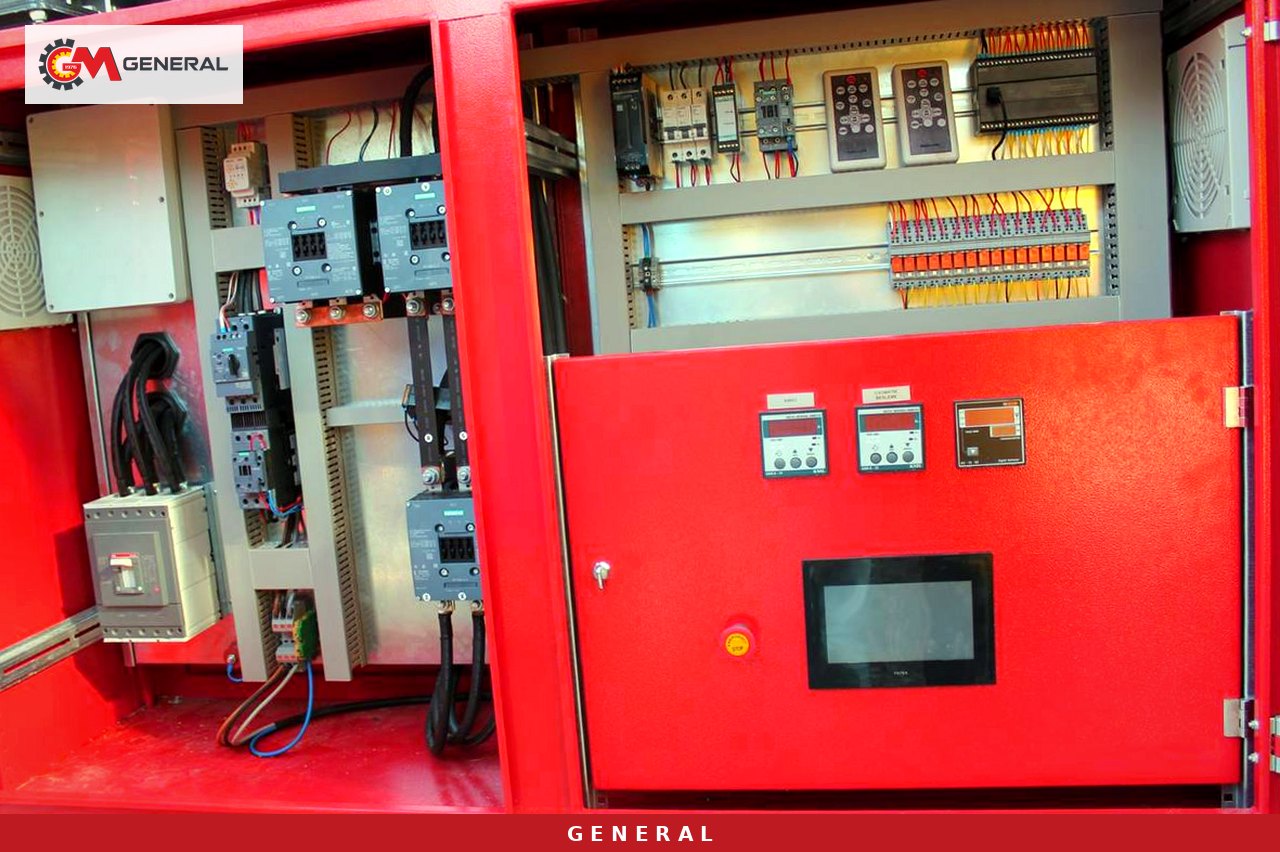
A PLC is only as smart as the signals that reach it. "Automation included" on a quotation is not enough; the list should show which sensor goes where. The General Makina automation and control system covers level sensors, belt drift and speed switches, temperature and vibration sensors and load cells.
Belt drift and speed switches
On long stockpile conveyors a drift switch detects the belt running off the frame, and a speed switch detects the belt slipping while the drive pulley still turns. At 375 TPH, material spilling off a belt edge wraps a pulley in minutes. Each of these switches is a separate row in the interlock table: when it trips, that conveyor and every machine before it stop.
Vibration, temperature and weighing
Temperature and vibration sensors on screen and crusher bearings warn of a fault before something breaks. A load cell on the main product conveyor logs shift tonnage automatically. Production reported without weighing is a figure estimated from truck counts, and it is not good enough to calculate wear cost per tonne.
The safety circuit is wired independently of the PLC
Emergency stop buttons, pull-cord switches and guard sensors are wired straight into the safety circuit. When this circuit opens, the equipment concerned stops whatever command the automation is sending. The separation is deliberate: a software bug, a changed parameter or a frozen screen must never affect personal safety. The question to ask at order stage is simple: does the emergency stop signal pass through a PLC input, or does it drop the contactors directly? The right answer is the second; the PLC only logs which button was pressed.
The lock-out/tag-out (LOTO) procedure used during maintenance runs through the same circuit. While crusher liners are being changed, the main isolator is padlocked and tagged, and no command from the cabin can turn that motor. Running a continuous pull-cord along both sides of long conveyors is a small item in the initial investment; adding it later means drilling the conveyor frame again.
Panels, generators and remote monitoring on distant sites
Most wheeled plants of this size work far from the grid on their own generator: the General 03 carries a 750 kVA power unit, the General 02 a 660 kVA unit. Starting every motor at once on a generator-fed line drags the voltage down; sequential start-up is needed here to protect the generator as much as to manage material flow. On large motors, the choice of starter (soft starter or frequency drive) should be made together with the generator rating.
On hot, dusty sites in the Middle East and North Africa, panel temperature is a separate topic. Filtered fans, an internal thermostat and, if needed, an air conditioner are measures that can be chosen per project; placing the panel door on the leeward side extends filter life. Cable trays and terminal entries are the first way in for dust.
Once the automation panel is networked, shift reports, tonnage produced, downtime and alarm history are logged. When a fault occurs, the service team can review the alarm records over the connection and reach a first diagnosis without visiting the site. Two ratios from these records are a good start for the operator: actual running time divided by planned shift time (availability) and shift tonnage divided by actual running hours (real hourly capacity). Hypothetical example: if the alarm log shows 1.5 hours of downtime in a 10-hour shift, hourly capacity is calculated over 8.5 hours; the gap to catalogue capacity points to feed-related or conveyor-related stops.
What to write into the automation specification
Settling PLC and SCADA scope at quotation stage heads off arguments during commissioning. You can attach the list below to your enquiry:
- Motor list and an interlock table for every motor (which motor starts and stops on which condition).
- Operating modes: fully automatic, manual or automatic from the cabin, and remote control.
- Which crusher current the feeder speed is tied to and how thresholds are tuned at commissioning.
- Sensor list: positions of level, belt drift, belt speed, temperature, vibration and load cell sensors.
- Confirmation that the safety circuit is wired independently of the PLC, and the length of the pull-cord line.
- Starting method of large motors when running on a generator.
- Panel cooling, dust sealing and layout inside the cabin.
- Reporting: the format for shift tonnage, downtime causes and alarm history.
- Delivery of the software backup, electrical drawings and terminal list.
Options by category are shown on the PLC and SCADA plant automation page.
Frequently asked questions
Can PLC automation be added to an existing crushing line?
Yes, but the scope depends on the site. The motor control panel usually has to be renewed, sensors fitted and cable routes opened. The existing motor list and single-line diagram are drawn up first, and the interlock table is written on top of them.
Does automation raise capacity?
It does not change the mechanical capacity of the crusher. What it changes is how close the line gets to catalogue capacity: with regular feed the crusher spends less time empty or overloaded, and because conveyor stops are logged, their cause can be found.
What happens if the operator wants to run manually?
Manual mode can be selected from the cabin. The interlock table stays active in manual mode as well; if the operator stops a conveyor, the stages before it still stop. The safety circuit is never bypassed in any mode.
What sets the price of the automation?
Motor count, the sensor list, which motors get frequency drives, SCADA and remote monitoring scope, panel cooling and cable length set the price. For a firm figure, request a quotation with the plant layout and motor list.
Decision and next step
For a 150-375 TPH line, automation belongs on the same table as machine selection. Choose the layout for your rock and tonnage first, then put the motor list, interlock table and sensor positions into the same quotation file. General Makina has built crushing and screening lines and their control panels together in Izmir since 1976; the machines carry ISO 9001 and CE certification and a 1-year warranty excluding wear parts. Send your plant layout and target products through our contact page and we will work out the right layout and automation scope with you.
Definitions of technical terms: Glossary