EN — English
 TR — Türkçe
 DE — Deutsch
 RU — Русский
 FR — Français
 ES — Español
 AR — العربية
 SR — Српски

Guinea Bauxite Heavy-Duty Jaw Stone Crushing Plant 250-450 TPH
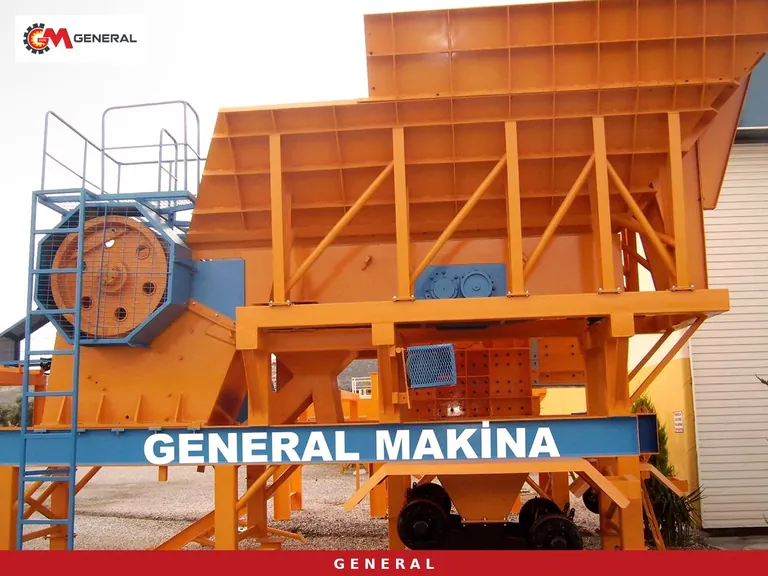
Along the Boké, Sangarédi and Kamsar corridor in north-western Guinea, bauxite comes out as a lateritic deposit lying just below the plateau surface, capped by a hard, iron-rich crust. For a primary line that has to handle 250-450 tonnes per hour, the real problem is therefore not the hardness of the ore; it is that rock-hard crust slabs and rain-softened clayey bauxite land in the same hopper during the same shift. This article explains why we choose a jaw crusher for that kind of feed, which GNRK model fits which tonnage, how to decide on the feeder between the dry and wet seasons, and what data should be collected on site before asking for a quotation.
Every model value in this article is taken from our product catalogue. We give no information on any mining licence, tender or operator in Guinea; please confirm the size specification, shipping requirements and site rules with the relevant mine operator or tender documents.
Bauxite in the Boké-Sangarédi belt: variability, not hardness, is what tests the jaw
A lateritic bauxite profile usually shows three zones: an iron-oxide-rich crust at the top that can be very hard in places, the porous bauxite ore in the middle, and a soft zone grading into clay at the bottom. Because neither the excavator nor blasting can separate these zones cleanly, the pile reaching the crusher mixes large hard blocks, earthy fines and moist lumps. The compression action of a jaw crusher suits this mixture well: it breaks the hard crust block without turning the soft ore into needless dust.
Ferruginous crust and the oversize block risk
Depending on how it is ripped, the plateau crust can arrive as slabs larger than one metre. The feed opening of the primary crusher must be chosen so that the largest block is gripped comfortably. The practical rule for jaw crushers is that the maximum feed size is about 0.8-0.9 of the opening width. Anything larger bridges the mouth and forces the operator to stop the line and work on top of the crusher. Recording the size of the largest crust pieces over several weeks is therefore the first task before any crusher is selected.
Clayey feed in the rainy season
Coastal and inland Guinea has a long and intense rainy season. During it, the clayey bauxite from the lower zone takes on moisture, sticks between grizzly bars and builds up layers in the crusher cavity. A line that runs smoothly in the dry season starts losing capacity at the same pit once the rains begin. What defines a heavy-duty line is that it is designed to absorb this difference between the two seasons.
Two seasons, one crusher: choosing the feeder for the site
Even with the same jaw crusher, the feeder in front of it changes how the line behaves. In the dry, dusty months, when the harmattan wind from the Sahara is felt, a vibrating grizzly feeder works well: the GNR grizzly feeder bypasses fines and soil around the crusher and delivers the large blocks at a rate that keeps the mouth full. The catalogue gives 200-300 tph feed capacity for the GNR 110 and 350-600 tph for the GNR 140; both accept a maximum feed size of 1500 mm.
In the wet season, however, a fixed-bar grizzly tends to blind. In a pit with a high share of the clay zone, the GWB1136 wobbler feeder is the safer choice: its rotating shafts with elliptical discs separate fine, sticky material underneath while cleaning themselves. The GWB1136 is 1100 mm wide and 3600 mm long, has an 18.5 kW motor and, with its motor-gearbox-chain drive, a feed capacity of 75-600 tph. Which feeder to choose depends on the share of the clay zone in the pit and on whether production must continue through the rainy season. You can compare all options in the crusher feeders category.
Matching models to 250, 350 and 450 TPH targets
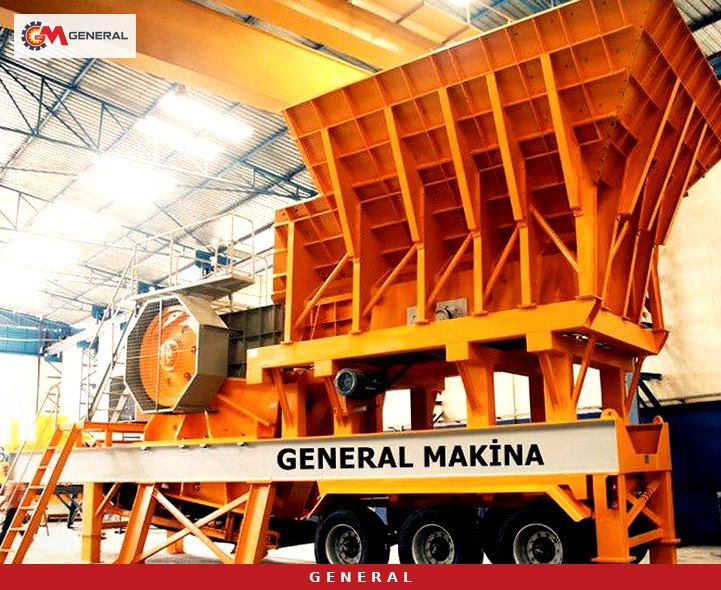
The 250-450 TPH range in the title should be read as two thresholds rather than one machine. The GNRK 110 is rated at 200-350 tph in the catalogue and covers the lower half of the range. The GNRK 130, at 400-500 tph, covers the upper end. Targets between 350 and 400 tph sit on the boundary of the two models; in that case either the larger model is selected and run with an adjusted closed-side setting (CSS) and feed rate, or the tonnage is split across two units, always judged together with the required product size.
| Configuration | Feeder | Jaw crusher (opening / motor / weight) | Crusher capacity | Suitable target |
|---|---|---|---|---|
| A - Stationary, mainly dry feed | GNR 110 grizzly, 200-300 tph | GNRK 110: 1100×850 mm / 110-132 kW / 33,000 kg | 200-350 tph | 250-300 tph |
| B - Stationary, high tonnage | GNR 140 grizzly, 350-600 tph | GNRK 130: 1300×1000 mm / 160 kW / 42,500 kg | 400-500 tph | 400-450 tph |
| C - Stationary, high clay share | GWB1136 wobbler, 75-600 tph | GNRK 110 or GNRK 130 | Depends on model | Production through the rains |
| D - Mobile, two units | On-board 1100×4750 mm feeder | 2 × GNR 110 mobile primary (GNRK 110), 55,000 kg each | 180-300 tph per unit | Line that follows the pit face |
The capacities in the table are catalogue ranges; the actual figure depends on ore moisture, clay content, crust share and the selected CSS. Where larger blocks and higher tonnage are involved, the GNRK 140 (1400×1100 mm, 200 kW, 47,000 kg, 500-600 tph) remains the upper option. The full technical table of every GNRK model is on the GNRK jaw crusher page.
Stationary line or mobile primary unit?
In Guinea, bauxite is usually mined in open pits across wide plateaus, with excavation faces that advance across the site. As the face moves away, haul distance grows. The decision then has two sides.
A stationary line runs for many years at one point on a concrete foundation; hopper volume, feeder length and conveyor route can be sized freely. If the pit life is long and a fixed crushing point can be set close to the centre of excavation, this route means fewer moving parts and more regular maintenance. Our fixed crushing plants are designed for this scenario.
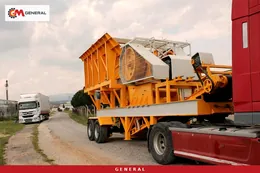
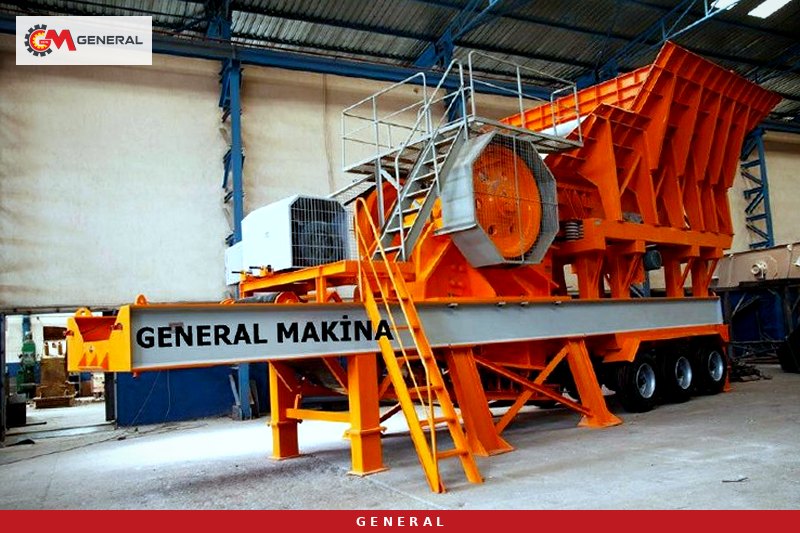
In a mobile primary unit, the feeder hopper and jaw crusher share one chassis. The GNR 110 mobile primary jaw unit accepts 0-1100 mm feed, delivers 0-250 mm product, works at 180-300 tph, is towed by a single truck and is set up on hydraulic legs without foundations. The 450 TPH target can only be approached with this unit by running two machines in parallel; a single unit serves the lower end of the range. For operators whose pit face moves often and who want short truck hauls, this layout makes sense.
Jaw plates, grizzly bars, liners: managing wear in bauxite
Bauxite itself is not considered a very abrasive material; what drives wear is how much ferruginous crust and quartz sand it contains. The wear plan is therefore based on samples from the pit, not on assumptions.
- Jaw plates are austenitic manganese steel (Mn13/Mn18) that work-hardens under impact; for high-silica feed Mn18/Mn22 is selected.
- Plates wear faster at the bottom; on symmetrical plates the time to turn them is tracked by measuring the CSS.
- The gap between grizzly bars sets the size of the bypassed fines; widening it in the clayey season can reduce blinding.
- Hopper and chute surfaces are protected by bolted, replaceable wear plates; the zone where hard crust blocks drop is the first inspection point.
- A spare set of jaw plates should be planned with the first shipment to avoid waiting at a remote site.
Following the same logic, the 250 t/h bauxite crushing and screening plant we built in Türkiye is a concrete example of how crushing and screening are arranged together for bauxite feed. A pit in Guinea has different conditions and must be evaluated with its own test results.
Data to collect on site before requesting a quote
A correct model recommendation depends on how complete the following information is. We suggest filling in this list with your mine engineer:
- Target capacity: separate hourly and per-shift figures for the dry and rainy seasons.
- Maximum feed size: the measured longest edge of the largest crust blocks.
- Required product size: the top size in the shipping or process specification.
- Clay and moisture: share of material from the lower zone and observed stickiness.
- Sample analysis: abrasiveness and crushability tests carried out by a competent laboratory.
- Power: is there a grid connection, or will the line run on generators?
- Dust and climate measures: options selectable per project, such as dust suppression in the harmattan months, covered conveyors and a filtered engine enclosure.
- Logistics: the port of discharge and road conditions from the port to the site.
Machines are shipped in sections split to shipping dimensions. The rainy-season condition of the road on which heavy bodies travel from port to site should be factored into the installation schedule.
Frequently asked questions
Why a jaw rather than an impact primary for bauxite?
An impact crusher will break soft bauxite, but hard iron crust and quartz sand consume its blow bars and liners quickly. On soft ore, impact crushing also produces more fines than needed. The jaw, working by compression, safely accepts large hard blocks and keeps metal consumption low.
Does a grizzly feeder work in the rainy season?
In pits with a low clay share, and with the bar gap set correctly, it does. Where the clay zone is significant, blinding and capacity loss follow; in that case the GWB1136 wobbler feeder is the more suitable choice.
Is one mobile unit enough for 450 TPH?
No. The GNR 110 mobile primary unit is rated at 180-300 tph in the catalogue. For 450 TPH, either two mobile units run in parallel or a stationary line with a GNRK 130 is built.
What determines price and warranty coverage?
Price depends on the crusher model, feeder type, hopper volume, conveyor and screen scope, power solution and shipping method. Our machines carry ISO 9001 and CE certification and a 1-year warranty excluding wear parts. The exact figure is given in a quotation prepared once site data has arrived.
Bottom line
The success of a 250-450 TPH primary line on Guinean bauxite depends on how well it absorbs the difference between hard crust and the clay zone. The GNRK 110 is the main option for 250-300 tph and the GNRK 130 for 400-450 tph; the feeder is chosen as grizzly or wobbler according to season and clay share. As a team building crushing and screening plants in Izmir since 1976, with export experience across North Africa and the Middle East, we review your site data and prepare a configuration for you. Send your target tonnage, feed size and product requirement through our contact page and we will prepare your quote accordingly.
Definitions of technical terms: Glossary