EN — English
 TR — Türkçe
 DE — Deutsch
 RU — Русский
 FR — Français
 ES — Español
 AR — العربية
 SR — Српски

Ghana Granite Quarry Generator-Powered Stone Crushing Plant 120-180 TPH
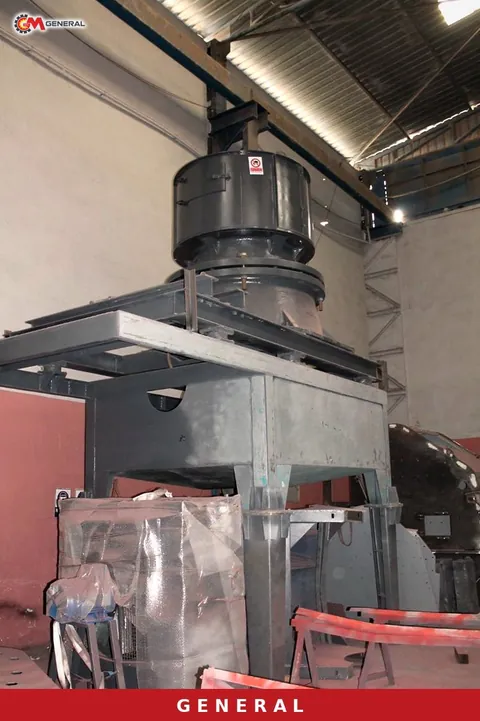
For an investor planning a granite quarry in Ghana, the first technical obstacle is rarely the crusher. It is electricity. When the pit lies far from town, or the local line drops out often, the heart of the plant stops being the crusher and becomes the generator. This article looks at a generator-powered stone crushing plant for a 120-180 TPH granite operation starting from the power budget: which real models fit that range, what kVA power unit each one carries, what to watch on site through West Africa's wet and dusty seasons, and which quarry data to collect before asking for a quotation.
Off-grid granite quarry: the calculation starts with the generator
On a grid-connected site, crusher and screen motors are chosen against transformer capacity. Without a connection the order reverses. First you check whether the power unit brought to site can carry every consumer at once: primary and secondary crusher, feeder, screen and conveyors. The advantage of a generator-powered plant is that good granite, not the power line, decides where the quarry goes. The price is fuel logistics, maintenance discipline and a correctly sized power unit.
On our wheeled mobile crushing and screening plants the power unit is engineered together with the chassis, so that sizing arrives done at the factory. What the buyer has to check is whether his own operating plan will push past it: if a tertiary crusher, a washing unit or a long stockpile conveyor is to be added later, the power unit should be discussed against that expansion from day one. We compare grid and diesel energy in general terms in our electric vs diesel hybrid mobile crusher energy analysis.
What Ghanaian granite demands from a crushing line
In the south and east of Ghana, notably around the capital and towards the coast, quarries producing aggregate from crystalline rocks such as granite and gneiss are common. These rocks are hard and rich in silica, which favours compression crushing: it wears the crusher's internal surfaces far less than machines that break stone by impact. Even so, strength, jointing and abrasiveness can change from one vein to the next in the same district. What follows is a general framework; a compressive strength and abrasion test on a sample from your own face turns model selection from a guess into a measurement.
The second issue is overburden. In a tropical climate granite is capped by a reddish, clayey weathered soil that turns wet and sticky in the rainy season. If that soil travels with the blasted rock all the way to the crusher, it blinds the screen and spoils the cleanliness of the chippings. Stripping overburden separately and scalping fines ahead of the crusher should therefore be planned from the first day.
Two wheeled candidates for 120-180 TPH and their power budgets
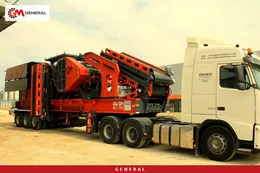
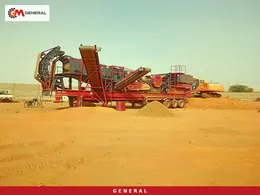
Within our wheeled mobile crushing plants range, two sibling models cover this band. Both use the same GPJ 90 primary jaw, the same feed opening and the same screen; they differ in the secondary crusher type and the power unit that goes with it.
| Parameter | General 944 | General 950 |
|---|---|---|
| Capacity | 120-180 TPH | 120-180 TPH |
| Primary crusher | GPJ 90 jaw | GPJ 90 jaw |
| Secondary crusher | GM430 cone | DMK01 impact |
| Max. feed size | 800 mm | 800 mm |
| Screen | 1600×5000 mm, three-deck horizontal | 1600×5000 mm, three-deck horizontal |
| Product fractions | 0-5 / 5-12 / 12-19 mm | 0-5 / 5-12 / 12-19 mm |
| Generator | 550 kVA | 600 kVA |
| Weight | 70,000 kg | 70,000 kg |
| Dimensions | 4130×20350×4500 mm | 4130×20350×4500 mm |
General 944: low metal consumption in granite with a cone secondary
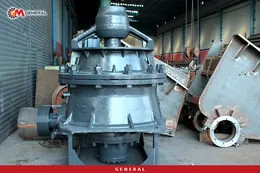
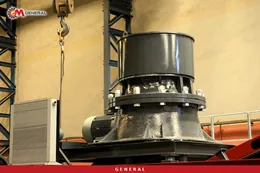
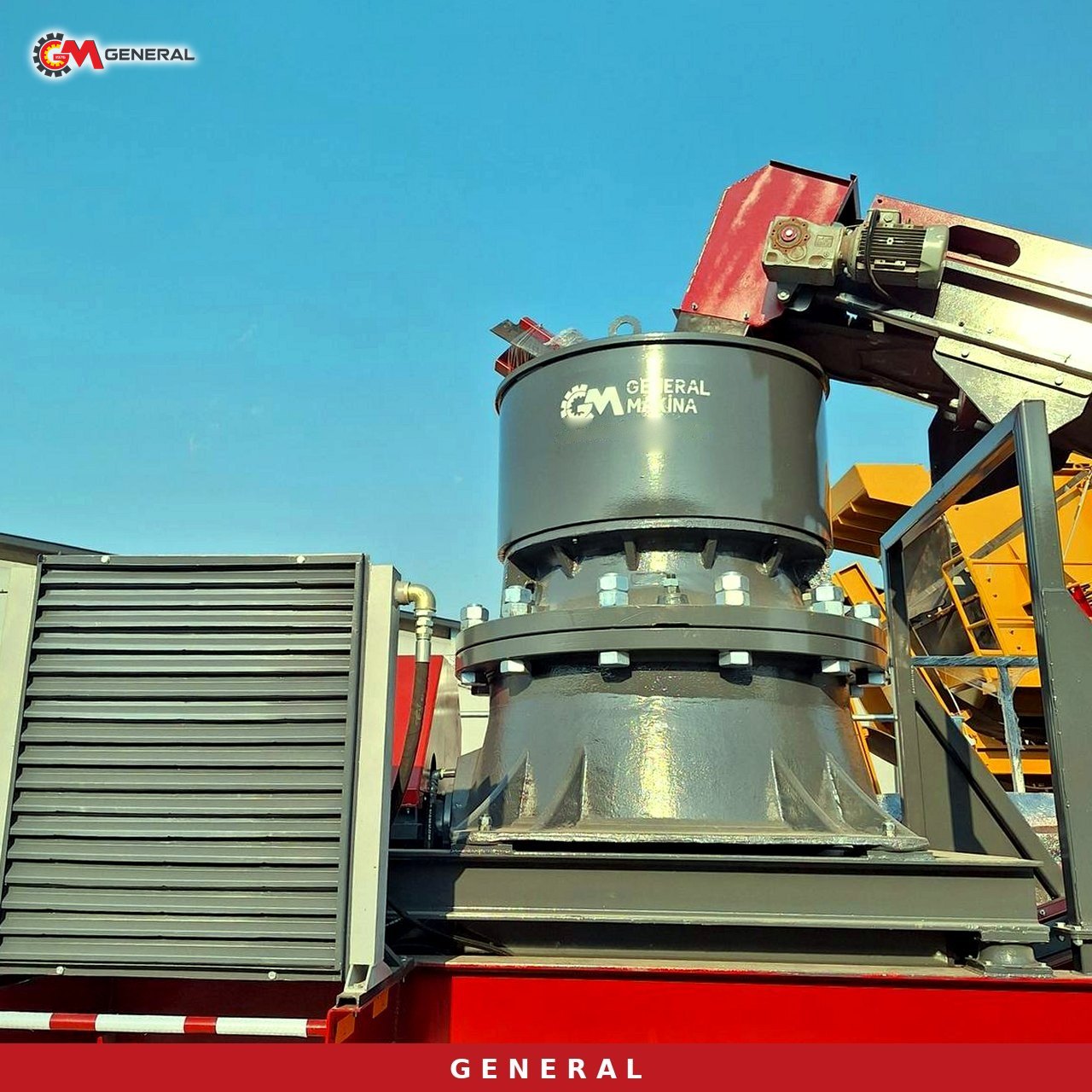
The General 944 places a GM430 cone crusher behind the jaw primary. Because the cone breaks stone by squeezing it between mantle and concave, wear parts in high-silica granite last much longer than on an impact rotor. At a remote pit every part change can mean a shipment from abroad, so in Ghanaian conditions this difference feeds straight into the production calendar. The power unit is rated at 550 kVA.
General 950: when does an impact secondary make sense?
The General 950 uses a DMK01 impact crusher behind the same primary and comes with a 600 kVA power unit. The impact secondary gives a high reduction ratio and cubical grains; one truck moves the plant and it is working within about 30 minutes. In hard, abrasive granite, however, rotor parts wear faster. If your stone comes from a softer, less abrasive vein, or your customer insists on cubical shape, the 950 joins the shortlist; for typical Ghanaian granite the first candidate is the 944.
If the target rises above 180 TPH there are two routes: run two units in parallel, or move to the twin-chassis GNR-MC110 in the 200-300 TPH band. The GNR-MC110 carries a 750 kVA power unit, with its GPJ 110 jaw primary and DMK03 impact secondary on separate chassis. For a crusher-by-crusher comparison, see our crushers category.
Reading the kVA plate correctly: how the power unit is loaded on site
The kVA figure on a generator plate is apparent power; the active power the motors actually use is that value multiplied by the power factor (cos φ): kW = kVA × cos φ. Comparing 550 or 600 kVA directly with the plant's total motor power is therefore misleading. Three situations deserve real attention:
- Start-up sequence: if large motors start together, the inrush current strains the power unit. Conveyors, screen, secondary and primary should come on line in a set order, and shut down in reverse.
- Full feed: a cone crusher fed with a full (choke-fed) chamber gives better grain shape and a steadier load. Stop-start feeding creates sudden load swings on the generator.
- Extra consumers: if a dust-suppression pump, site lighting, a container office or a workshop will hang on the same unit, list those loads at quotation stage.
A hypothetical example: if the daily production target is H tonnes and the average capacity is Q TPH, the required running time is H ÷ Q hours. Fuel demand must be worked out from that time and the power unit's own consumption curve; take the consumption value from the generator maker's data sheet and do not build a budget on guessed figures. Refuelling intervals, storage and haulage of diesel follow from the same calculation.
From Tema and Takoradi ports to the pit: shipping, rain and harmattan
A wheeled plant shipped from Türkiye usually enters Ghana through Tema or Takoradi port. The 70-tonne chassis, measuring 4130×20350×4500 mm, is towed from the port to the quarry by a tractor unit, so bridges, bends and unpaved stretches on the route must be checked before loading. In the rainy season laterite roads soften; timing the installation for the dry season reduces haulage risk. Confirm transport permits and axle-load limits with the relevant Ghanaian authority.
Positioning on site and ground preparation
When the wheeled chassis arrives, it is placed on a platform close to the face where trucks and loaders can turn freely. The ground under the chassis must be compacted and drained. If rainwater pools beneath it the ground settles and both screen angle and belt alignment drift. Placing stockpiles on gently sloped, drained areas also stops the fine fraction turning into mud.
Dust in the dry season, moisture in the wet
During the dry months the harmattan wind blowing from the Sahara carries fine dust across West Africa. In that period the generator's air filters, radiator cores and the control panel filters need checking more often than usual. Water-spray dust suppression at transfer points and covered conveyors are measures that can be selected per project. In the rainy season the problem flips: moisture makes fines stick to screen meshes and raises the risk of condensation in the panel. Since mesh apertures are set per order to suit the material, describe how your stone behaves in its wettest month to the manufacturer as well.
The quarry file to prepare before requesting a quote
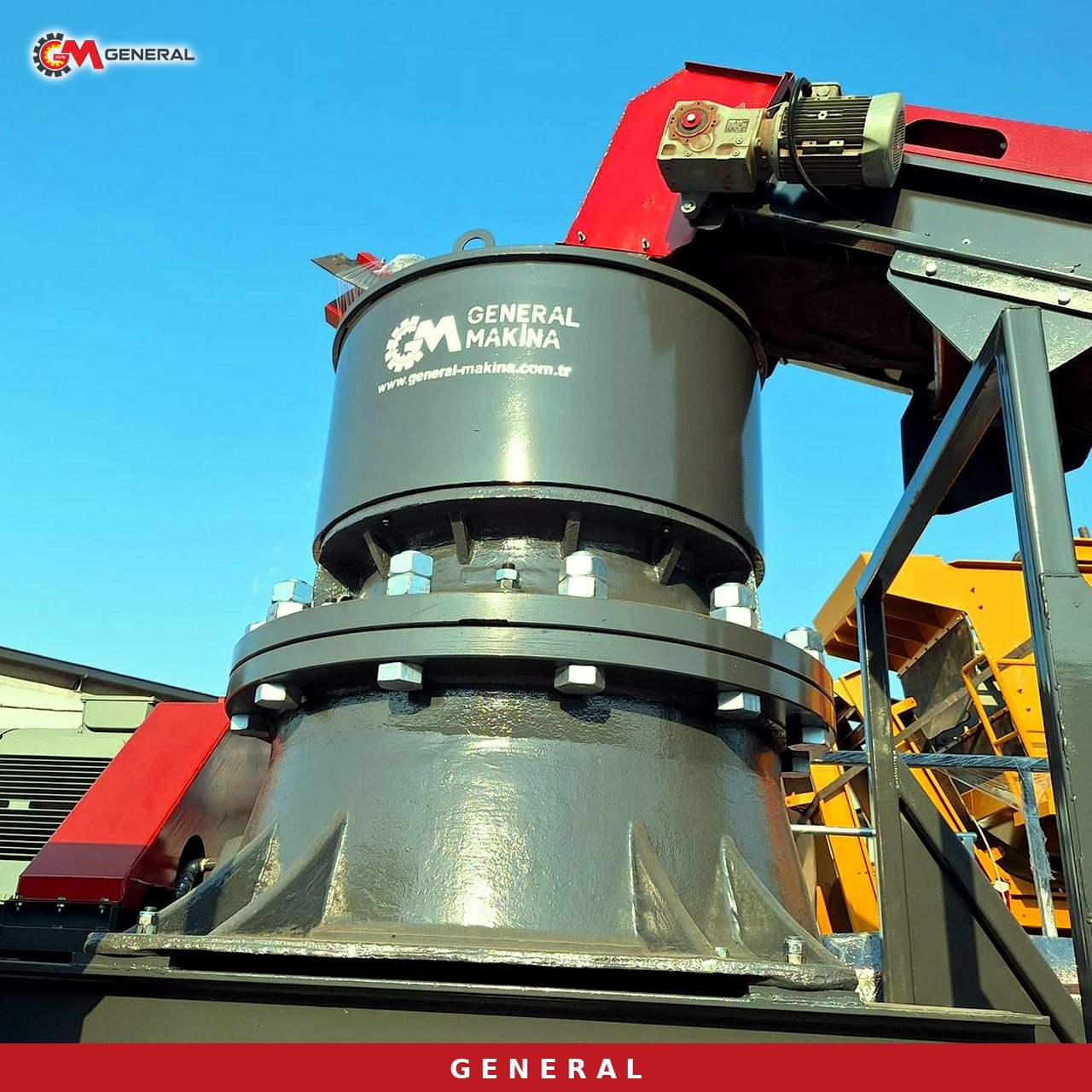
A sound quotation for a Ghanaian granite quarry is built on a handful of concrete facts. The more complete this list, the more accurate the model, mesh and power-unit proposal:
- Sample results: compressive strength, abrasiveness and clay/moisture content (otherwise a representative sample and photos of the face).
- Largest block size after blasting, and whether it suits the 800 mm feed opening.
- Target products and their shares, for example 5-12 and 12-19 mm for concrete and 0-5 mm for roads.
- Daily and monthly output target and number of shifts.
- Grid situation: none, distant or unreliable; any extra consumers to be fed by the generator.
- Port of arrival (Tema or Takoradi) and the condition of the road from port to pit.
- Any planned tertiary crusher, washing line or concrete batching plant.
Readers who want a reference in a similar rock class can see a General 944-based hard-stone application in Africa, described at 120-150 t/h, in our GNR 944 mobile hard-stone crushing and screening plant project. Our machines carry ISO 9001 and CE certification and a 1-year warranty (wear parts excluded).
Frequently asked questions
General 944 or General 950 for granite in Ghana?
If keeping wear cost low in hard, siliceous granite is the priority, choose the General 944 with its GM430 cone secondary. If the stone is softer or cubical shape matters most, the General 950 with its DMK01 impactor is considered. The final choice follows the sample results.
Can the plant run entirely on a generator, with no grid power?
Yes. The General 944 comes with a 550 kVA power unit and the General 950 with 600 kVA, feeding crushers, screen and conveyors. Any additional consumers should be stated at quotation stage.
Which products does it make?
Both models produce 0-5 / 5-12 / 12-19 mm fractions over a 1600×5000 mm three-deck screen. Mesh apertures and gradation are set per order to match your stone and product targets.
How are price and delivery time determined?
Price depends on the model, secondary crusher type, screen and conveyor equipment, extras such as dust suppression, and the shipping method. Delivery planning likewise follows the order scope; both are given in writing in a project-specific quotation.
Conclusion
For a 120-180 TPH granite quarry far from the grid in Ghana, the soundest starting point is the General 944 with its 550 kVA power unit and GM430 cone secondary; for softer stone or a cubical-shape priority, the 600 kVA General 950 comes in. Sample results, the port-to-pit route and every load hanging on the generator decide together. Send us your quarry data and request a quotation with a model and power-unit proposal through our contact page.
Definitions of technical terms: Glossary