EN — English
 TR — Türkçe
 DE — Deutsch
 RU — Русский
 FR — Français
 ES — Español
 AR — العربية
 SR — Српски

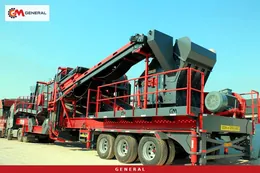
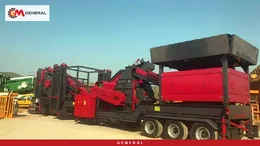
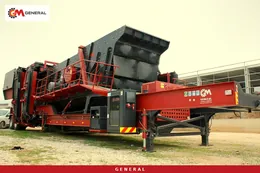
Senegal Basalt Wear-Resistant Stone Crushing Plant 120-180 TPH
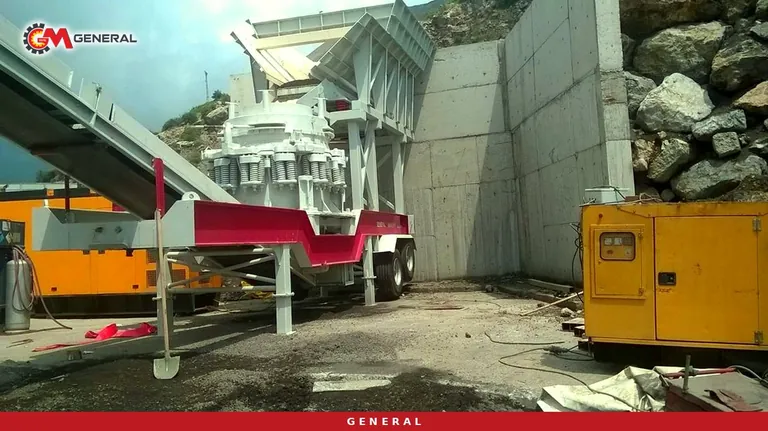
An investor preparing to open a basalt quarry in Senegal usually arrives with two numbers: how many tonnes of aggregate per hour he wants and how much budget he has. Almost nobody asks for the third number, yet it decides the operation's margin: how many grams of steel it takes to crush one tonne of basalt. Basalt is a dense, fine-grained, hard volcanic rock, and how quickly each crusher part wears out depends less on the capacity than on the stone itself and the way the line is built. In this article we treat "wear-resistant crusher" not as a marketing adjective but as the sum of measurable engineering decisions: which crushing principle, which alloy, which feed arrangement and which setting. The target band is 120-180 tph, and every technical value comes from our product pages. We give no information about any specific quarry or project in Senegal; the values for your site must be confirmed by sample testing and by the specification of the relevant authority.
Which crusher surface basalt attacks, and why
Wear is governed not by the Mohs hardness of the stone but by its free silica and the resulting abrasion index (Bond Ai). Our cone crusher page gives an order of Ai≈0.20 for basalt and Ai≈0.55 for granite. That makes basalt less abrasive than granite, but it can also create false comfort. Basalt, especially the tight, dense kind, resists impact strongly. In a machine that breaks by impact, the rotor has to spend more energy shattering the stone, and impact fatigue joins sliding abrasion on the metal surface. In a machine that breaks by compression, the stone is squeezed between two surfaces and sliding on the metal stays more limited.
Volcanic basalt outcrops are known in western Senegal, notably around the Cap-Vert peninsula, while other rock types occur further inland. That general picture is not enough for an investment decision. Porosity, weathering and the share of clay bands can differ even between two quarries in the same area. So the first step is to send a few representative samples from the face to an accredited laboratory for abrasion, compressive strength and Los Angeles tests. Without those results, any "part life" figure you are given is only a guess.
Tracing wear along the material flow
A wear-resistant plant does not come from one strong crusher but from a flow that removes needless work at every stage. A basalt line should be examined at four points, from the hopper where the truck tips to the stockpile.
Hopper and pre-scalping
Run-of-mine material from the blast contains soil, weathered crust and fines. If these fines enter the jaw they are not crushed; they only grind between the plates, accelerate wear and occupy capacity for nothing. The by-pass section of a grizzly feeder separates them before they reach the crusher. As our feeder product page explains, keeping fines away from the primary makes jaw and impact liners wear more slowly. Bear in mind that clayey, sticky feed can blind the gaps between the bars, and mud on the quarry floor in the rainy season raises that risk.
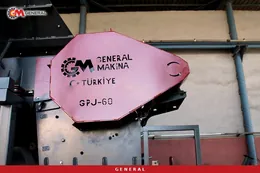
Jaw primary: GPJ 90
On the General 944 the first stage is a GPJ 90 jaw crusher that accepts feed up to 800 mm. The jaw breaks stone by compression between a fixed and a moving jaw, so metal loss stays low in hard, abrasive rock. The jaw plates are austenitic manganese steel, whose surface hardens under impact. Keeping blasted blocks within the 800 mm limit prevents point overloading of the plates, which means the drill-and-blast plan directly affects crusher life.
Cone secondary: GM430
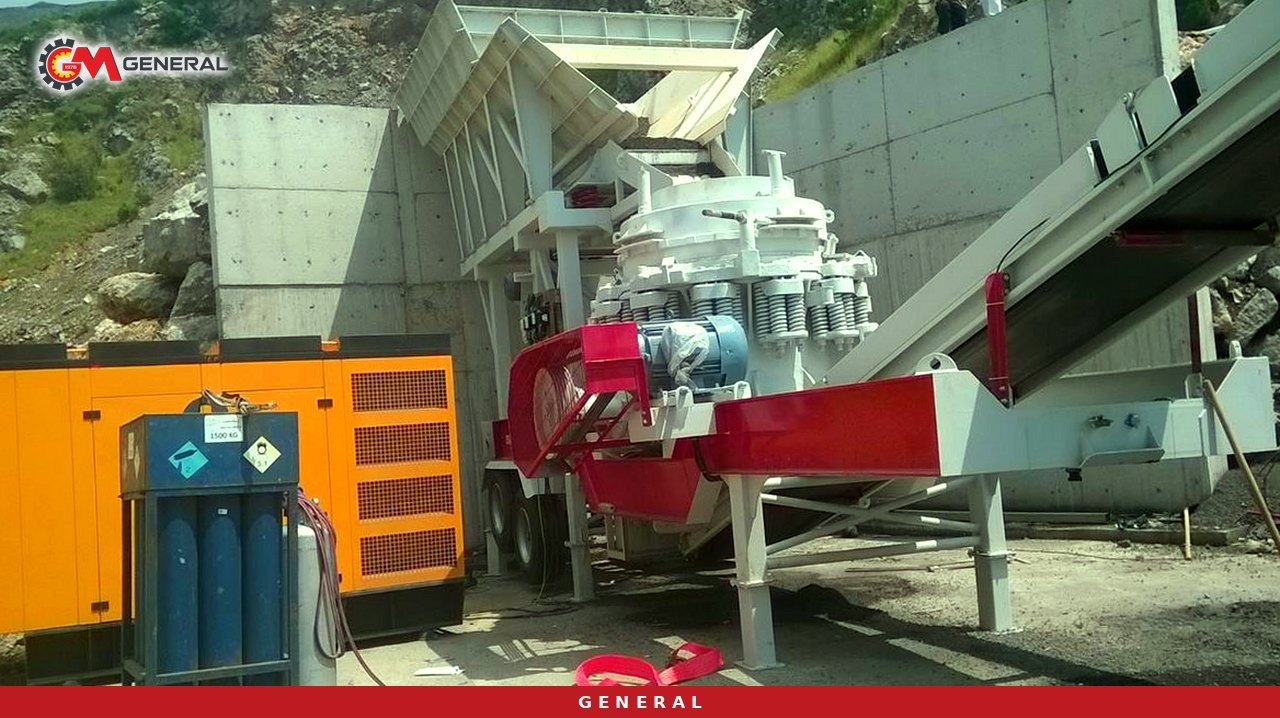
In a basalt line the real decision sits in the second stage. The GM430 cone crusher squeezes material with multi-directional compression between an eccentrically gyrating mantle and a fixed concave. Our cone crusher page gives a 6:1–8:1 reduction ratio for the secondary stage. Keeping the cone mouth full at all times (choke feeding) improves particle shape and makes the mantle wear evenly. A half-empty cone gouges the liner in one band and forces an early change.
Screen and conveyors
The General 944 splits the product on a 1600×5000 mm three-deck horizontal screen into 0-5, 5-12 and 12-19 mm fractions. Screen mesh wear in basalt is discussed less than crusher liners, but without regular mesh changes a torn aperture sends off-spec product to the stockpile. Drop heights at conveyor transfers and scraper maintenance matter as much as metal loss.
Cone or impact: options for 120-180 TPH
Two sibling models of the same size and weight cover the 120-180 tph band. Both start with a GPJ 90 jaw; the difference is the second stage. The General 944 uses a GM430 cone secondary, the General 950 a DMK01 impact secondary. For basalt the basic rule is: if your priority is low metal consumption per tonne, choose the cone; if it is high reduction and pronounced cubical shape, choose the impactor. If the target goes above 180 tph or growth is planned, the twin-chassis GNR-MC110 is the next step up. For those who want to lift cubicity further, the GNR MK110 cubicizer can be added after the primary.
| Item | General 944 | General 950 | GNR-MC110 | GNR MK110 (add-on) |
|---|---|---|---|---|
| Capacity | 120-180 tph | 120-180 tph | 200-300 tph | 160-250 t/h |
| Primary | GPJ 90 jaw | GPJ 90 jaw | GPJ 110 jaw | — |
| Secondary | GM430 cone | DMK01 impact | GS1215 / DMK03 impact | Rotor cubicizer |
| Max. feed | 800 mm | 800 mm | 900 mm | 350 mm |
| Screen | 1600×5000 mm, 3-deck | 1600×5000 mm, 3-deck | 2000×6000 mm, 4-deck | — |
| Generator | 550 kVA | 600 kVA | 750 kVA | — |
| Strength in basalt | Compression, low metal loss | High reduction, cubical product | Modular growth | Hardox 500 liners, shaping |
All values in the table are taken from the respective product pages; dimensions not shown are set per order. The General 944 product page notes that screen apertures are also matched to the rock at order stage. You can compare the other wheeled layouts side by side in the wheeled mobile crushing plants category.
The alloy decision for wear parts
The same crusher fitted with the wrong alloy produces a completely different operating cost. The metallurgy explained on our wear parts page gives this picture for basalt:
- Austenitic manganese steel (Mn13/Mn18/Mn22): work-hardens under impact, surface hardness rising from 200 to 550 HB. It is the natural choice in basalt for jaw plates and the cone mantle-and-concave pair. As silica rises, move to Mn18/Mn22.
- High-chrome white cast iron (~700-800 HB): the blow bar standard for clean, abrasive feed in impact crushers, but brittle. With coarse, high-impact basalt feed or tramp iron it risks cracking.
- Ceramic-reinforced composite (MMC): can deliver about 2-3× the life of high-chrome in abrasive duty; worth considering for operators who choose an impact secondary and want fewer part changes.
- Hardox 500: the liner material of the GNR MK cubicizer series; in very high free-quartz duty liner life should be monitored, with a cone as the fallback.
Our cone crusher page states that mantles and concaves are usually manganese steel, or high-chrome for high-silica material. If your basalt results show low silica, standard manganese is enough; if the lab report shows a high value, we settle the alloy grade together before the order. The warranty is 1 year and excludes wear parts, so the alloy choice lands directly on the operator's budget.
Work out the wear cost per tonne yourself
Comparing part prices is misleading; the right measure is cost per tonne. The formula is simple: wear cost per tonne = (part price + cost of the downtime spent on the change) ÷ tonnes crushed over the part's life. Hypothetical example: if a mantle set costing 100 units is changed after 40,000 tonnes of basalt and the changeover costs 20 units of downtime, the cost per tonne is 120 ÷ 40,000 = 0.003 units. A cheaper set at 80 units that is worn out after 25,000 tonnes, with the same downtime, comes to 100 ÷ 25,000 = 0.004 units. You can test your own figures in our energy and wear cost calculator.
From Dakar port to the quarry: shipping and climate
For a wheeled plant bound for Senegal, logistics is part of the machine choice. The General 944 has transport dimensions of 4130×20350×4500 mm and weighs 70,000 kg. It travels by sea from our factory in Izmir to the port of Dakar and then by road to the quarry. Those dimensions mean bridges, bends and road surfaces along the route from the port to the site must be checked in advance for heavy haulage; abnormal-load permits should be confirmed with the relevant authority.
Where grid power does not reach the quarry, the General 944 runs on its 550 kVA generator. In the dry season the dusty harmattan wind from the Sahara calls for a separate maintenance schedule for generator air filters, engine radiators and dust build-up on the screen. Measures that can be selected per project include water-spray dust suppression at the crusher discharge and belt transfers, covered conveyors and a pre-filter for the generator. In quarries near the coast, salty humidity puts corrosion control of electrical panels and exposed bolted joints on the agenda. Treat these not as standard equipment but as items added to the quote according to your site conditions.
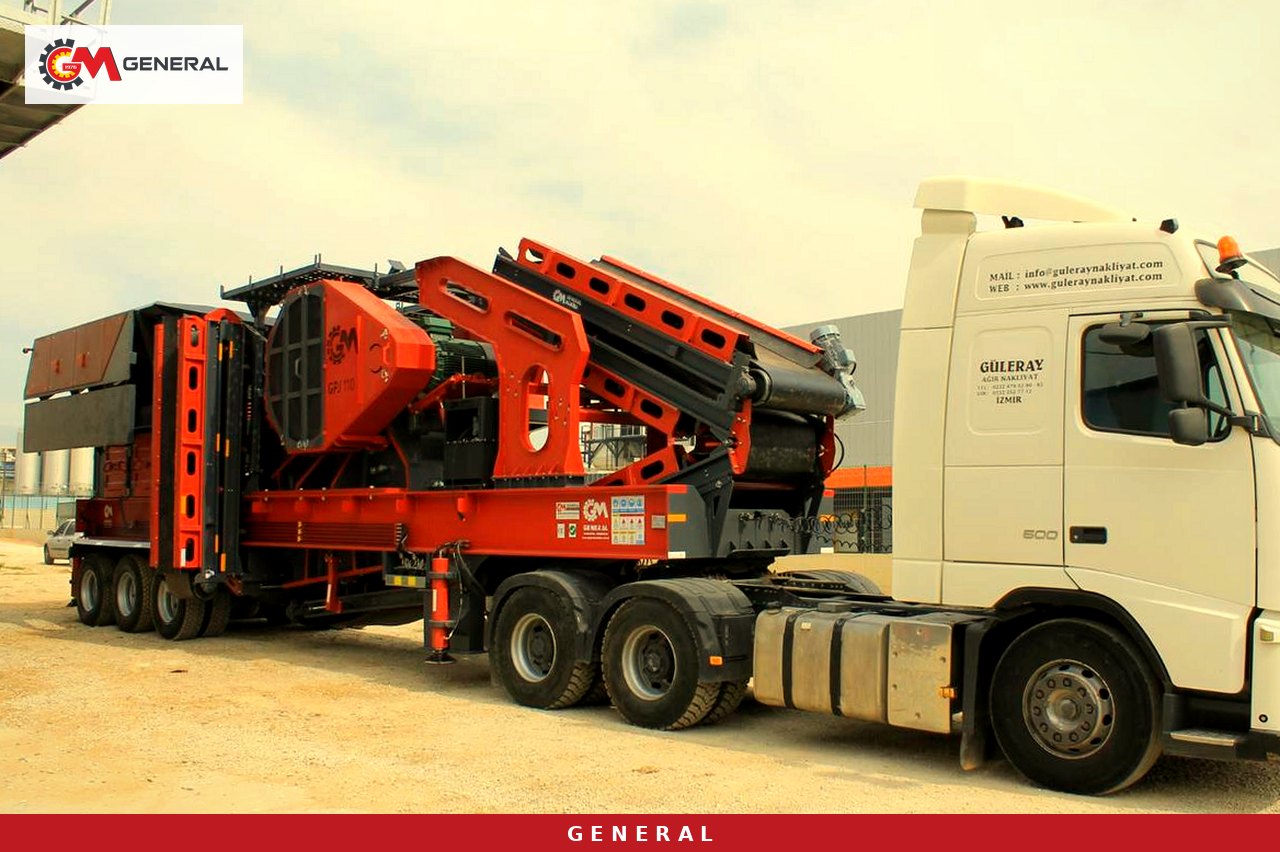
Once on site, positioning also affects wear. The plant must stand on firm, level ground, the chassis support legs must carry equal load, the screen must run horizontal and the crusher mouth must sit at the right angle to the truck tipping point. A screen running on a tilt piles material on one side, and that strip of mesh tears early.
What to collect at the quarry before requesting a quote
The more complete the following data, the faster we can propose the right configuration:
- Laboratory results of representative basalt samples: abrasion, compressive strength, Los Angeles value.
- The largest block size after blasting (assessed against the 800 mm limit).
- Target product list and proportions: 0-5, 5-12, 12-19 mm or a different fraction set.
- Daily operating hours and target hourly tonnage (where you sit within 120-180 tph).
- Clay, soil and moisture in the feed; the state of the quarry floor in the rainy season.
- Power supply: grid or generator.
- The route from Dakar port to the quarry and the site's distance from the coast.
- The end use: concrete aggregate, asphalt chippings or road sub-base, plus any cubicity value in the specification.
Frequently asked questions
Is the General 944 or the General 950 better for Senegal basalt?
Both produce 120-180 tph and start with the same GPJ 90 jaw. If low metal consumption per tonne is your priority, the General 944 with its GM430 cone secondary leads; if high reduction and cubical shape come first, the General 950 with its DMK01 impact secondary does. The laboratory result settles the choice.
Can a cone crusher deliver cubical basalt chippings?
A choke-fed cone gives good particle shape. If the specification demands a lower flakiness index, the GNR MK110 mobile cubicizer at 160-250 t/h with 0-25 mm product, can be added at the end of the line as a shaping stage.
Where do I source wear parts later?
We supply jaw plates, mantle and concave sets and screen mesh under the spare parts support described on our product pages. We decide together which alloy suits which part based on your sample results; the scope is listed in the spare parts category.
What drives price and delivery time?
Price depends on the model, the secondary crusher type, the generator and screen configuration, add-ons such as dust suppression, and the shipping scope. Delivery time depends on the production schedule at the time of order. We prepare a written quote for your project on both points.
Conclusion
In a plant crushing basalt in Senegal, wear resistance is the combined result of a compression-based line, a feed that keeps fines away from the crushers, a manganese grade matched to the samples and a choke-fed cone. For a 120-180 tph target the General 944 follows that logic most closely; the General 950 and the GNR-MC110 answer other priorities. As a manufacturer building in Izmir since 1976 with ISO 9001 and CE certification, we would like to work out the configuration with your quarry data. Send your sample results and target product list through our contact page and we will prepare a quote for you.
Definitions of technical terms: Glossary