EN — English
 TR — Türkçe
 DE — Deutsch
 RU — Русский
 FR — Français
 ES — Español
 AR — العربية
 SR — Српски
How Does an Impact Crusher Work? The Logic of the Rotor and Blow Bar
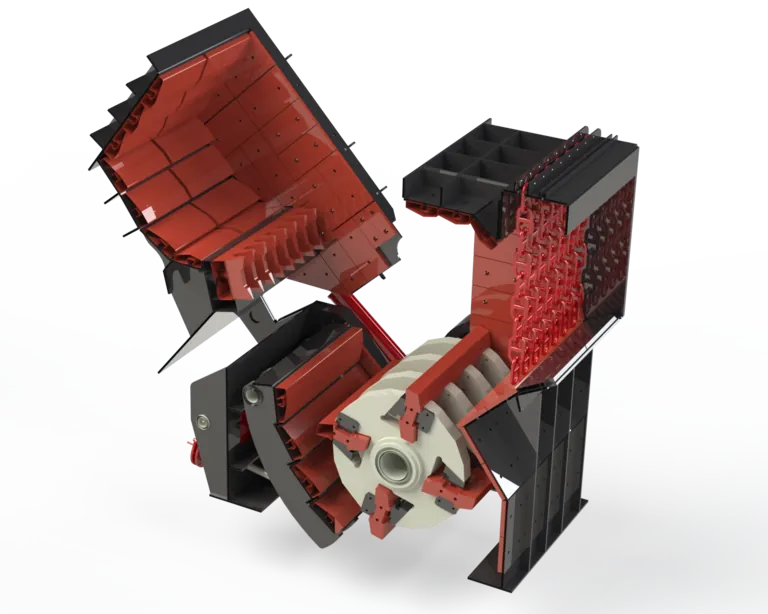
An impact crusher is a machine that breaks material by striking it rather than compressing it. In this article we explain the role of the rotor and the blow bar, why the primary (PDK) and secondary (DMK) series are designed differently, and which figure is decisive in model selection, based on General Makina's real technical values.
Rotor and blow bar: how does the crushing happen?
Inside the body there is a rotor turning at high speed. Blow bars are attached to the rotor with bolts or wedges. When material enters from above, the rotating bars strike the piece, the piece is thrown against the breaker plates opposite (grinding table) and is broken by the impact. This cycle continues until the crushed material is reduced to a size that can pass through the gap between the rotor and the plate.
Two conclusions follow from this. First: the product size is controlled by adjusting the plate distance — it is the equivalent of the discharge opening in a jaw crusher. Second: because the crushing energy comes from impact, the impact crusher produces cubical (near-cube) grains; this is the shape sought in concrete and asphalt aggregate.
Primary impact crusher (PDK): the first to meet the large piece
The PDK series is designed to take raw material coming from the quarry directly. The decisive figure is the maximum material size that can be fed:
| Model | Rotor Size (mm) | Max. Feed (mm) | Capacity (t/h) | Motor (kW) |
|---|---|---|---|---|
| GNR PDK02 | 1400 x 1200 | 900 | 200~300 | 200 |
| GNR PDK01 | 1400 x 1500 | 1000 | 250~500 | 315 |
| GNR PDK03 | 1600 x 2000 | 1300 | 500~900 | 500 |
As the rotor width increases, both the feed capacity and the power demand rise: going from PDK02 to PDK03, capacity increases roughly threefold while the motor goes from 200 kW to 500 kW. Capacity is determined not by rotor diameter but by rotor width — in all three models the rotor height stays in the 1400-1600 mm band while the width goes from 1200 to 2000 mm.
Secondary impact crusher (DMK): second stage, fine product
The DMK series takes the output of the primary crusher. The striking point is this: in all four models the maximum feed is fixed at 800 mm.
| Model | Rotor Size (mm) | Max. Feed (mm) | Capacity (t/h) | Motor |
|---|---|---|---|---|
| GNR DMK01 | 1100 x 1000 | 800 | 120-180 | 160 kW |
| GNR DMK02 | 1100 x 1200 | 800 | 170-250 | 200 kW |
| GNR DMK03 | 1100 x 1500 | 800 | 250-300 | 250 kW |
| GNR DMK05 | 1400 x 2000 | 800 | 250-500 | 500 kW |
If the feed stays fixed while capacity rises from 120 to 500 t/h, it means model selection is made according to throughput, not according to piece size. In the secondary stage the piece size has already been limited by the primary; what needs to be chosen is the hourly tonnage.
Primary + secondary in a single body: the GPS series
For plants that do not want to split the two stages into separate machines, the GPS series handles both tasks in a single body:
| Model | Rotor Size (mm) | Max. Feed (mm) | Motor (kW) | Capacity (t/h) |
|---|---|---|---|---|
| GPS-1210 | 1200 x 1000 | 600 | 160 | 100 - 250 |
| GPS-1413 | 1400 x 1250 | 800 | 250 | 125 - 320 |
| GPS-1415 | 1400 x 1500 | 1000 | 315 | 150 - 400 |
When GPS-1415 and PDK01 are compared, both take a 1000 mm feed and draw 315 kW; the difference is in capacity: PDK01 gives 250~500 t/h while GPS-1415 gives 150-400 t/h. The GPS produces a lower throughput at the same power because it also performs second-stage crushing within the same body. The gain is in the number of machines and in space, the loss is in hourly tonnage.
Mobile impact groups
If the crusher, feeder and chassis are wanted on a single platform:
| Model | Feeder | Capacity (t/h) | Motor (kW) | Crusher | Weight (kg) |
|---|---|---|---|---|---|
| M-PDK02 | 1200 x 4750 | 200-300 | 250 | PDK 02 | 45.000 |
| M-PDK01 | 1500 x 5000 | 250-500 | 315 | PDK 01 | 50.000 |
| M-DMK 01 | 1000 x 3000 | 120-180 | 160 | DMK 01 | 32.000 |
| M-DMK 03 | 1500 x 4000 | 175-300 | 250 | DMK 03 | 45.000 |
While the stationary PDK02 is 200 kW, the mobile M-PDK02 is 250 kW; the 50 kW in between is the feeder and conveyor drives. This difference is overlooked when comparing quotations — comparing stationary crusher power directly with mobile group power is misleading.
The order when selecting a model
- Stage: is raw material coming from the quarry (PDK), or the primary output (DMK)?
- Feed size: in the PDK this determines the model (900 / 1000 / 1300 mm). In the DMK it is fixed at 800 mm.
- Hourly tonnage: in the DMK this is the real selection criterion.
- Installation: stationary or mobile group — take the power difference into account.
Related pages
Definitions of technical terms: Glossary