EN — English
 TR — Türkçe
 DE — Deutsch
 RU — Русский
 FR — Français
 ES — Español
 AR — العربية
 SR — Српски
What Is a Jaw Crusher and How Does It Work?
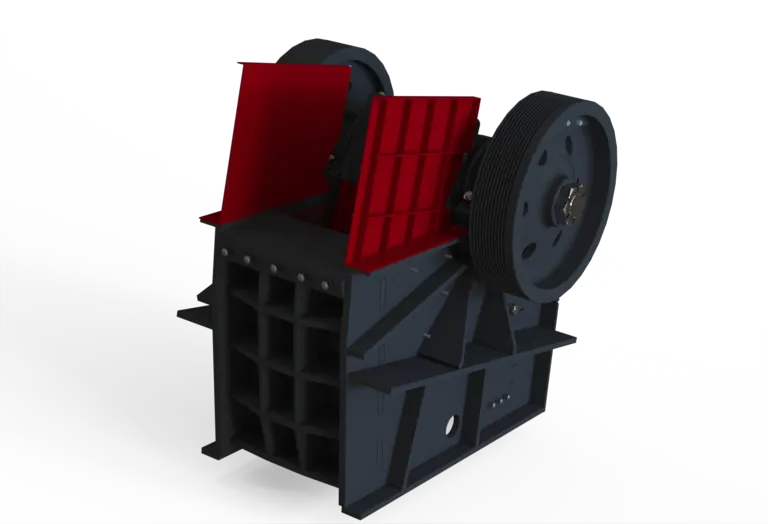
The jaw crusher is the first machine material meets in a crushing and screening plant. In this article we explain its working principle, what the feed opening and discharge setting mean, and which figure you should look at when choosing a model, using the actual technical values of the General Makina GNRK / GNR series.
Working principle: crushing by compression
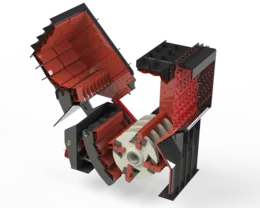
A jaw crusher works between two jaws. One is fixed to the frame, the other swings via the eccentric shaft. The flywheel regulates the speed of the eccentric shaft; it also absorbs the sudden load fluctuation at the moment of crushing and allows the motor to run without jolting.
Material enters through the feed opening at the top. Since the gap between the two jaws narrows downwards, the piece is crushed one stage further with every swing, moves down and is discharged through the outlet opening at the bottom. Crushing takes place by compression — not by impact as in an impact crusher. That is why the jaw crusher is preferred at the primary stage for abrasive and hard material (basalt, granite, quartz).
Feed opening: what can enter the crusher?
The feed opening size determines the largest piece that can enter the crusher. The actual values of the GNRK series:
| Model | Feed Opening (mm) | Discharge Settings (mm) | Motor (kW) rpm | Flywheel Speed (rpm) | Weight (kg) | Capacity (t/h) |
|---|---|---|---|---|---|---|
| GNRK 60 | 610 x 380 | 40-130 | 30/37 - 1500 | 330 | 6.000 | 20-80 |
| GNRK 90 | 900 x 650 | 70-180 | 75/90 - 1500 | 293 | 11.400 | 60-225 |
In practice the largest fed piece must not completely fill the width of the opening; otherwise bridging (blockage) occurs and feeding is interrupted. The larger your piece size after blasting in the quarry, the wider the opening must be chosen.
The discharge setting directly changes capacity
The discharge opening is an adjustable value and determines the product size. The capacity ranges in the table arise exactly from this setting: on the GNRK 60, when the discharge is closed to 40 mm the capacity approaches the lower limit (20 t/h), and when opened to 130 mm it approaches the upper limit (80 t/h). The same machine shows a fourfold capacity difference with a single adjustment.
That is why the question "how many tons does it crush?" has no single answer. The right question is: how many tons at which product size? State your target discharge size when requesting a quotation.
What do motor power and weight tell us?
The motor is 30/37 kW for the GNRK 60 and 75/90 kW for the GNRK 90. While capacity doubles, the power demand increases roughly two and a half times. The weight rises from 6.000 kg to 11.400 kg — the body mass is needed to withstand the crushing force and to damp vibration. If a crusher with a light body delivers the same capacity, the service life of the chassis should be questioned.
The flywheel speed is 330 rpm on the GNRK 60 and 293 rpm on the GNRK 90. On the larger machine the speed drops because more material is processed with each swing; low speed + high mass provides balanced operation with larger pieces.
Stationary crusher or mobile primary plant?
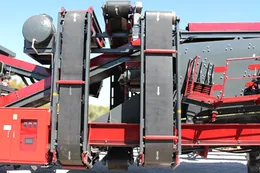
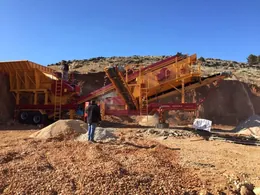
When you buy the crusher alone, the feeder, chassis and drive are planned separately. In a mobile primary plant these come on a single chassis:
| Model | Feeder | Capacity (t/h) | Total Motor (kW) | Jaw Crusher | Weight (kg) |
|---|---|---|---|---|---|
| GNR 60 | 700 x 3000 | 20-80 | 41,5 | GNRK 60 | 15.000 |
| GNR 90 | 1000 x 3800 | 70-180 | 95,5 | GNRK 90 | 25.000 |
| GNR 110 | 1100 x 4750 | 180-300 | 139,5 | GNRK 110 | 55.000 |
When the two tables are placed side by side, the logic of the selection becomes visible: the total power of the GNR 60 plant is 41,5 kW, while the GNRK 60 crusher inside it is 30/37 kW. The difference lies in the feeder and auxiliary drives. Likewise, while the plant weight is 15.000 kg, the crusher itself is 6.000 kg; the remaining mass is the chassis, feeder and hopper.
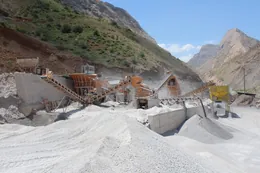
The decision criterion is how long you stay on site. If you will work for years in a single quarry, a stationary installation gives higher capacity with a lower investment. If you will move from site to site, a mobile plant reduces the setup time from days to hours.
Four figures to check in order when selecting a model
- Feed piece size → determines the feed opening (610 x 380 or 900 x 650).
- Target product size → determines the discharge setting and therefore the capacity that will be achieved.
- Target tons per hour → together with the discharge setting, narrows down the model range.
- Time spent on site → decides between a stationary installation and a mobile plant.
Once these four figures are clear, the model emerges by itself. If only one thing remains uncertain, it is usually the target product size; talking about capacity without clarifying it is misleading.
Related pages
Definitions of technical terms: Glossary