EN — English
 TR — Türkçe
 DE — Deutsch
 RU — Русский
 FR — Français
 ES — Español
 AR — العربية
 SR — Српски
Crusher Wear Parts Guide
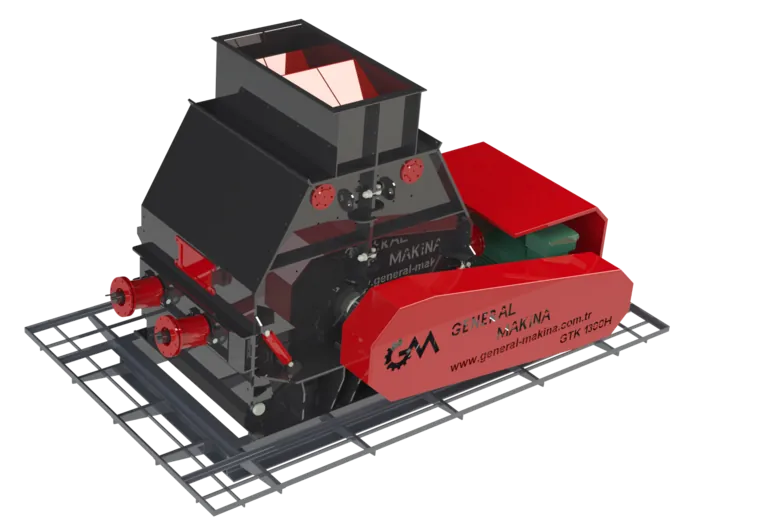
Each crusher type has its own wear pattern; stocking the wrong parts inflates both downtime and cost. The matching below follows the General Makina product family.
Jaw crusher — jaw plates
Fixed and moving jaw plates are manganese steel; wear concentrates in the lower third of the chamber. On most models plates can be flipped for a second life. GNRK series openings and duty groups:
| Model | Ağız Ölçüsü(mm) | Çıkış Ölçüleri(mm) | Motor(kw) d/dak | Volan Devri(d/dak) | Ağırlık(kg) | Kapasite(t/s) | Grubu |
|---|---|---|---|---|---|---|---|
| GNRK 60 | 610 x 380 | 40-130 | 30 /37 - 1500 | 330 | 6000 | 20-80 | Primer |
| GNRK 90 | 900 x 650 | 70-180 | 75 /90- 1500 | 293 | 11400 | 60-225 | Primer |
| GNRK 900 | 900 x 200 | 11--55 | 30 - 1500 | 330 | 5960 | 50 - 75 | Sekonder |
| GNRK 110 | 1100 x 850 | 150-225 | 110/132 - 1500 | 228 | 33000 | 200 - 350 | Primer |
| GNRK 130 | 1300 x 1000 | 125-250 | 160 - 1500 | 215 | 42500 | 400 - 500 | Primer |
Impact crusher — blow bars and liners
Blow bars and housing liners wear together; replace bars before the height reaches the critical limit to protect rotor balance.
Cone crusher — mantle and concave
The mantle-concave pair forming the chamber wears as a set and is replaced as a set; single-side replacement distorts the product curve.
VSI — rotor tips
In vertical shaft impactors wear concentrates on rotor tips and anvils. Larger rotors take larger tip sets:
| Model | Rotor Ölçüsü(mm) | Beslenebilecek Max. Malzeme Ebadı(mm) | Kapasite(t/s) | Motor(kW) |
|---|---|---|---|---|
| GNR 700 | 700 | 25-35 | 45~135 | 90-132 |
| GNR 800 | 800 | 40-50 | 55~160 | 132-160 |
| GNR 900 | 900 | 50-55 | 80~210 | 2x200 |
Kubitzer — liner plates
Since cubical shaping is rock-on-rock, liner consumption is lower than in impact crushers; bed-zone liners still need periodic checks.
Stock planning: matching parts to criticality
Plan wear stock by type: jaw plates and blow bars are the fastest movers; the mantle-concave pair carries long lead times, so keep a spare set if the plant must stay online. VSI tip sets are light but must keep set integrity — always stock complete sets.
Three operating mistakes that accelerate wear
(1) Oversize feed — directly cuts part life; (2) uneven feeding — works one zone of the chamber and creates asymmetric wear; (3) late replacement — a worn part consumes its neighbour: a thinned jaw plate loads the pitman, a shortened blow bar eats the rotor body.
Timing replacement: measure, don't guess
The difference between "still works" and "must change" is a measurement, not a glance: remaining tooth height on jaw plates, remaining bar section on blow bars, wall thickness at reference points on mantles — compared against day-one values. A plant that logs measurements schedules replacement inside a planned window; a plant without logs either scraps parts early or runs them until they damage the body — both extremes are expensive. Stock planning feeds on the same log: jaw plates and blow bars are fast movers, while the mantle-concave pair carries long lead times and deserves a spare set if the plant must stay online.
Maintenance recommendations depend on the model and operating conditions — contact us for a plan specific to your machine.
Part-specific selection guides
This guide is the overview; detailed selection guides per part family:
- Jaw plates: material and selection — Mn grades, tooth profile, wear signs
- Blow bars: material-application matching — manganese / martensitic / high-chrome
- Mantle and concave: cavity selection — coarse/fine cavity, pair-change rule
- Screen media selection — wire / polyurethane / rubber
For any wear part, request a quote with your machine model from the spare parts page.
Definitions of technical terms: Glossary