EN — English
 TR — Türkçe
 DE — Deutsch
 RU — Русский
 FR — Français
 ES — Español
 AR — العربية
 SR — Српски
Cubicizer or Tertiary Impact Crusher? Motor Power per Ton Compared
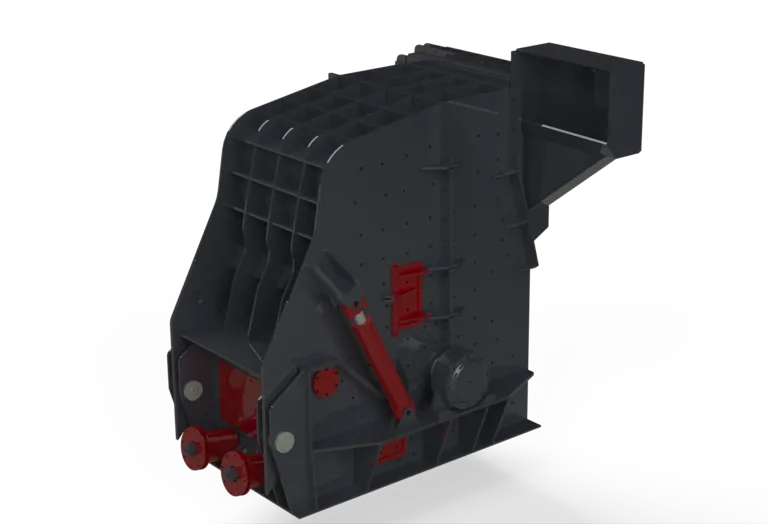
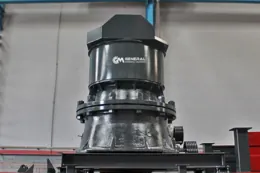
A cubicizer crusher is used in the final stage of aggregate production for cubical shape and low energy consumption. In this article we place the real catalogue figures of General Makina's GNR K series and GNR tertiary series side by side and calculate the motor power required per ton.
What a cubicizer does and how it differs from an impact crusher
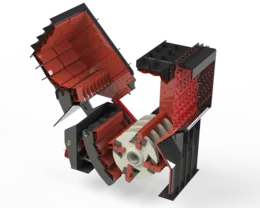
A cubicizer crushes material mostly rock-on-rock: material thrown from the rotor strikes the bed of its own material accumulated in the crusher body. In a classic tertiary impact crusher, however, the material hits the metal impact plate directly. This difference produces two results: wear part consumption drops in the cubicizer, and the mechanical power needed for the crushing work decreases.
GNR K series cubicizer — catalogue figures
| Model | Rotor Size (mm) | Max. Feed (mm) | Capacity (t/s) | Motor (kW) |
|---|---|---|---|---|
| GNR K50 | 1000x750 | 120 | 45~80 | 45 |
| GNR K100 | 1550x1200 | 180 | 90~130 | 90 |
| GNR K110 | 1550x1800 | 210 | 160~250 | 160 |
GNR tertiary impact series — the comparison base
| Model | Rotor Size (mm) | Max. Feed (mm) | Capacity (t/s) | Motor (kW) |
|---|---|---|---|---|
| GNR 65 | 1200x650 | 150 | 70~130 | 132 |
| GNR 100 | 1200x1000 | 150 | 90~160 | 160 |
| GNR 130 | 1200x1300 | 150 | 130~200 | 200 |
| GNR 150 | 1200x1500 | 150 | 200~300 | 250 |
Motor power per ton: a 36% difference
The most honest way to compare the two series is to take the midpoint of the capacity range and divide it into the motor power. The resulting figure gives the motor power that must be installed for one ton of material per hour.
| Model | Type | Capacity midpoint (t/s) | Motor (kW) | kW / (t/s) |
|---|---|---|---|---|
| GNR K50 | Cubicizer | 62.5 | 45 | 0.72 |
| GNR K100 | Cubicizer | 110 | 90 | 0.82 |
| GNR K110 | Cubicizer | 205 | 160 | 0.78 |
| GNR 65 | Tertiary impact | 100 | 132 | 1.32 |
| GNR 100 | Tertiary impact | 125 | 160 | 1.28 |
| GNR 130 | Tertiary impact | 165 | 200 | 1.21 |
| GNR 150 | Tertiary impact | 250 | 250 | 1.00 |
The cubicizer series averages 0.77 kW/(t/s), while the tertiary impact series averages 1.20 kW/(t/s). The installed power requirement is roughly 36% lower with the cubicizer. That means turning the same tonnage with a smaller motor, and therefore a lower grid load and a smaller generator.
A second finding from the table: the scale effect exists only in the impact crusher
In the tertiary impact series, power per ton drops steadily as the model gets larger: 1.32 → 1.28 → 1.21 → 1.00. In other words, the small impact crusher is the most expensive one per ton. In the cubicizer series this trend does not exist; all three models stay steady in the 0.72–0.82 band.
The practical result: the difference between the two types is greatest at small capacities. In the 60–110 t/s band, GNR K50 and K100 hold roughly a two-to-one advantage in kW/(t/s) over the closest impact model. Around 250 t/s, however, the gap closes (K110 at 0.78 versus GNR 150 at 1.00).
Mind the feed size
The cubicizer series accepts a maximum feed of 120–210 mm, and this value increases as the model gets larger. In the tertiary impact series, the feed is fixed at 150 mm across all four models; what grows is the rotor width and therefore the throughput. This shows that the two machines sit in different places within the plant: the GNR K110 can swallow coarser material, while the GNR 150 passes the same size at a higher throughput.
Model selection
If cubical product ratio and energy cost are your priority and the feed is below 210 mm, choose the cubicizer; if you need high throughput with a fixed 150 mm feed, the tertiary impact crusher is suitable. For the entire stage chain of the plant, you can look at our article on crushing stages.
The values in the tables are taken from the General Makina product catalogue; site conditions (material hardness, moisture, feed arrangement) affect actual consumption.
Definitions of technical terms: Glossary