EN — English
 TR — Türkçe
 DE — Deutsch
 RU — Русский
 FR — Français
 ES — Español
 AR — العربية
 SR — Српски

How to Choose a Mobile Crusher for 100-300 Tonnes per Hour
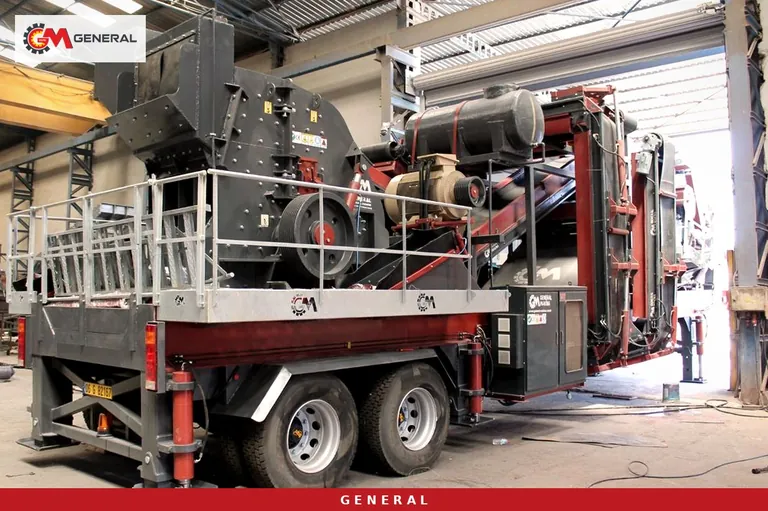
When buyers look for a mobile crusher that will produce between 100 and 300 tonnes per hour, the most common mistake is matching the target tonnage to the top of the catalogue capacity range. A catalogue range shows how much a machine can deliver under certain material and setting conditions; what it will actually deliver on your site depends on rock hardness, the size of blocks coming from the face, the required product fineness and the amount of material recirculated to the crusher. This article explains how to calculate capacity backwards from a daily target, which models in the General Makina mobile range are candidates at the 100, 150, 200, 250 and 300 t/h steps, and the five variables that upset the calculation. The steps for narrowing down a model from project data are covered separately in our article on choosing a mobile crushing and screening plant model; here the focus is purely on tonnage calculation and step selection.
Work backwards from the daily target
Hourly capacity is a result derived from sales or site demand, not a starting point. The calculation has three lines: how many tonnes of saleable product are needed per day, how many hours per day the plant actually crushes, and how much of that tonnage enters the crusher a second time.
Hypothetical example: 1,600 tonnes of product per day
Assume a road project needs 1,600 tonnes of aggregate per day and a single shift lasts 10 hours. Those 10 hours are not all production: morning warm-up and checks, waiting for the loader or trucks, screen mesh changes, the lunch break and end-of-shift cleaning all come off the clock. If we take 8 hours of net crushing time in our example, the required product capacity is 1,600 ÷ 8 = 200 t/h. Someone who divides by the full shift gets 160 t/h and picks a machine one step smaller; the difference comes back as a plant that falls short of target every single day.
Take the net-hours assumption from your own site records. How often the excavator drops a bucket, the truck loading pattern and how many times a year the plant will be relocated all affect this figure directly. If relocations are frequent, deduct set-up and dismantling hours from the annual calendar as well.
Closed circuit: the crusher sees more load than the product
Most of the impact and jaw-plus-impact models in the range work in closed circuit: oversize that cannot pass the target aperture on the screen is sent back to the crusher by conveyor. The General 02 product page, for example, states that coarse material is returned to the rotor until it reaches the target size. This means the tonnage the crusher processes per hour is higher than the product tonnage leaving the screen.
Back to our hypothetical example: 200 t/h of net product is required, and with a fines-heavy recipe let us assume 50 tonnes per hour of oversize returns to the crusher. The crusher and screen then carry 250 t/h. If you look only at the 200 t/h product and choose a machine whose range tops out in the 200-250 band, the plant is adequate on paper but runs permanently at its limit. The recirculation rate depends on the product recipe: the higher the share of 0-5 mm sand and the tighter the closed-side setting, the more material returns. That is why you should state target fractions and their proportions in writing when asking for a quotation.
What the low and high ends of the catalogue range tell you
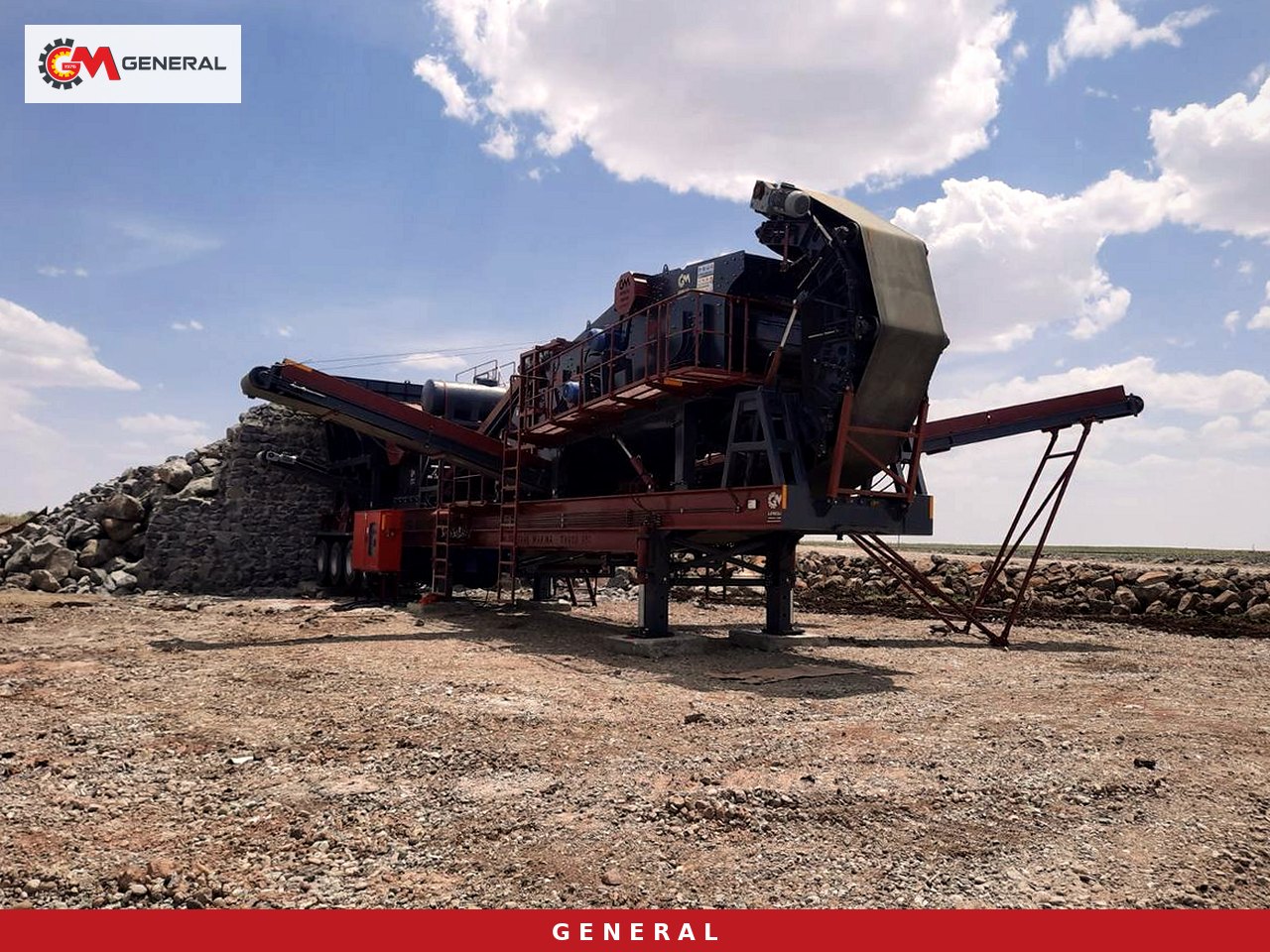
General Makina mobile plants are rated with a range rather than a single figure: 80-150 t/h for the General 800, 150-250 t/h for the GM 125, 250-375 t/h for the General 03, and so on. The top of the range represents easily crushed, clean feed and a coarse product mix; the bottom represents hard, abrasive rock, fine products and a tight setting. The same machine approaches the top end in limestone and drops to the bottom end in basalt and granite.
The practical rule: your target tonnage should sit in the middle or the lower part of the range. If your calculated load lands on the top end of a model, look at the next step up. For instance, a 250 t/h load is at the very limit of the GM 125 (150-250 t/h); the same load falls in a more comfortable position within the ranges of the GNR-MC110 (200-300 t/h) and the General 03 (250-375 t/h). We discuss the balance between capacity and investment size in our article on plant capacity sizing and investment.
Candidate models for the 100-300 t/h steps
The table below shows which models cover the crusher load you have calculated. All figures come from the technical tables on the respective product pages. Do not read the table in isolation from the crusher-type decision: jaw-primary models lead in hard, abrasive rock, impact models in limestone.
| Step | Mid-range / comfortable zone | At the edge of the range (limit) |
|---|---|---|
| 100 t/h | General 800 (80-150 t/h), Mobil 90 (90-150 t/h), GM 90JP (70-180 t/h) | GM 100 (100-180 t/h, low end), General 640 (60-100 t/h, top end) |
| 150 t/h | General 01, General 944, General 950 (120-180 t/h), GM 100 (100-180 t/h) | General 800 and Mobil 90 (top end), GM 125 (150-250 t/h, low end) |
| 200 t/h | GM 125 (150-250 t/h) | GNR-MC110 (200-300 t/h, low end); 120-180 t/h models insufficient |
| 250 t/h | GNR-MC110 (200-300 t/h), General 03 (250-375 t/h) | GM 125 (top end), General 02 (250-300 t/h, low end) |
| 300 t/h | General 03 (250-375 t/h) | General 02 and GNR-MC110 (top end) |
The 150 t/h step is the most crowded, and here the choice is driven by material more than capacity. The General 01 handles primary and secondary duty with a single GPS 1210 impact crusher; the General 944 combines a GPJ 90 jaw with a GM430 cone, and the General 950 pairs the same jaw with a DMK01 impact crusher. For river gravel and clayey feed, the washing Mobil 90 is a separate option. At 200 t/h and above the range narrows: on the tracked side the GM 125 tracked mobile impact crusher, on the wheeled side the GNR-MC110, General 02 and General 03 remain.
Feed size quietly cuts capacity
It is not enough for the largest block from the face to fit the crusher opening; blocks close to the feed-size limit bridge in the crusher, stop the feeder and drag down the hourly average. Models at the same step have different feed sizes:
| Model | Capacity (t/h) | Max. feed (mm) | Crusher | Power / generator (kVA) |
|---|---|---|---|---|
| General 800 | 80-150 | 600 | PDK 1280 primary impact | 450 |
| Mobil 90 | 90-150 | 800 | GPJ 90 jaw + washing screen | 350 |
| GM 100 (tracked) | 100-180 | 600 | GNR-01 impact, 160 kW | 450 |
| General 01 | 120-180 | 700 | GPS 1210 impact | 550 |
| General 944 | 120-180 | 800 | GPJ 90 jaw + GM430 cone | 550 |
| General 950 | 120-180 | 800 | GPJ 90 jaw + DMK01 impact | 600 |
| GM 125 (tracked) | 150-250 | 700 | GNR PDK02 impact, 200 kW | 550 |
| GNR-MC110 | 200-300 | 900 | GPJ 110 jaw + GS1215 / DMK03 impact | 750 |
| General 02 | 250-300 | 1000 | GPS 1413 impact | 660 |
| General 03 | 250-375 | 900 | GPS 1415 impact | 750 |
In a blasted quarry with a high share of large blocks, choosing the model with the wider feed opening among those that meet the tonnage reduces the excavator hours spent breaking oversize in front of the crusher. In the 200-300 t/h band the General 02 offers the widest opening at 1000 mm; the GNR-MC110 accepts 900 mm feed and, because it is split over two chassis, its weight is not concentrated on a single platform.
Does the screen area carry the tonnage?
Crusher capacity alone is not enough; you also need screen area that classifies the crushed material at the same rate. Screens grow with each step: 1600×5000 mm on the 120-180 t/h models, 2000×5000 mm on the General 02, 2000×6000 mm on the GNR-MC110 and 2400×5000 mm on the General 03. If you will sell four fractions (0-5 / 5-12 / 12-19 / 19-40 mm), look first at the models with 4-deck screens (General 01, 02, 03 and GNR-MC110); the 944 and 950 produce 0-5 / 5-12 / 12-19 mm with a 3-deck horizontal screen. An undersized screen either lets fines carry over into coarse product or increases recirculation; both reduce net product tonnage.
Generator kVA and the energy side
Mobile plants usually draw power from a generator on site, and power demand rises with each step: 450 kVA for the General 800 and GM 100, 550 kVA for the General 01, 944 and GM 125, 600 kVA for the General 950, 660 kVA for the General 02, and 750 kVA for the GNR-MC110 and General 03. If you are sourcing the generator separately, use the value on the model's product page; if stockpile conveyors or an extra screen will be added later, have the power calculation redone at quotation stage.
The real mechanisms for using energy efficiently are well defined: matching crusher and screen to the same tonnage, adjusting the feeder to crusher load and starting motors in sequence. A PLC/SCADA automation and control system provides sequential start/stop, blockage protection and motor-load monitoring, so the crusher does not idle and feed is throttled back when it overloads. Soft-starter, frequency control and remote monitoring options are available on the General 01.
Checklist before requesting a quotation
- Is the daily saleable product target (tonnes) and shift pattern written down?
- Have net crushing hours been calculated from the site's loading and waiting records?
- Are target fractions and their proportions defined; how large is the sand share?
- Has the crusher load been calculated including closed-circuit recirculation?
- Does this load sit in the middle or lower part of the selected model's catalogue range?
- Has the largest block in the quarry been measured and compared with the model's feed limit?
- Have rock hardness and abrasiveness been reflected in the impact or jaw primary decision?
- Are generator kVA and grid availability clarified?
Frequently asked questions
Is the catalogue capacity product output or crusher load?
The range shows the model's production band under given material and setting conditions. Because oversize returned in closed circuit passes through the crusher a second time, build your calculation on crusher load and make sure to raise this distinction in the quotation meeting.
One large plant or two small ones for 200 t/h?
Two plants keep half the output running when one is down for maintenance, but they need twice the operators, loaders and generators. If you will run continuously at one site, a single larger model makes sense; for work split between different locations, two separate plants may be more logical. The decision is site-specific.
Should I choose tracked or wheeled?
This depends more on how often you move on site than on capacity. In the 100-250 t/h band there are the tracked GM 100 and GM 125, and the General series on the wheeled side. For details see our mobile crushing plants page.
What drives the price?
The capacity step, crusher type (impact, jaw, cone), screen size and number of decks, generator scope, chassis design and automation options determine the price. There is no price list on the site; a firm quotation is prepared from your project data.
Conclusion
To find the right step, divide the daily target by net hours, add closed-circuit recirculation, place the resulting load in the middle of the catalogue range and cross-check it against feed size, screen area and generator power. A model that passes these four checks delivers on site the tonnage it promises on paper. General Makina has been manufacturing crushing and screening equipment since 1976 and provides a 1-year warranty on its mobile plants. Send us your daily target, material and fractions, and request a quotation for the model that fits your step via our contact page.
Definitions of technical terms: Glossary