EN — English
 TR — Türkçe
 DE — Deutsch
 RU — Русский
 FR — Français
 ES — Español
 AR — العربية
 SR — Српски

Mobile Crusher Settings That Raise On-Site Rock Crushing Efficiency by 30%
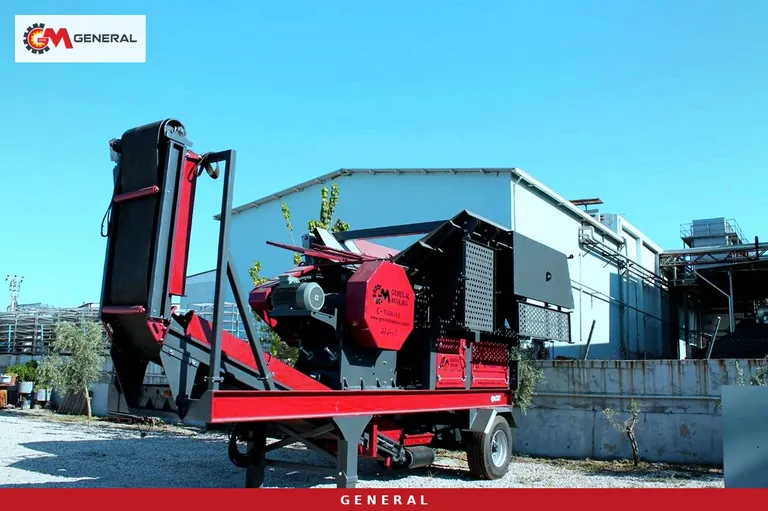
A mobile crusher starts work on site with the settings it left the factory with. But the rock, its moisture and its size distribution differ from one site to the next. A few weeks later the picture is usually the same: the feeder keeps stopping, the return conveyor runs full, the fraction you need comes out short, and a pile of fines nobody buys grows under the screen. The plant feels tired and the operator starts saying "that's all it can do". Most of the time, what is missing is not power but a handful of settings that no longer match each other.
Let us be clear about the 30% in the title from the start: it is not a figure guaranteed on every site. The gain depends on the rock being processed and on how far the current settings have drifted from target. On a line that is already well tuned, there is little left to win. On a line that has run for months untouched, with the wrong screen apertures or a crusher fed with an empty chamber, an improvement of that order in saleable tonnage is a realistic target when the settings are corrected in the right sequence. This article explains which mechanisms that gain comes from and in what order to tackle them on site.
Measure first: how will you judge the adjustment?
A crew that does not record today's performance before adjusting will never know what actually worked. Tie the word "efficiency" to a single number: the tonnage of saleable fractions sent to stockpile in a given shift. Total throughput through the crusher is not that number; material circulating on the return conveyor, or fines with no buyer, inflate the tonnage without earning anything.
The baseline record should include: end-of-shift tonnage of every stockpile (weighbridge or bucket count), whether the return conveyor runs full, how many times the feeder stopped, the crusher motor current and the moisture of the rock that day. The evaluation formula is simple: Improvement = (saleable tonnage after adjustment − saleable tonnage before) ÷ saleable tonnage before. Unless you compare the same rock, the same shift length and an average of several shifts, even a day in a softer bench will look like "the adjustment worked".
Feeder speed and grizzly by-pass: what enters the crusher?
The first setting on the line is not on the crusher but on the feeder. The vibrating feeder speed must keep the crusher supplied steadily. Too fast and the crusher chokes up and the feeder stops; too slow and the crusher runs half empty, burning energy without producing tonnage. Either way, average output falls. With a frequency-controlled (VFD) drive, feeder speed can be stepped from the panel; the goal is the highest speed that keeps stoppages to a minimum.
The second point to check is the grizzly by-pass section. On the GNR vibrating grizzly feeder fines and soil-laden material drop through the grizzly and bypass the crusher, so the crusher does not waste capacity re-breaking material that is already small. If the bar spacing is too narrow, material that needs no crushing goes into the crusher; if it is too wide, oversize escapes through the by-pass and contaminates the product. In sticky, clay-rich run-of-mine the grizzly blinds. At that point adjustment is not enough, and the equipment choice should move towards a wobbler feeder.
Crusher adjustments: setting and rotor speed
When to change CSS and OSS
On jaw and cone crushers, product size is governed by the closed side setting (CSS: the gap when the jaw or mantle is at its closest position). The open side setting (OSS) is the gap at the widest position and affects how quickly coarse pieces travel down. Closing the CSS makes the product finer but reduces throughput and speeds up wear. Opening it raises throughput, but the oversize retained on the screen is loaded back into the recirculation loop.
The right CSS is chosen together with the target fraction and the screen layout. Among our mobile crushing and screening plants the General 01 and General 944 product pages give an output setting range of 0-100 mm. That alone shows there is no single correct value; the setting follows demand on site. A practical rule: start with a CSS close to the upper limit of your best-selling fraction, then change it in small steps while watching the load on the return conveyor. Check the wear parts after each step, because worn jaws or liners open the CSS by themselves.
Choke feeding the cone crusher
On a cone crusher the CSS is set hydraulically, and hydraulic cylinders protect against tramp and packing. To get the full effect of the setting, however, the crushing chamber must be kept full. This feed regime is called choke feeding. In a full chamber, particles also break by pressing against each other; the product comes out more cubical and the liners wear evenly. A cone crusher fed with an empty chamber lets stone bounce between the liners, the product turns flaky and the liner hollows out in one zone. The product page gives reduction ratios of 6:1–8:1 for the secondary stage and about 10:1 for the tertiary stage; a CSS that pushes beyond these drops the crusher below its capacity.
Rotor speed: particle shape and fines in impact and VSI crushers
On an impact crusher, the setting is not the only thing that shapes the product; the rotor tip speed changes the result too. As speed rises, stone hits the blow bars and aprons harder. The result is a more cubical product and more fines, and blow bar wear accelerates. Lower speed gives more coarse particles and fewer fines. Which one counts as "efficiency" depends on what the site sells. A quarry short of sand for concrete can live with extra fines. A quarry selling road base or coarse chippings sees the same fines as an unsellable heap.
On a vertical shaft impactor (VSI) the relationship is even clearer. The rotor accelerates material up to about 80 m/s and throws it against its own rock (rock-on-rock) or against anvils. On the GNR-MVSI 900 mobile VSI plant the maximum feed is 50 mm; the unit is a shaping and sand stage, and its product is split into 0-3 / 3-5 / 5-12 mm fractions. Raising rotor speed increases the sand share. But if pieces larger than 50 mm reach the feed, rotor speed will not fix it; the CSS of the previous stage must be corrected first.
Screen decks and apertures: the setting that controls recirculation
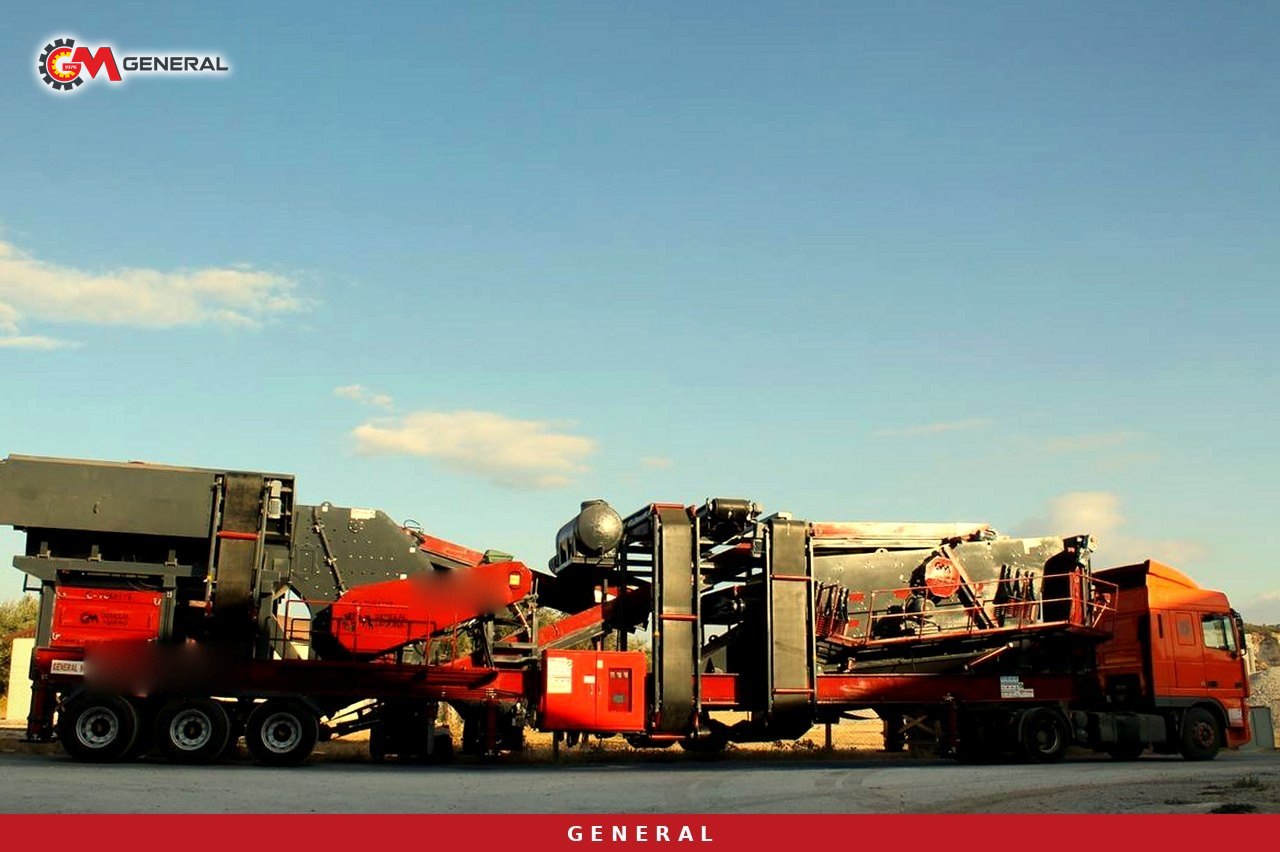
On many sites, lost tonnage is created at the screen, not at the crusher. If the screen does not separate properly, saleable material either ends up in the coarse fraction or travels back to the crusher on the return conveyor to be broken again for no reason. The vibrating screen product pages give three useful facts. Near-size particles (75-125% of the aperture) reduce efficiency. Inclination is typically 15-30°; a steeper deck raises capacity but reduces the effective aperture. And each additional deck cuts capacity by about 10%. Commercial screening efficiency is quoted at 90-95%.
On site this means that keeping a deck for a fraction you do not sell costs capacity on the others. The General 01 has a 1600×5000 mm, four-deck screen; the General 944 has a three-deck screen of the same size. If you do not need all four decks, reorganising the apertures around the fractions in demand can deliver results faster than any crusher adjustment. Where damp material blinds the mesh, screens with an adjustable oval stroke are designed to reduce pegging. Record the old and new apertures whenever you change the mesh; only then will the next measurement be a meaningful comparison.
Load balancing with automation: holding the setting through the shift
A setting made well in the morning can lose its value in the afternoon when the rock gets harder or moisture rises. It is hard for an operator to catch every change by eye. The automation and control system ties this job to motor current. When crusher current approaches its threshold, feeder speed drops automatically; when the current returns to normal, feeding increases again. The crusher therefore runs continuously loaded without blocking, and choke feeding of the cone crusher depends on this same balance.
The same system starts equipment against the material flow, from stockpile back to feeder, and stops all upstream stages when a conveyor stops, so no belt has to start under load. Once the panel is networked, shift tonnage, downtime and alarm history are logged. Those logs are a ready data source for the before-and-after comparison described in the first section.
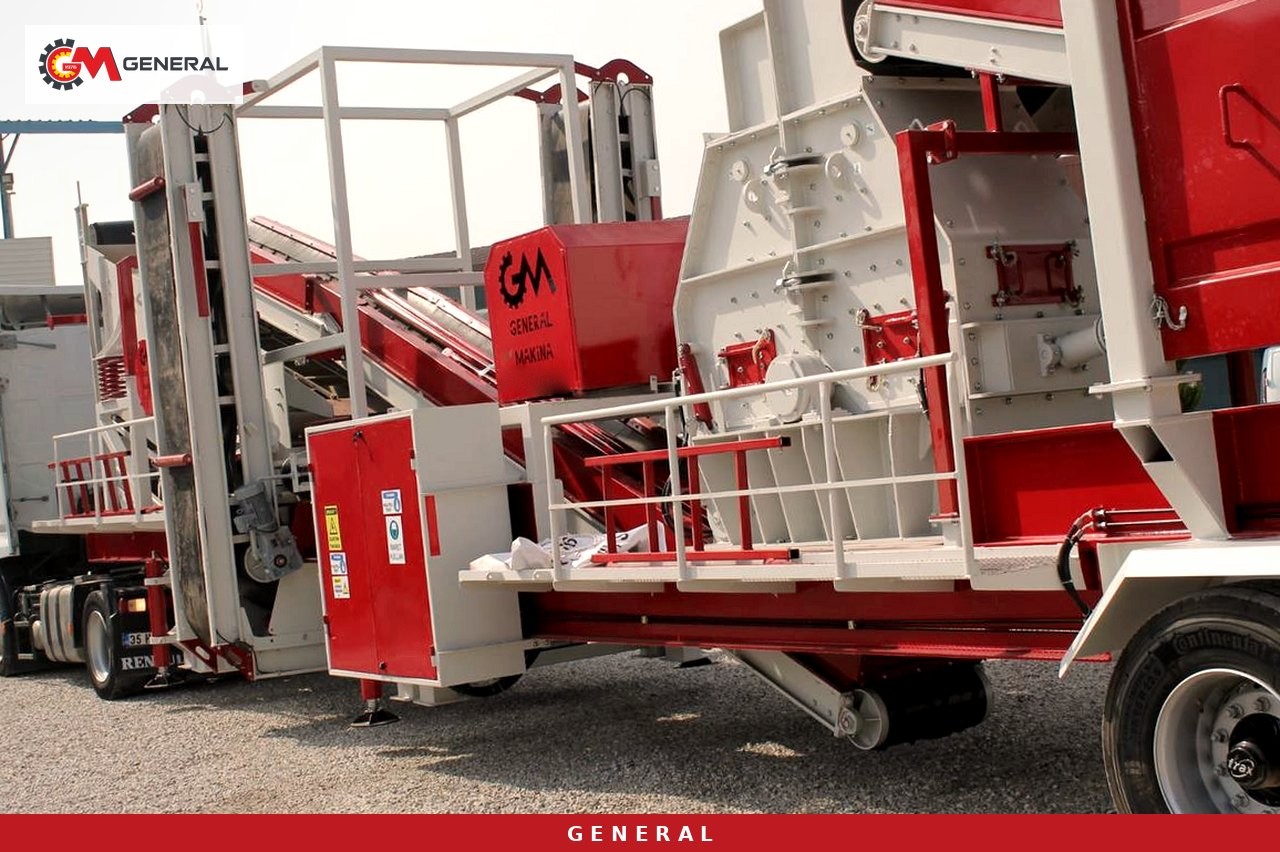
Setting points by model and the order of work
The available adjustments differ by crusher type. The table below uses the values on the product pages to summarise which setting matters most on which model. Values not listed are defined for the material at the order stage.
| Model | Crusher arrangement | Max. feed | Capacity | Screen | Key setting |
|---|---|---|---|---|---|
| General 800 | PDK 1280 primary impact | 600 mm | 80-150 t/h | 1300×4000 mm, 3 decks | Rotor speed, apron gap |
| General 01 | GPS 1210 impact (primary+secondary) | 700 mm | 120-180 t/h | 1600×5000 mm, 4 decks | Grizzly by-pass, deck layout |
| General 944 | GPJ 90 jaw + GM430 cone | 800 mm | 120-180 t/h | 1600×5000 mm, 3 decks | CSS, choke feeding |
| GNR-MVSI 900 | VSI 900 vertical shaft | 50 mm | 90-180 t/h | 1600×5000 mm, 3 decks | Rotor speed, feed size |
Changing every setting at once hides which step worked. The sequence below lets you see the effect of each change separately:
- Keep a three-shift baseline: tonnage per fraction, recirculating load, feeder stoppages, crusher current, moisture.
- Measure the wear parts. A CSS adjustment made on worn jaws, liners or blow bars is misleading.
- Bring grizzly spacing and feeder speed to the highest value at which the feeder no longer stops.
- Set the CSS for your best-selling fraction; on a cone crusher, confirm visually that the chamber stays full.
- On impact or VSI crushers, choose rotor speed to suit the fines and particle-shape target.
- Rearrange screen apertures and deck layout around the fractions you actually sell.
- Tune the current threshold and feeder response in the automation; switch on shift reports.
- Measure again with the same method and calculate the improvement with the formula.
If the plant is still at the selection stage, treat adjustability as a model feature too. For the logic of narrowing models by capacity band, see our guide on choosing a mobile crusher for 100-300 t/h.
Frequently asked questions
Can every mobile crusher gain 30% in efficiency?
No. This figure is not a guarantee. On a line already matched to its rock, the margin is small. On a line with the wrong apertures, empty-chamber feeding or frequent feeder stops, a gain of that order is a reasonable target. Only a before-and-after measurement made with the same method shows the result.
Why does closing the CSS reduce throughput?
A narrower gap means every particle is broken more times before it leaves the crusher. Less material passes per unit of time and wear increases. If you need a finer product, closing the setting may be right, but judge it together with the recirculating load and stockpile tonnage.
Does a higher rotor speed always give a better product?
It gives a more cubical product and more fines, but it also speeds up blow bar or rotor tip wear. If there is no buyer for the fines, higher speed can reduce saleable tonnage.
What information is needed for setting advice and a quotation?
Rock type, the largest run-of-mine piece size, moisture, the fractions you sell and your target tonnage. Price and delivery terms are prepared for each project based on this information.
Conclusion
Mobile crusher efficiency depends on the balance between feeder speed, grizzly by-pass, CSS/OSS, rotor speed, screen layout and automation. When these settings are handled with measurement and in sequence, a large part of the lost tonnage can be recovered; how much depends on your rock and on the current state of the line. For a model and setting concept that suits your material, contact us and we will prepare a project-specific quotation based on your rock data.
Definitions of technical terms: Glossary