EN — English
 TR — Türkçe
 DE — Deutsch
 RU — Русский
 FR — Français
 ES — Español
 AR — العربية
 SR — Српски

5 Innovative Mobile Crusher Features That Cut On-Site Rock Crushing Costs
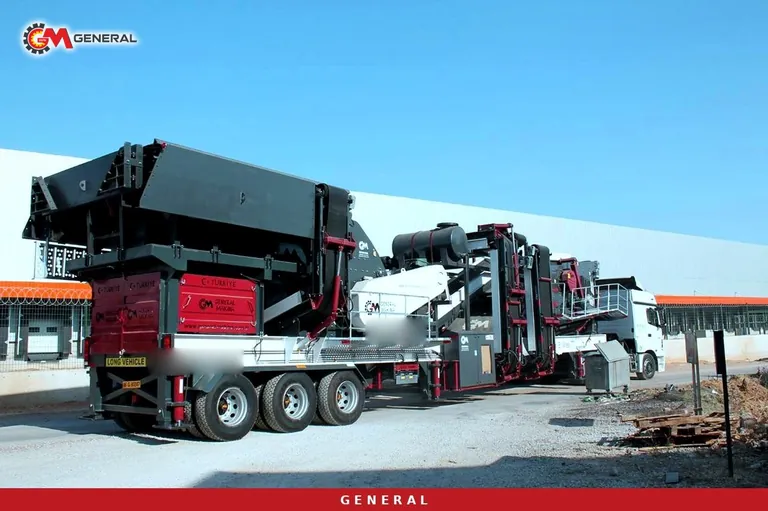
The cost of a tonne of aggregate produced on site never comes from a single invoice. It is the sum of five linked items, and writing them down sharpens every decision: Cost per tonne = (energy + wear parts + maintenance and downtime + operator + transport and setup) ÷ tonnes produced. Any design feature that shrinks one of the items on top, or raises the tonnage underneath, pulls the cost per tonne down. The five features in this article are engineering solutions described on the product pages of General Makina's mobile plants, and each one acts on a specific item of that formula.
We treat the word "innovative" in the title as a mechanism rather than an adjective: which component, under which conditions, reduces which cost item? We give no percentages or savings rates, because the gain depends on the rock type, the share of fines in the feed, the current crusher setting and how often the site moves. Every technical value quoted comes from the specification table of the model named next to it.
1. By-pass grizzly feeding: only rock that needs crushing enters the crusher
Part of the run-of-mine material arriving from the face is often already at target size, or is soil and fines. If it passes through the crusher, the rotor or jaw spends energy on it, the liners rub against it and the crushing chamber fills up for nothing. A by-pass grizzly feeder splits the flow before the crusher: fines dropping between the grizzly bars are routed around the crusher, and only oversize rock reaches the chamber.
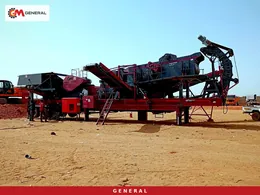
General Makina applies this at different scales across its range. The vibrating feeder on the General 01 has a by-pass grizzly that separates fines at the very start of the line. On the tracked GM 90JP, material removed by the 820×3000 mm grizzly vibrating feeder is carried away on a 600×6000 mm by-pass conveyor. On the GM 125, a 1360×2160 mm grizzly pre-screen and a 600×5000 mm by-pass conveyor do the same job.
The cost effect comes from three directions. First, crusher capacity is reserved for rock that genuinely needs crushing, so more oversize passes through the same crusher. Second, because fines and soil never enter the chamber, jaw plates and blow bars do not wear against them. Third, the risk of clayey fines sticking in the chamber and slowing the flow drops. How large the gain is depends entirely on the feed grading: if the run-of-mine is almost all large blocks, the grizzly contributes little; with river material or overburden-rich feed, it becomes clearly visible. Sharing even an estimated grading of your feed at the quotation stage lets the right grizzly opening be chosen.
2. Two stages in one body: primary and secondary together in the GPS 1210 on the General 01
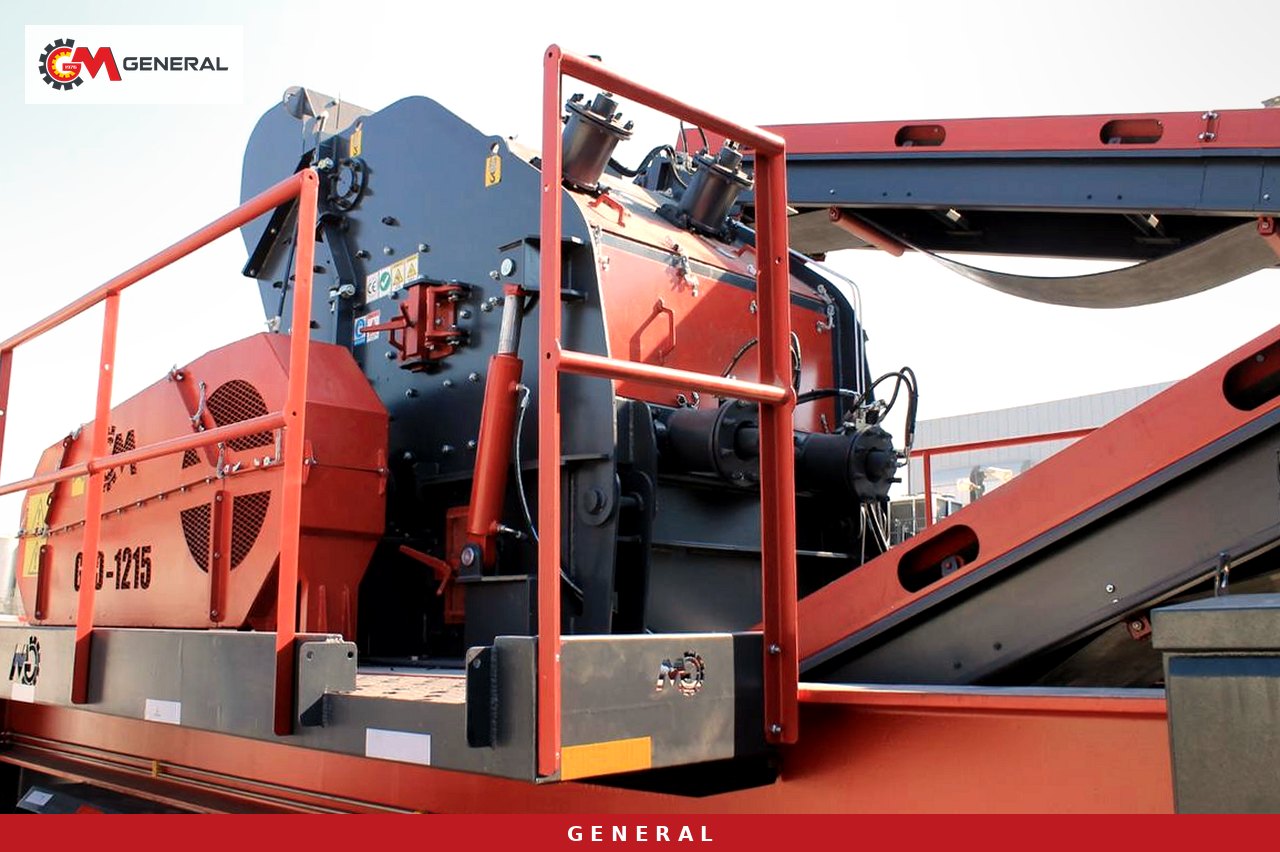
In a conventional mobile line, a primary crusher reduces the large blocks and a secondary crusher gives the product its final size. Two crushers mean two drive groups, two sets of liners, two separate settings and lubrication points, and a longer chassis. The General 01 mobile crushing and screening plant combines both duties in a single body: the GPS 1210 two-chamber, triple-pendulum impact crusher. The plant accepts 700 mm feed, produces 120-180 t/h and its 1600×5000 mm four-deck screen sorts output into 0-5 / 5-12 / 12-19 / 19-40 mm fractions.
The difference shows when you compare it with two-crusher models in the same tonnage band. The General 944 (GPJ 90 jaw + GM430 cone) and the General 950 (GPJ 90 jaw + DMK01 impactor) also produce 120-180 t/h, but both weigh 70,000 kg. The General 01 weighs 55,000 kg and runs on a 550 kVA generator. A lighter chassis pays off in transport; one crusher fewer pays off in spare-parts stock, liner change time and maintenance hours.
This feature is not the right answer for every rock. Impact crushing is economical on limestone and low-abrasive stone; on hard, abrasive basalt, granite or quartz, blow bars wear quickly. In that case the choice that lowers cost per tonne is the General 944 with its compression-type cone secondary. In other words, the single-body solution saves money when matched with the right rock; on the wrong rock, the wear item claws the gain back.
3. Automation: control that ties feed rate to crusher load
The most expensive minutes on a mobile plant are those when the machine runs but produces nothing: an overloaded crusher that trips, a conveyor forced to start under a full belt, a blocked chute. General Makina's automation and control system does not leave these situations to the operator's reflexes. In the sequenced start defined on the PLC, equipment is started against the material flow, from the stockpile conveyor back to the feeder; when one unit stops, every stage above it stops automatically, so no belt starts loaded. When crusher current approaches its threshold the feeder slows, and when current returns to normal the feed rate rises again.
For the General 01, a touchscreen panel, soft-starter, frequency control and internet-linked remote monitoring are offered; which of them fall within the delivery scope is settled in the order. Once the control panel is networked, shift reports, tonnes produced, downtime and alarm history are logged. That log makes the denominator of the cost formula, the tonnes actually produced, measurable. A savings calculation made without knowing which shift lost how much time, and why, never rises above guesswork.
The return on automation comes from keeping the crusher at an operating point that is full but never choked. A full chamber supports rock-on-rock breakage, while a crusher running half empty spends energy without turning it into product. The system components are described on the automation and control system page.
4. Crusher, washing screen and screw washer on one chassis: Mobil 90
An operation working with clayey river gravel or dirty run-of-mine cannot get clean aggregate from a dry mobile crusher. The usual fix is to set up a separate washing plant next to the crusher, which means a second chassis, transfer conveyors, a second installation and a second power connection. The Mobil 90 crushing, washing and screening plant combines all three jobs on one wheeled chassis: the GPJ 90 jaw crusher sizes blocks up to 800 mm, the 1600×5000 mm 3/4-deck washing screen both washes and sorts the material, and the 600×6000 mm twin screw washer recovers 0-5 mm sand without losing it to the water.
The plant has a capacity of 90-150 t/h, delivers 0-5 / 5-20 / 20-60 mm products and runs on a 350 kVA generator; the 45,000 kg three-axle chassis has a transport size of 3600 × 15700 × 4500 mm. Two mechanisms stand out on the cost side. The first is that the investment and installation burden of a separate washing plant disappears. The second is that fine sand captured by the screw goes to the stockpile as saleable product instead of ending up in the settling pond. Depending on the application, a cone or impact secondary crusher can be added in front. For sand jobs that need no crushing, models in the mobile washing and screening plants category may suit better.
5. Folding hydraulic conveyors and support legs: setup without foundations
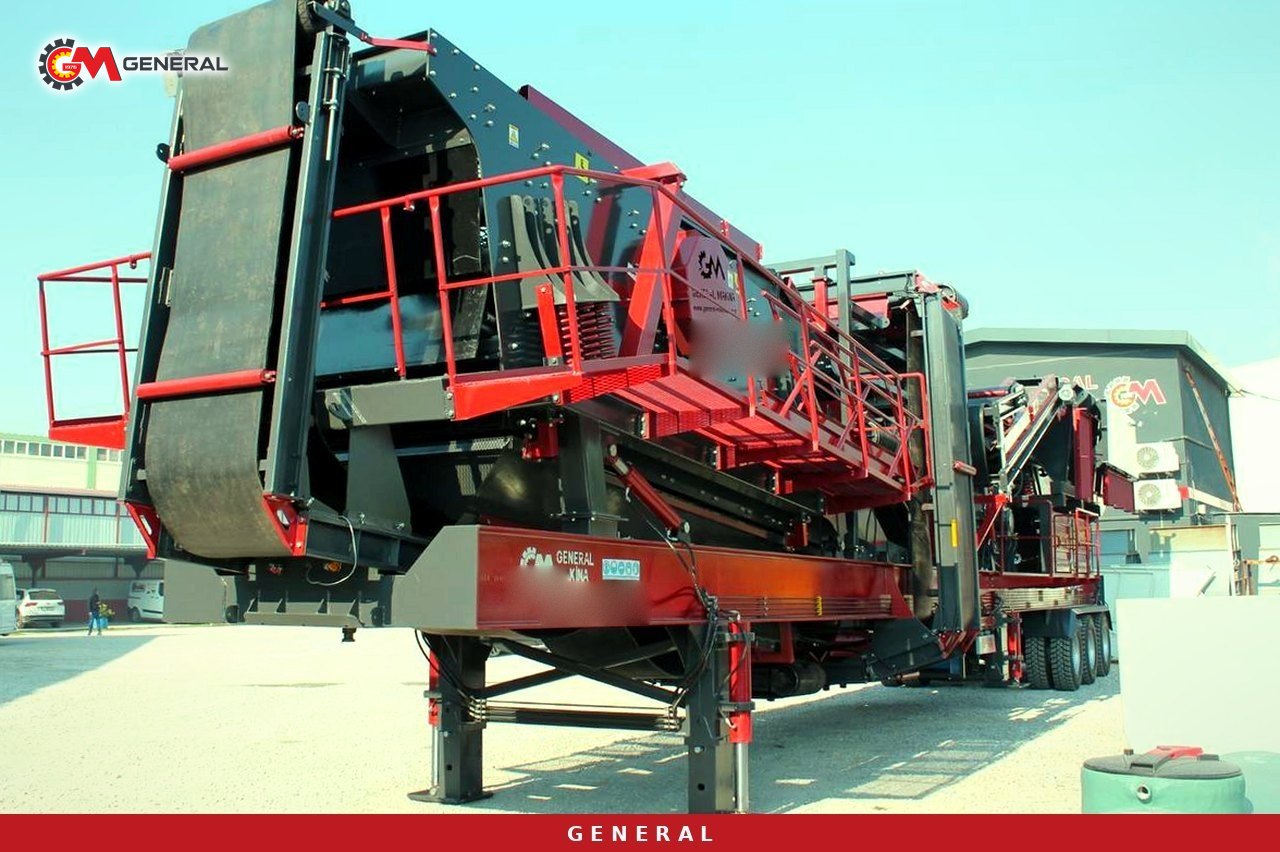
Most of the setup cost of a stationary plant goes into the ground rather than the crusher: excavation, concrete foundations, steel structure and conveyors erected one by one. If the site changes every few months, that cost repeats with every move. Folding hydraulic conveyors and hydraulic support legs shrink this recurring item: conveyors fold onto the chassis for transport and open hydraulically on site, while the legs fix the chassis to the ground with no concrete foundation required.
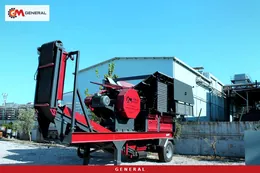
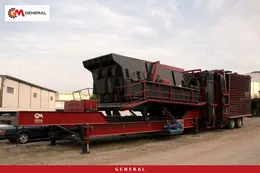
On the General 03, folding hydraulic conveyors and support legs come on a four-axle chassis together with 250-375 t/h capacity and a 2400×5000 mm four-deck screen; a 750 kVA power unit is standard. At a smaller scale, the General 800 gathers folding conveyors and legs on a single synchronised chassis: 80-150 t/h capacity, 35,000 kg weight and a 3600×15500×4500 mm transport size. You can compare wheeled and tracked options by tonnage band on the mobile crushers page.
The effect of this feature on cost per tonne is directly proportional to how many times a year the operation relocates. For a quarry that will work one site for many years, a stationary plant can still make sense. For a contractor following a road project or working several small quarries in turn, avoiding excavation and foundation costs at every move becomes decisive. Foundation-free setup also shortens dismantling and ground restoration when leaving a site.
Decision matrix and pre-quotation checklist
The table below matches each feature with the cost item it reduces and the technical data of an example model. The last column is not a ratio; it shows the condition under which the gain becomes visible.
| Feature | Mechanism | Item reduced | Example model and data | Where the gain is clearest |
|---|---|---|---|---|
| 1. By-pass grizzly feeding | Fines bypass the crusher | Wear, energy | GM 125: 1360×2160 mm grizzly, 600×5000 mm by-pass conveyor | High share of fines and soil in the feed |
| 2. Two stages in one body | GPS 1210 does primary and secondary in one body | Investment, maintenance, transport | General 01: 120-180 t/h, 700 mm, 55,000 kg | Limestone and low-abrasive rock |
| 3. Automation | Feeder speed follows crusher current; sequenced interlocks | Downtime, maintenance | General 01: soft-starter, frequency control, remote monitoring (option) | Variable feed, shift work |
| 4. Crushing, washing and screening on one chassis | No separate washing plant; screw keeps 0-5 mm sand | Investment, setup, product loss | Mobil 90: 90-150 t/h, 800 mm, 350 kVA | Clayey river gravel, dirty run-of-mine |
| 5. Folding hydraulic conveyors and legs | No foundations; conveyors travel on the chassis | Transport and setup | General 03: 250-375 t/h, 750 kVA, four-axle chassis | Frequent site changes |
Preparing the following information before requesting a quotation clarifies which feature will actually pay off on your site:
- Rock type and abrasiveness (limestone, or basalt and granite): decides between a single-body impactor and a jaw-plus-cone combination.
- Largest block size in the feed (mm) and an estimated share of fines or soil: defines the contribution and opening of the by-pass grizzly.
- Whether the material contains clay or contamination: shows whether a single chassis with washing is needed.
- How many times a year the site will change: reveals the value of folding conveyors and hydraulic legs.
- Power source (generator or grid): the required kVA and panel design depend on it.
- Target fractions and daily tonnage: set the number of screen decks and the model band.
- Shift pattern and need for remote monitoring: define the scope of automation options.
To see energy and wear cost per tonne with your own values, use the cost-per-tonne calculator. Entering the figures of your current line and comparing which item each feature would affect, on the same formula, gives a sounder basis than estimates.
Frequently asked questions
Can all five features be found together on one machine?
Partly. The General 01 combines a by-pass grizzly feeder, two stages in one body and a touchscreen panel option. Washing needs a different architecture, such as the Mobil 90. Which combination you need is determined by rock type and product targets.
By what percentage do these features cut cost per tonne?
Quoting a single figure would not be honest. The gain depends on the share of fines in the feed, the abrasiveness of the rock, the current crusher setting and how often you relocate. The sound approach is to calculate your current line's cost per tonne with the formula above and assess, item by item, which cost each feature would touch.
Is a single-body impact plant suitable for hard basalt?
Usually not. Blow bars wear fast on abrasive rock such as basalt and granite. In the same 120-180 t/h band, consider the General 944 with jaw and cone, or the General 950 with jaw and impactor.
How do I get price and delivery information?
Price varies with the model, crusher combination, number of screen decks, generator choice, automation options and transport scope. When you request a quotation with your rock type, feed size and tonnage target, price and delivery details are given specifically for your project.
Conclusion: buy the cost item a feature removes, not the feature
Each of the five features acts on a different item of the cost-per-tonne formula: the by-pass grizzly on wear and energy, two stages in one body on investment and maintenance, automation on downtime, the single washing chassis on the burden of a second plant, and folding conveyors on transport and setup. Knowing which item is largest on your site tells you which feature is worth paying for. General Makina has manufactured in Izmir since 1976; its plants carry ISO 9001 and CE certification and are delivered with a one-year warranty excluding wear parts. Send your rock type, feed size and tonnage target through our contact page and we will prepare a quotation for the right model combination.
Definitions of technical terms: Glossary