EN — English
 TR — Türkçe
 DE — Deutsch
 RU — Русский
 FR — Français
 ES — Español
 AR — العربية
 SR — Српски

Urban jobsite mobile crusher operating plan
Naming the real constraint
An urban jobsite mobile crusher operating plan does not begin with tonnes per hour. It begins with how many hours and how many square metres the site allows. In a quarry, feed and crusher setting decide output; on a tight urban plot the decisive figures are the truck turning circle, the loader swing envelope, the local rule on working hours and the distance to the nearest occupied facade. Urban planning therefore starts with measuring the site, not with choosing the machine.
The output of the plan is a single sheet: a layout sketch, a time window and a material flow diagram. The three interlock, and changing one forces the other two to be recalculated.
Space: manoeuvring, layout and one-way flow
On a confined site the costliest mistake is to place the crusher first and think about haulage afterwards. The correct order is the reverse: the gate the truck enters, the space it turns in and the gate it leaves are fixed first, and the crusher and screen occupy what remains outside that route. Where one-way flow can be established, the number of reversing movements falls, which shortens the cycle and reduces risk at the same time. The demolition stockpile sits on the feed side and the product stockpile on the loading side; if the two meet at the same point, the layout is wrong.
A boundary is also drawn so that pedestrian and machine routes never cross. On urban sites there are pedestrians beyond the hoarding as well, so barriers and signage belong to the plan rather than being added later.
Time: the shift window and noise
Working hours in built-up areas are restricted by local authority decisions and those limits differ from city to city, so the first planning step is to obtain the rule in writing. The narrower the window, the more the uninterrupted running time matters compared with rated hourly capacity: refuelling, wear part checks and blockage clearing are moved outside the window.
On the noise side the machine carries documentation of its own. For equipment used outdoors, European Union rules require the manufacturer to determine the guaranteed sound power level and to indicate it on the machine together with the CE marking, while an EC declaration of conformity accompanies the unit. When an urban site is laid out, that figure is the only firm number available for positioning the plant relative to neighbouring buildings.
Constraint table
| Constraint | Measured on site | Planning decision | Verification |
|---|---|---|---|
| Manoeuvring room | Truck turning radius and gate width | One-way flow or banksman-guided reversing | Trial run with an empty truck |
| Working hours | Window permitted by the authority | Maintenance and refuelling outside the window | Written permission and shift roster |
| Distance to neighbours | Distance to nearest dwelling facade | Unit position and barrier placement | Dimension on the layout sketch |
| Noise source | Guaranteed sound power level of the machine | Orientation and screening | Machine plate and declaration of conformity |
| Dust | Crushing and discharge points | Water spray and reduced drop height | In-shift observation log |
| Road soiling | Tyre tracks at the exit gate | Wheel cleaning and sweeping frequency | Daily gate check |
| Stockpile capacity | Area available for product | Despatch frequency and number of fractions | End-of-day pile measurement |
Machine choice: compactness is a function
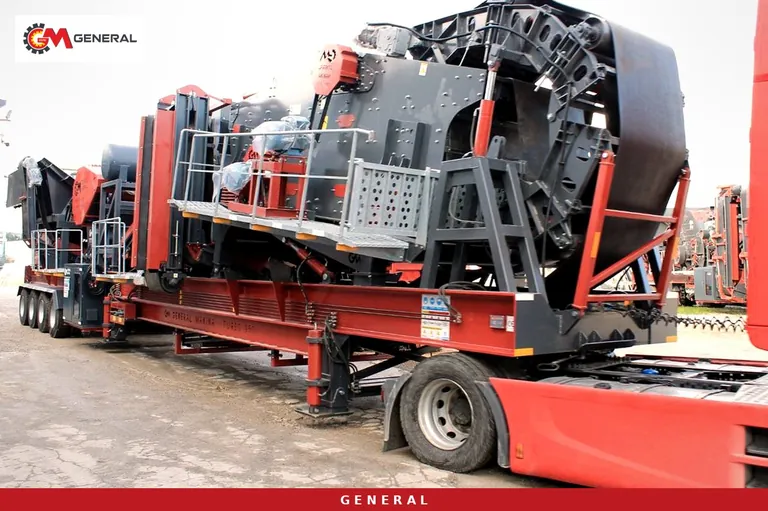
On a narrow plot the catalogue capacity ranks second; transport width, erection footprint and repositioning ability rank first. Tracked units earn their place where demolition advances across the site, because they move on their own without setting up fixed legs: the machine travels to the material instead of the material being hauled to the machine. Units in the track-mounted mobile crushers family are assessed on exactly this confined-space logic.
Material flow: cutting truck movements
The largest hidden cost of an urban site is haulage. Crushing demolition concrete on site and reusing it as fill, sub-base or temporary road material reduces both the trucks leaving and the trucks arriving with imported material. This part of the plan is a simple balance: fractions to be produced on site, quantities to be consumed on site, and the surplus that must leave. Crushing without that balance only moves the pile from one corner to another.
Neighbours: managing the complaint
In a built-up area a single complaint can effectively narrow the permitted window. The plan therefore treats neighbour notification as part of the work: working days and hours are announced in advance, one contact point is published, and every report is logged with its date and time. The log both produces data for improvement and serves as evidence when an objection is resolved. The articles that carry the same logic into set-up and daily operation sit under jobsite and mobile plant.
Frequently asked questions: urban jobsite mobile crusher operating plan
Should screening be done on a confined site
Yes when more than one fraction will be consumed on site; if a single fraction is enough, a screen is a unit that consumes space and time for nothing.
Is night work possible
It depends on local rules and is usually restricted. Planning should aim at using the daytime window without interruption rather than assuming night work.
How often must the crusher be repositioned
Where demolition proceeds in phases, several positions are normal. Every move requires the layout sketch and the flow diagram to be redrawn.
Definitions of technical terms: Glossary