EN — English
 TR — Türkçe
 DE — Deutsch
 RU — Русский
 FR — Français
 ES — Español
 AR — العربية
 SR — Српски

Using Mobile Crushers for Recycling and Asphalt/Concrete Crushing
Concrete from a demolition site, asphalt millings from a road resurfacing job and lifted asphalt slabs are often lumped together as "waste", yet once they reach the crusher they behave nothing alike. One carries reinforcing steel, another carries bitumen, the third arrives mixed with soil, timber and plaster. A contractor setting up mobile crushing for recycling should define the feed before choosing the machine: waste type, top lump size, rebar density and fines content decide which crusher and which pre-screening layout make sense. This article walks through how demolition concrete (C&D), asphalt and concrete waste are processed on site, why the impact crusher dominates this work, and where on the line steel, dust and fines problems are actually solved.
Three different feeds: demolition concrete, asphalt slabs and millings
Demolition concrete comes from columns, beams, slabs and foundations. Lumps are irregular, rebar sticks out of many of them, and the same pile contains plaster, brick, ceramics and soil. The main risk is steel entering the crusher, bridging in the hopper, ripping belts or jamming in the crushing chamber.
Asphalt slabs are pavement pieces cut out or lifted with a bucket. They contain no steel, but the bitumen binder makes the material flexible and sticky. After crushing, particles stay coated with bitumen; the goal is not to shatter the stone but to reach the target size without destroying the binder.
Asphalt millings (RAP from cold planing) are already small. They usually need clumps broken open and screening rather than real crushing. Running millings through a primary crusher creates unnecessary fines; separating in-spec material by pre-screening and crushing only the lumps is the sensible route.
All three feeds can go through one machine on the same day, but feeder settings, grizzly opening and screen layout must be considered separately for each. On mixed piles, keeping concrete and asphalt in separate stockpiles on site has a direct effect on product quality.
Why the impact crusher is preferred for this work
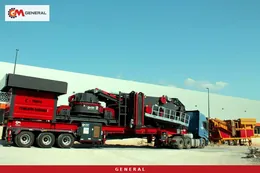
Concrete and asphalt are not high-silica, abrasive rocks like granite or basalt. In an impact crusher, blow bars on the rotor strike the material and throw it against the breaker plates; concrete splits along the weak planes between cement paste and aggregate. The result is a high reduction ratio in one stage and a cubical particle shape. General Makina's product pages list concrete/asphalt recycling explicitly as an application of its impact machines: the GM 100 tracked mobile impact crusher names concrete/asphalt recycling among its uses, and the GNR DMK series secondary impactor lists asphalt/C&D recycling among suitable materials.
The second reason impact crushers suit recycling is flexibility in wear parts. As the impact crusher product pages state, high-chrome blow bars are recommended for clean, abrasive feed, while tough manganese or martensitic bars are recommended for C&D work with tramp-iron risk. A piece of steel that slips through in demolition concrete can break a brittle high-chrome bar, so the content of the feed should decide the bar alloy. With asphalt the steel risk is low, and the choice is driven mainly by wear life.
When a jaw crusher takes the lead
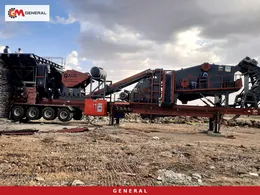
In demolition with heavily reinforced, oversized blocks, the impact crusher is not always the first choice. A jaw crusher, working by compression, tolerates large steel-laden lumps better and reduces the feed as a first stage. The GM 90JP tracked mobile jaw crusher also lists concrete/asphalt recycling among its applications; it accepts feed up to 700 mm and its GNR 90 jaw crusher is rated 95 kW. For such jobs a jaw-primary, impact-secondary setup works well; for cleaner, smaller demolition rubble a single impact machine delivers with less equipment. General selection criteria between crusher types are covered in our impact or jaw guide; this article focuses only on recycling feed.
Where to remove rebar on the line
Steel separation is not solved at one point; it is handled in three stages.
Before the crusher: On the demolition site, breaker and shear attachments on the excavator cut protruding long bars and reduce concrete pieces to fit the feed opening. Every long bar entering the hopper is a risk for bridging and belt damage.
In the crusher: The impact crusher strips the concrete off the steel. After crushing, rebar is largely freed and travels on the belt as separate pieces. That is why enough clearance and easy access under the crusher discharge belt matter for safely removing jammed steel.
After the crusher: Freed steel is collected by a magnetic separator (overband) mounted above the belt. General Makina's concrete (C&D) recycling plant page also states that a magnetic separator is integrated into the line for rebar removal. For copper cable, plastic and timber that the magnet cannot catch, planning a hand-picking point beside the belt improves product cleanliness considerably.
Pre-screening and fines removal
Soil and fines entering the crusher with demolition concrete do two kinds of damage: they waste energy and wear in the crusher, and they contaminate the final product. That makes grizzly pre-screening the most rewarding part of a recycling line.
- GM 100: a 900×2400 mm vibrating feeder is followed by a 1000×1500 grizzly pre-screen; crushed material is classified in closed circuit on a 1500×5500 mm triple-deck track screen. The integrated screen lets you produce fractions on site without bringing a separate screening machine.
- GM 125: a 1100×2600 mm feeder and 1360×2160 grizzly give a wider pre-screening surface; the 600×5000 mm bypass conveyor stockpiles grizzly undersize separately without sending it through the crusher. With mixed demolition feed this bypass keeps soil-heavy fines away from the product.
- Mobile Pre-Screen DMK: designed for the second stage; it takes 0-100 mm feed, lets ready-sized fines bypass the crusher at the pre-screen and delivers a 0-30 mm product. Its capacity range is 40-300 t/h. When finer, cubical recycled aggregate is needed after primary crushing, see the Mobile Pre-Screen DMK page.
In wet, clayey or organic piles, a vibrating screen deck can blind. In that case a screening solution less prone to clogging, such as a rotating trommel, or processing the feed in a dry period should be considered.
Crushing asphalt: temperature, sticking and over-crushing
Bitumen governs how asphalt behaves. In piles left in hot weather and direct sun, bitumen softens; material smears onto hopper walls, breaker plates and belt scrapers. Sticking lowers throughput and forces frequent stops for cleaning. In practice asphalt crushing is shifted to the cooler hours of the day, stockpiles are kept shaded or covered where possible, and millings piles that have re-bonded under their own weight are opened up with a loader before feeding.
The second issue is over-crushing. With asphalt the aim is to preserve bitumen-coated aggregate as much as possible. If rotor speed and crushing gap are set too aggressively, particles fracture, uncoated faces appear and the fines share rises. Asphalt settings therefore differ from concrete; with millings, a light crush that only breaks clumps plus accurate screening is often enough.
Cleanliness matters too: base-course material or soil mixed into asphalt lowers the reuse value of reclaimed asphalt. Loading the surface course and lower layers separately during removal prevents a problem the crusher cannot fix.
Model matching and site constraints
The table below uses the technical values on the product pages to show which machine fits which role in a recycling flow. Capacities are ranges that vary with material; with recycling feed, real tonnage is confirmed on site depending on steel and fines content.
| Model | Crusher type | Capacity | Max. feed | Crusher power | Generator / power | Role in recycling |
|---|---|---|---|---|---|---|
| GM 90JP | Jaw (GNR 90) | 70-180 t/h | 700 mm | 95 kW | 250 kVA | First stage for heavily reinforced, oversized demolition blocks |
| GM 100 | Impact (GNR-01) | 100-180 t/h | 600 mm | 160 kW | 450 kVA | Crushing plus triple-deck screening in one machine for concrete/asphalt |
| GM 125 | Impact (GNR PDK02) | 150-250 t/h | 700 mm | 200 kW | 550 kVA | High tonnage on large recycling sites, fines separation via bypass |
| Mobile Pre-Screen DMK | Secondary impact | 40-300 t/h | 0-100 mm | — | — | 0-30 mm cubical product in the second stage |
Dust, noise and tight sites
On urban demolition sites the crusher often works close to buildings, roads and neighbouring plots. Water spraying is planned at the feed point, crusher discharge and belt transfer ends; overdo the water, though, and fines turn to mud and blind the screen. The concrete recycling plant page also mentions planning air/water cleaning options for dust and lightweight material. Positioning stockpiles with the wind direction in mind and reducing belt drop heights cut dust without extra equipment.
When space is tight, the tracked machine's advantage becomes clear: the GM series is self-propelled, needs no concrete foundation or ground preparation, and can be driven to a new spot close to the pile as demolition progresses, shortening loader haul distance. On the energy side, generator capacity (450 kVA for the GM 100, 550 kVA for the GM 125) should be factored into fuel logistics and night-work restrictions.
Where recycled aggregate is used
The value of crushed concrete and asphalt depends on knowing its destination from the start. In general practice, aggregate from demolition concrete goes into fill, sub-base and base layers, site haul roads, drainage and backfill. Asphalt millings, once properly screened and classified, can be added back into asphalt mixes or used for stabilised and temporary site roads. Which use is accepted depends on the project specification and the relevant national regulations, so product grading and cleanliness should be confirmed with the client before ordering.
The fraction plan follows the end use: a single mixed fraction may be enough for fill, while sub-base needs more controlled grading. A triple-deck screen produces several products in one pass, and stockpiling fines separately keeps the coarse product clean. A complete line is put together following the machine-set logic on the recycling plant page.
Site information to gather before requesting a quotation
- Waste type and share: demolition concrete, asphalt slabs, millings or mixed.
- Largest lump size and whether pre-breaking/shearing is available on site.
- Rebar density: light mesh slabs or heavily reinforced columns and beams.
- Soil, brick, timber and plastic content; moisture and clay condition.
- Target products and destination: fill, sub-base or new asphalt mix.
- Daily target tonnage and working hours, day/night restrictions.
- Site width, distance to neighbouring buildings, dust and noise conditions.
- Whether grid power is available or a generator will be used.
Frequently asked questions
Can reinforced concrete go straight into an impact crusher?
Yes, but protruding long rebar should be cut first. During crushing, concrete separates from the steel; freed steel is collected after the crusher by a magnetic separator. Tough manganese or martensitic blow bars are preferred against tramp-iron risk.
Can asphalt and concrete be crushed with the same machine?
Yes. The GM 100 product page lists concrete/asphalt recycling as an application. The two materials should still be stockpiled separately, processed in separate batches, and asphalt settings adjusted to avoid over-crushing.
Is a separate screening machine needed?
The GM 100 runs in closed circuit with an integrated 1500×5500 mm triple-deck track screen, so many jobs need no extra screen. On the GM 125 fines are separated via the bypass conveyor; if several fractions are needed, a separate screen is planned in the line.
How do I get price and delivery information?
Price depends on the model, pre-screening and screen equipment, magnetic separator, dust-suppression options and wear-part alloy. If you send the information in the checklist above, a quotation is prepared for that specific configuration.
Conclusion: Success in recycling depends less on crusher power than on feed preparation, removing steel at the right point and separating fines before they enter the crusher. Tracked impact machines deliver a cubical product from concrete and asphalt in one stage; with heavily reinforced oversized rubble, a jaw first stage relieves the line. With over 50 years of experience and a 1-year warranty on its machines, General Makina is ready to plan the line around your waste composition with you. Send your site details through our contact page to request a quotation.
Definitions of technical terms: Glossary