EN — English
 TR — Türkçe
 DE — Deutsch
 RU — Русский
 FR — Français
 ES — Español
 AR — العربية
 SR — Српски

Mobile Crushers for Sale and Their Features: Tracked or Wheeled?
Most mobile crusher listings open with tonnage and crusher type, yet on site the first thing that decides cost and time is how the machine changes position. A tracked unit and a wheeled, chassis-mounted plant may carry the same crusher and still serve two very different operating models. This article sets General Makina's tracked GM series beside the wheeled General series and the single-chassis portable crushers, comparing on-site movement, road haulage, set-up, line configuration and capacity. The goal is to let you see which column your job falls into before you ask for a quotation.
Two ways of moving: a machine that walks, a plant that is towed
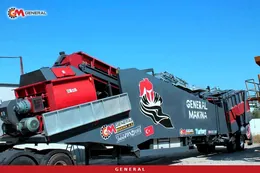
A tracked mobile crusher is a crushing unit on a crawler undercarriage that moves under its own power. All three models in the track-mounted mobile crushers range — GM 90JP, GM 100 and GM 125 — run on Strickland tracks and need neither ground preparation nor a concrete foundation. The machine arrives on a low-loader, is unloaded and then drives itself into position.
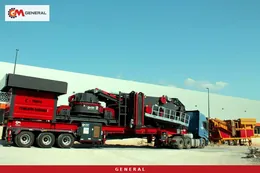
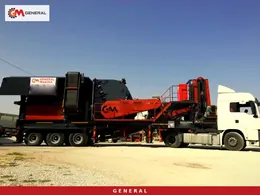
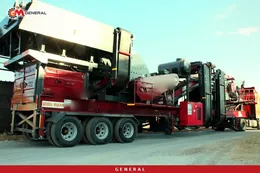
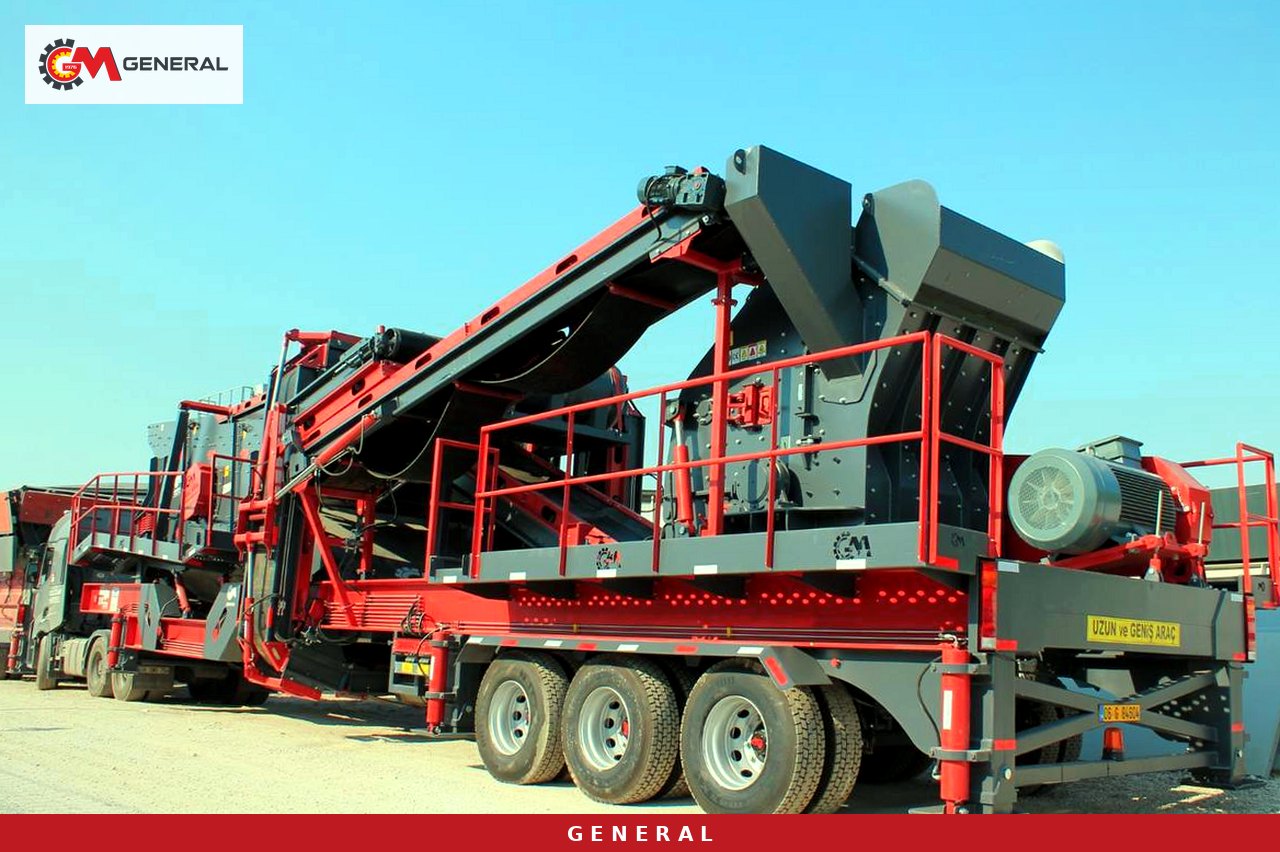
A wheeled mobile plant is a chassis towed on public roads by a tractor unit and fixed on site on hydraulic legs. In the General series the hopper, crusher, screen and conveyors share one chassis; folding hydraulic conveyors and support legs remove the need for excavation or foundations. The difference is practical: a tracked machine can shift a few hundred metres within the site in minutes, while a wheeled plant has to retract its legs and wait for a tractor every time it relocates. On long road moves the picture reverses — the wheeled plant leaves with one tractor, whereas the tracked unit must be loaded onto a separate transporter every time.
Moving within the site: following the face or staying put?
As the blast face advances in a quarry, keeping the crusher close to it shortens the truck and loader cycle. If the face moves often, a tracked machine has a clear edge: the GM 90JP is designed for primary jaw work that changes position frequently inside quarries and job sites, and for terrain that is hard to reach. On rough and sloping ground it walks to points a tractor cannot enter.
When material is hauled to a stockpile area and the plant stays at one spot for months, the tracks become a cost item that does not pay back. For this kind of stationary production a wheeled plant, carrying crushing and screening on one chassis, delivers a full product range with fewer machines.
Hypothetical example: two contractors
Contractor A works a single limestone quarry, following the face and repositioning the crusher every week. Contractor B produces road base on three widely separated road projects a year, staying a few months at each. For A, relocation is an operating routine, and a tracked unit removes the tractor, leg retraction and realignment steps from it. For B, the real cost is haulage between sites; here a wheeled plant towed on the road moves with fewer logistics steps. The example contains no figures; it only shows that the deciding criterion is how often and how far the machine moves.
Capacity ranges: which models cover which band?
The table below gathers the values published on the product pages in one format. Each figure belongs only to the model in its row; actual output depends on rock hardness and the required grading and is set in the project.
| Model | Undercarriage | Crusher | Capacity | Max. feed | Screen / pre-screen | Weight |
|---|---|---|---|---|---|---|
| GM 90JP | Tracks | GNR 90 jaw, 95 kW | 70-180 t/h | 700 mm | 1000×2000 mm, double-deck | 35,000 kg |
| GM 100 | Tracks | GNR-01 impactor, 160 kW | 100-180 t/h | 600 mm | 1500×5500 mm, triple-deck | 42,000 kg |
| GM 125 | Tracks | GNR PDK02 impactor, 200 kW | 150-250 t/h | 700 mm | 1360×2160 mm grizzly pre-screen | 48,000 kg |
| General 640 | Wheeled chassis | GPJ 60 jaw + GNR 50 impactor | 60-100 t/h | 500 mm | 1200×4000 mm, 3-deck | 38,000 kg |
| General 01 | Wheeled chassis | GPS 1210 impactor | 120-180 t/h | 700 mm | 1600×5000 mm, 4-deck | 55,000 kg |
| General 950 | Wheeled chassis | GPJ 90 jaw + DMK01 impactor | 120-180 t/h | 800 mm | 1600×5000 mm, 3-deck | 70,000 kg |
| General 03 | Wheeled, 4-axle chassis | GPS 1415 impactor | 250-375 t/h | 900 mm | 2400×5000 mm, 4-deck | — |
The first takeaway: the tracked family tops out with the GM 125 in the 150-250 t/h band. For higher tonnage, the wheeled side offers the General 03 (250-375 t/h) or the twin-chassis GNR-MC110 (200-300 t/h). The second: tracked machines weigh between 35,000 and 48,000 kg, while single-chassis plants with a jaw plus a second stage, such as the General 950, reach 70,000 kg because they carry two crushers and a large screen together.
A single crusher unit or a complete crushing and screening plant?
This is the point most often missed in a purchase decision. The tracked GM 90JP is a primary crusher: it has a 10 m³ hopper, a grizzly feeder, a jaw crusher, a 1000×2000 mm double-deck screen and a 600×6000 mm bypass conveyor. It handles pre-separation, but saleable fractions such as 0-5 / 5-12 / 12-19 mm require a second stage and screening behind it. An operator who wants a tracked line should therefore plan the crusher together with a tracked screen and conveyors.
The GM 100 is different here: its GNR-01 impact crusher works in closed circuit with a 1500×5500 mm triple-deck track screen and delivers the target fraction in one pass; it suits limestone, low-abrasion rock and concrete/asphalt recycling. In wheeled General plants the hopper, crusher or crushers, 3- or 4-deck screen and return conveyor are already on one chassis. The General 950, for instance, carries a GPJ 90 jaw primary and a DMK01 impact secondary on the same chassis and produces 120-180 t/h in hard, abrasive rock such as basalt and granite.
Growing step by step with portable crushers
A third route is to build the line piece by piece with single-chassis portable rock crushers. Depending on the model, the GNR mobile primary jaw crusher series runs at 40-300 t/h, the M-PDK primary impact series at 80-500 t/h and the M-DMK secondary impact series at 40-350 t/h. These units travel on one truck and are commissioned on hydraulic legs without foundations. They are a flexible start for operators who only need primary crushing today and plan to add secondary and sand stages later.
Set-up and commissioning: the steps before first production
On a tracked machine, set-up means unloading, walking into position and swinging the conveyors into working position; no hydraulic legs or foundations are required. On a wheeled plant the chassis is towed into place, the hydraulic legs are lowered and the folding conveyors are opened. According to its product page, the General 950 is moved on one truck and starts producing in 30 minutes; the General 640 is compact enough to fit on a single truck.
For both types, set-up speed depends more on the site than on the machine: ground bearing capacity, the truck approach route to the hopper, stockpile locations matching conveyor discharge heights, and the power supply. Power ratings differ as well: the GM 90JP is listed with a 250 kVA power unit, the GM 100 with 450 kVA and the GM 125 with 550 kVA; on the wheeled side, the General 01 and General 950 generators are 550 kVA and 600 kVA respectively.
Decision matrix: which one fits your job?
The matrix contains no figures; each row corresponds to a question you should ask on site.
| Site condition / need | Tracked (GM series) | Wheeled (General series) | Portable single unit |
|---|---|---|---|
| Following the face, weekly relocation | Strong | Weak | Medium |
| Long road moves between projects | Needs a separate transporter | Strong | Strong |
| Sloping, rough ground a tractor cannot reach | Strong | Weak | Weak |
| 3-4 saleable fractions from one machine | Possible with GM 100; GM 90JP needs an extra screen | Strong | Extra screen needed |
| Primary crushing of hard, abrasive rock | GM 90JP (jaw) | General 950 / 944 (jaw primary) | GNR jaw |
| Concrete/asphalt recycling, short urban jobs | Strong | Medium | Medium |
| Staged growth, spreading the budget over time | Medium | Medium | Strong |
Choosing the crusher type for your material is a separate question; for the criteria between jaw and impact see our article Impact or Jaw? Crusher Type Selection Criteria. In short: a jaw primary leads in abrasive granite and basalt, while an impact crusher gives cubical product in one pass in soft limestone.
Checklist to prepare before requesting a quotation
Asking the manufacturer the right questions is the only way to get comparable offers. With the following information ready, tracked and wheeled options can be priced on the same basis:
- Type of material (limestone, basalt, granite, river gravel, demolition concrete) and its abrasiveness.
- Largest lump size in the run-of-mine feed, to be compared with the crusher's maximum feed size.
- Target hourly output and daily operating hours.
- Required product fractions and how many separate stockpiles they need.
- How many times a year and over what distance the plant will be moved; how often it relocates within the site.
- Ground conditions: slope, soft soil, areas a tractor can reach.
- Power source: grid or generator.
- Existing equipment: do you already own a screen, conveyors or a secondary crusher?
The main price drivers follow from the same list: undercarriage type (tracks or chassis), number and type of crushers, screen deck count and size, power unit, number of conveyors and options. When comparing two offers, check that these items are identical in both.
Frequently asked questions
Can a tracked mobile crusher travel on public roads by itself?
No. A tracked machine walks within the site; between projects it is loaded onto a low-loader and driven off again on arrival. If road moves are frequent and long, the logistics of a wheeled plant are simpler.
Does a wheeled mobile plant need a foundation?
General series plants work on hydraulic support legs; no excavation or concrete foundation is required. Level ground with adequate bearing capacity is sufficient.
Can I produce saleable aggregate with a single tracked crusher?
It depends on the model. The GM 100 delivers fractions in one pass thanks to its integrated triple-deck screen and closed circuit. The GM 90JP is a primary jaw crusher; separate fractions require additional screening and, where needed, a second stage.
How are price and delivery time determined?
The price is prepared for each project according to the chosen model and equipment, and the delivery schedule is set in the quotation according to the order scope. Filling in the checklist above is the shortest route to a comparable offer.
Conclusion
Choosing between tracks and wheels is not a quality ranking but a logistics decision. If the machine will relocate frequently within a site on difficult ground, the GM series fits; if it will be towed between projects and you need the full product range on one chassis, wheeled mobile crushing plants are the better match. Portable single units offer a third path for those building their line in stages. General Makina has been manufacturing crushing and screening equipment since 1976 and supplies its plants with a 1-year warranty. Send us your material, capacity and transport details through our contact page to request a quotation.
Definitions of technical terms: Glossary