EN — English
 TR — Türkçe
 DE — Deutsch
 RU — Русский
 FR — Français
 ES — Español
 AR — العربية
 SR — Српски

Using Mobile Crushers for Construction and Demolition Waste (Concrete Recycling)
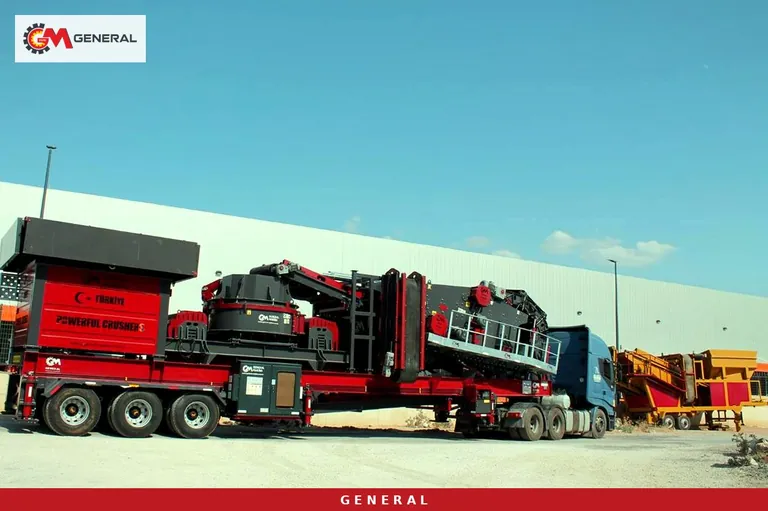
Demolition rubble starts costing money the moment it is loaded onto a truck: every trip means fuel, driver hours and a tipping fee. The same rubble, crushed and screened on site, becomes fill, sub-base or road base and feeds the next work item. The real question with mobile crushers for construction and demolition (C&D) waste is not "which crusher?" but "where, at what volume and for which product will I crush this waste?". This article helps demolition contractors and site managers answer that before the job starts: on-site crushing versus a central recycling yard, how selective demolition affects the crusher, which equipment tier fits which volume, and where recycled aggregate can go.
The decision before demolition: crush on site or at a central yard?
There are two basic set-ups for processing demolition waste. In the first, the equipment comes to the demolition site, the rubble is crushed in place and the product is used as fill or as foundation material for the new building on the same plot. In the second, waste from several sites is collected at a fixed stockpile yard and processed continuously. Which one is right depends on waste tonnage, the space available on site and where the product will be used.
To compare them systematically without guessing numbers, write two expressions side by side:
- Haul-and-dispose burden = (total waste tonnage ÷ truck payload) × (haulage cost per trip + tipping fee) + cost of buying and hauling in the replacement fill
- On-site crushing burden = mobilisation and set-up of the equipment + (operating hours × hourly operating cost) + handling of the product
The last term of the first expression is often forgotten: once the rubble leaves the site, the fill the plot needs has to be bought and trucked in from elsewhere. With on-site crushing the same tonnage pays twice: the disposal trips disappear and the fill comes from inside the site. To build the hourly operating cost from energy and wear items, use the site's operating cost per tonne calculator with your own fuel, power and parts prices.
A central yard makes more sense for a continuous, mixed-source waste stream. When waste arrives from several jobs, it is easier on a fixed site to keep piles separated by source, split product into fractions, store it and deliver to customers regularly. The machine no longer has to move every week, so the equipment choice shifts towards heavier units.
Selective demolition: crusher performance is decided in the demolition plan
Brick, gypsum plaster, timber joinery, PVC, insulation and cable in a rubble pile directly lower the quality of the aggregate the crusher produces. Removing them after the crusher is always more expensive and less complete. Demolition should therefore start with soft strip before reaching the reinforced concrete frame, and the waste should be split into at least three piles: clean concrete, masonry (brick, block, ceramic) and other waste.
In practice, separate piles mean two different products. Material crushed from clean concrete is a candidate for higher-value uses, while mixed masonry usually goes to fill. Mixing the two drags the good material down to the lowest use class. When the loader operator knows which pile he is feeding from, product stockpiles can also be kept separate by source.
Complete this checklist on site before demolition begins:
- Has the building been surveyed for asbestos and similar hazardous materials, and have they been removed by a licensed contractor?
- Were doors, windows, timber, PVC, cables and building services removed during soft strip?
- Will areas rich in gypsum plaster and plasterboard go to a separate pile?
- Are three stockpile points marked for clean concrete, masonry and mixed waste?
- Has protruding rebar been cut with an excavator attachment and have concrete pieces been reduced to fit the feed opening?
- Have the product stockpile area, truck turning route and loading point been defined?
- Are a water source and hose line ready for dust suppression?
Equipment tiers by job volume: from crusher bucket to mobile plant
There is no single "right machine" for demolition waste; as volume grows, the equipment moves up one tier. The table below puts four tiers side by side using values from General Makina product pages. Before choosing, fix the total tonnage, the largest lump size and the target product.
| Equipment | Feed | Capacity | Power | Weight | Role in demolition waste |
|---|---|---|---|---|---|
| Crusher bucket | 950×550 mm opening | — (bucket 0.85 m³) | Excavator hydraulics | 3,900 kg | Small to medium volume, tight or hard-to-reach sites |
| M-DMK 02 portable secondary impactor | 0-350 mm | 150-250 t/h | 200 kW | 38,000 kg | 0-50 mm product from pre-broken or small-sized rubble |
| General 800 (PDK 1280 primary impactor) | 600 mm | 80-150 t/h | 450 kVA generator | 35,000 kg | Medium-size recycling site needing screened fractions |
| General 01 (GPS 1210 impactor) | 700 mm | 120-180 t/h | 550 kVA generator | 55,000 kg | Central yard with continuous flow, several products from a four-deck screen |
Small, scattered jobs: an excavator-mounted crusher bucket
When demolishing a detached house, a boundary wall or a narrow inner-city plot, bringing in a separate crusher usually makes no sense in terms of space or cost. The excavator crusher bucket fits the 21–30 tonne class excavator already working on site, takes concrete, rubble and brick through its 950×550 mm opening and discharges through an adjustable gap. The jaws are manganese steel; reinforced concrete can be crushed, but the rebar has to be separated. This is not a solution for continuous production: as volume rises, the excavator both loads and crushes and becomes the bottleneck.
Medium volume: a single-chassis portable impact unit
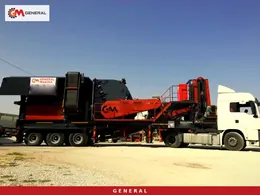
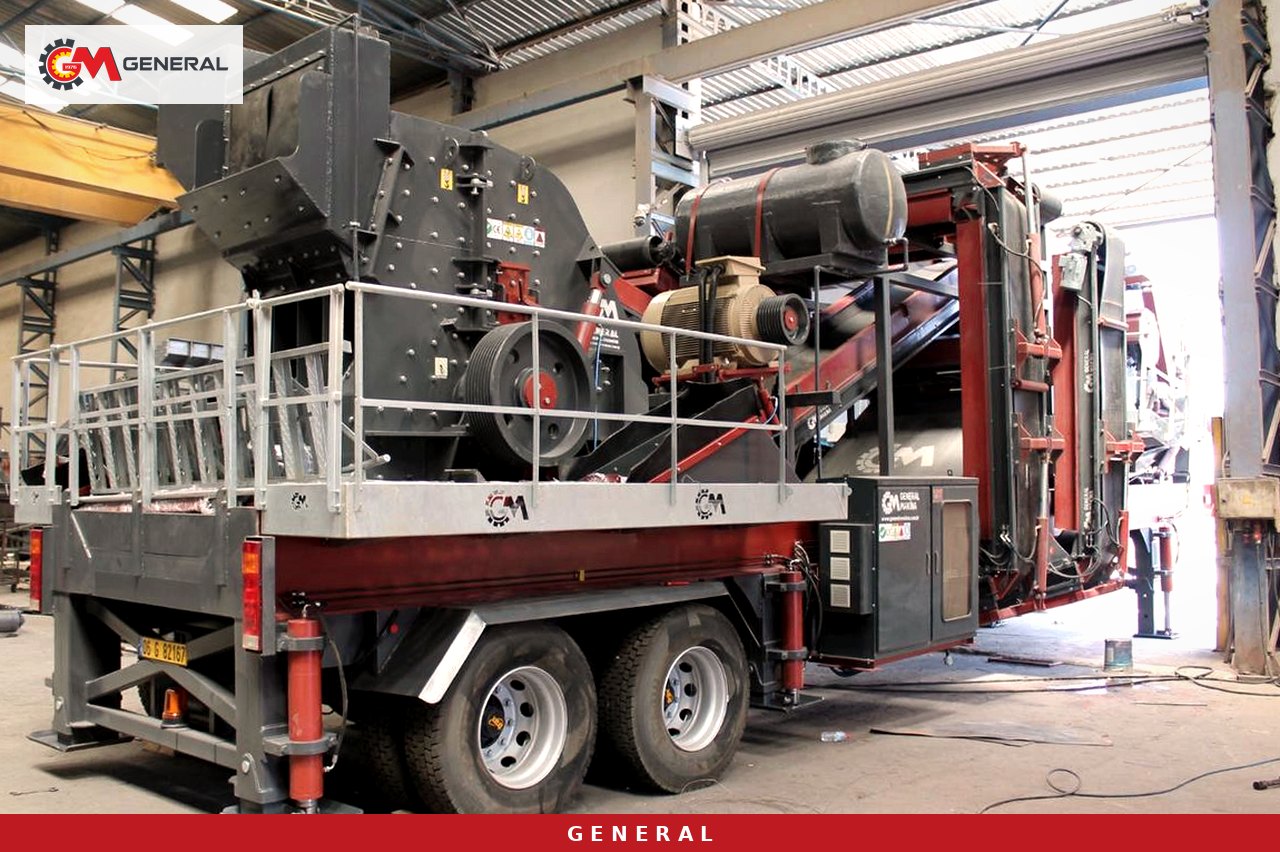
Once the waste exceeds what a crusher bucket can handle, the next tier is portable units that combine a feeder hopper and an impact crusher on one chassis. You will find this group on the portable rock crushers page. The feature that matters in demolition work is the by-pass screen on the feeder table of the M-DMK series: the soil-laden fines are sent to a separate stockpile before reaching the crusher. In demolition rubble these fines both raise crusher wear and contaminate the product; removing them at the start solves both problems at once. Table values for M-DMK 01 are 120-180 t/h, 160 kW and 32,000 kg; for M-DMK 03 they are 175-300 t/h, 250 kW and 45,000 kg.
This unit is in the secondary class and accepts 0-350 mm feed. Large slab and column pieces must first be reduced with an excavator attachment. For demolition with very large blocks, M-PDK primary impact units accepting 0-1200 mm feed (M-PDK01: 250-500 t/h, 315 kW; M-PDK02: 200-300 t/h, 250 kW) are added to the chain.
Portable unit or mobile crushing and screening plant?
A portable impact unit delivers one 0-50 mm product. That is enough for fill on the same plot or for rough road base. If you plan to sell the recycled aggregate or use it on several jobs, the product has to be split by size. This is where mobile crushing and screening plants come in, carrying the crusher and a multi-deck screen on the same chassis.
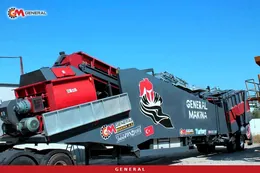
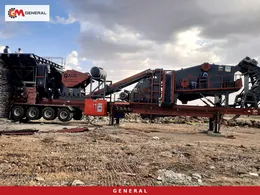
General 800 runs in closed circuit with a PDK 1280 primary impactor and a 1300×4000 mm three-deck screen; its product page lists recycling sites among its applications. General 01 does primary and secondary work in one housing with the GPS 1210 impactor and splits the material on a 1600×5000 mm four-deck screen. Both plants list product fractions of 0-5 / 5-12 / 12-19 / 19-40 mm; screen apertures and the final grading are set at order stage according to the feed. Closed circuit means oversize returns to the crusher until it reaches target size; with demolition concrete this avoids a separate step for oversize piling up on the screen.
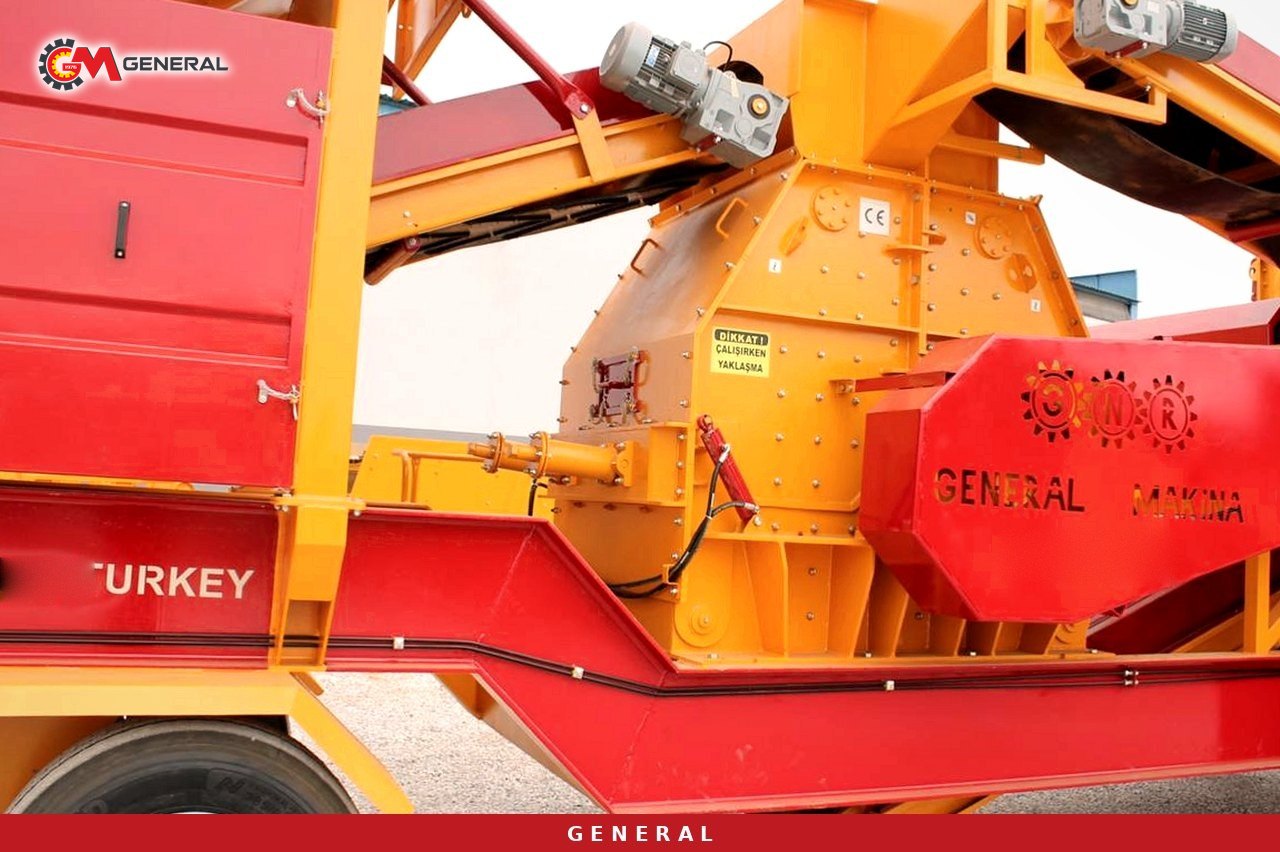
Use this rule for the decision: if the product is used only on the same plot, a portable unit is enough; if it will be sold, must meet different specifications or the sand size has to be marketed separately, a screening plant is needed. In the second case, write the plant's generator rating (450 kVA for General 800, 550 kVA for General 01) into the site plan.
Where does recycled concrete aggregate go?
The end use of crushed concrete depends on how clean the source is and on the grading of the product. A general ranking applies: screened, uncontaminated product from clean concrete is a candidate for more demanding uses such as road sub-base and base; mixed product with a high masonry share usually goes to fill, backfill and haul roads. Using recycled aggregate in new concrete is a separate matter of specification and laboratory approval; the standard and the client's specification for the project govern.
To get the product accepted, consistency matters more than a single good sample. Practical rules:
- Stockpile the product of each source pile separately and label the stockpile with its source.
- Take samples from different points of the stockpile and match test results to the stockpile label before dispatch.
- Reduce light contaminants such as gypsum, timber and plastic with a hand-picking station beside the belt.
- Keep the fine fraction (0-5 mm) separate; plaster and soil concentrate in it, so it should not be blended into the other fractions.
This approach is the precondition for selling recycled product as a material rather than as waste. For crusher-side details such as rebar separation, blow bar alloy and asphalt feed, see our article on mobile crushers for recycling asphalt and concrete.
Site layout, dust, noise and permits
Demolition sites often sit inside residential areas, so the machine position has to be chosen not only for material flow but also for its impact on the surroundings. Place the crusher as far as possible from neighbouring buildings, on the side where the wind does not blow towards homes. The feed point, crusher discharge and stockpiles are the dust sources; plan water spraying at all three. Keeping stockpiles low reduces both dust and visual impact.
Working hours, noise limits, waste tracking and rules for using recycled material vary from country to country and even between municipalities. Confirm local regulations with the relevant authority and complete the permit process before the machine arrives. If you are considering a complete line, the concrete (C&D) recycling plant page shows how the machine set is configured.
Two safety rules are non-negotiable: nobody enters the working radius of the excavator feeding the hopper, and an emergency stop must be within reach at the hand-picking point on the belt. Clearing jammed rebar is done only after the machine has been stopped and locked out.
Frequently asked questions
Do I need a separate mobile crusher for a small demolition job?
Not necessarily. If the waste volume is limited and a 21–30 tonne class excavator is already on site, a crusher bucket may be enough. As volume grows and crushing time exceeds loading time, a portable impact unit or a mobile screening plant becomes the more logical choice.
Can I feed reinforced concrete straight into the crusher?
Long protruding rebar must be cut first and pieces reduced to fit the feed opening. The crusher frees concrete from steel, but the released rebar has to be collected from the belt; this must be planned into the line from the outset.
Can recycled aggregate be used in new concrete?
That depends on the standard and specification governing the project and requires laboratory approval. Uses such as fill, backfill and sub-base are more common; a clean concrete source and screened product widen the options.
How can I find out price and delivery time?
Price varies with crusher type, number of screen decks, power unit and additional conveyors. Send us the waste type, estimated tonnage, largest lump size and target products and we will prepare a project-specific quotation.
Conclusion
The profitability of mobile crushing on demolition waste is set by decisions made before machine selection: whether the waste is processed on site or at a central yard, whether selective demolition separates the piles, and where the product will be used. A crusher bucket fits small jobs, a portable impact unit with by-pass screen fits medium volume, and a mobile crushing and screening plant fits continuous work that needs saleable fractions. General Makina, building crushing and screening equipment in İzmir since 1976, supplies ISO 9001 and CE certified machines with a 1-year warranty excluding wear parts. Share your waste type and volume and we will define the right tier for your site together: contact us for a quotation.
Definitions of technical terms: Glossary