EN — English
 TR — Türkçe
 DE — Deutsch
 RU — Русский
 FR — Français
 ES — Español
 AR — العربية
 SR — Српски

The Ideal Mobile Crushing Plant Configuration for Road Construction and Sub-Asphalt Material
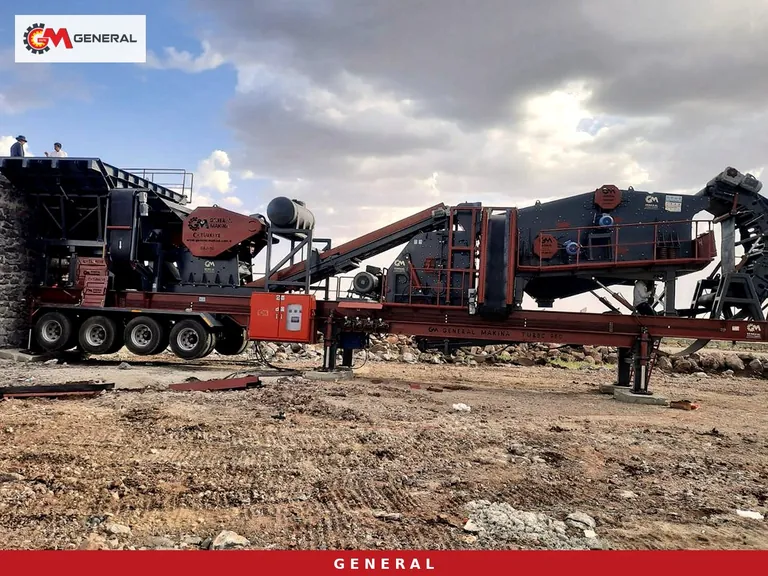
On a road job, a crushing plant answers a different question than it does in a quarry. In a quarry the goal is usually more saleable tonnage; on a road project the goal is to produce subbase and base material in the grading the specification demands, steadily enough to keep pace with the laying crew. Excess fines sit idle in the stockyard, while one missing fraction can stop the grader and the roller. This article builds a mobile crushing and screening plant configuration backwards from the road layer: first the product you need, then the crushing stages for your rock, the screen decks, moving along the alignment, and finally the capacity balance with the plant-mix unit. "Ideal" in the title does not mean one model is right on every site; the ideal setup is the one that fits your rock, your specification and your programme.
Define the layer first: what do you need from the plant?
Under the asphalt there are usually two granular layers: subbase and base. On some projects the base is specified as plant-mix stabilised with cement or another binder. The product expected from the crushing plant differs in each case. If natural pit material can be screened and used, the crusher's load is light; if the base must be fully crushed, the crusher becomes the heart of the line; if plant-mix is required, the crushing plant no longer makes the final product but supplies separate fractions to the cold bins of the mixing plant.
Acceptance criteria such as grading envelopes, crushed-face content, abrasion and plasticity are set by each country's and each project's own technical specification. Take those values from the project specification and the supervising engineer, not from a machine brochure. Bring three things to the configuration meeting: how many tonnes are needed for which layer, how many separate fractions the specification allows you to blend, and what the laboratory results say about the quarry rock. Without these three, any model choice is a guess.
Crushing stages by rock type: jaw, cone and impact
Borrow pits opened along a road alignment often change rock type. One section may give limestone, the next basalt. So plan the crushing stages around the hardest rock on the route, not the first pit.
Hard, abrasive rock: jaw primary + cone secondary
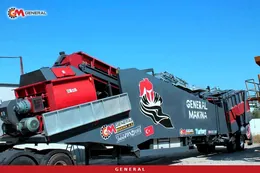
In basalt, granite or quartz-bearing rock the General 944 layout stands out: a GPJ 90 jaw primary takes the large blocks and a GM430 cone secondary does the second stage by compression. Compression crushing consumes metal wear parts more slowly in siliceous rock than an impact rotor does; if you will crush the same rock for months on a road job, that difference goes straight into the operating budget. The General 944 mobile jaw + cone plant runs at 120-180 t/h and accepts 800 mm feed.
More reduction and cubical shape in hard rock: jaw + impact
The General 950 pairs the same GPJ 90 jaw primary with a DMK01 impact secondary. Its capacity band matches the 944 (120-180 t/h); the difference lies in the secondary. The impact stage gives higher reduction and cubical particles, while liners need changing more often in abrasive rock. Where particle shape is an acceptance criterion, look at the 950; where the wear budget dominates, look at the 944.
Limestone and low-abrasion rock: primary impact
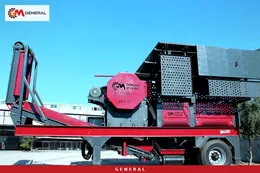
In soft to medium limestone a single impact crusher delivers high reduction without a jaw stage. The General 800 (PDK 1280, 80-150 t/h), General 01 (GPS 1210, 120-180 t/h), General 02 (GPS 1413, 250-300 t/h) and General 03 (GPS 1415, 250-375 t/h) belong here. The GPS 1210 on the General 01 performs primary and secondary work in one housing, so the line is shorter.
| Model | Crusher layout | Product fractions | Screen | Capacity | Max. feed | Generator |
|---|---|---|---|---|---|---|
| General 640 | GPJ 60 jaw + GNR 50 impact | 0-5 / 5-12 / 12-19 mm | 1200×4000 mm, 3-deck | 60-100 t/h | 500 mm | 300 kVA (optional) |
| General 800 | PDK 1280 primary impact | 0-5 / 5-12 / 12-19 / 19-40 mm | 1300×4000 mm, 3-deck | 80-150 t/h | 600 mm | 450 kVA |
| General 01 | GPS 1210 impact (primary + secondary) | 0-5 / 5-12 / 12-19 / 19-40 mm | 1600×5000 mm, 4-deck | 120-180 t/h | 700 mm | 550 kVA |
| General 944 | GPJ 90 jaw + GM430 cone | 0-5 / 5-12 / 12-19 mm | 1600×5000 mm, 3-deck | 120-180 t/h | 800 mm | 550 kVA |
| General 950 | GPJ 90 jaw + DMK01 impact | 0-5 / 5-12 / 12-19 mm | 1600×5000 mm, 3-deck | 120-180 t/h | 800 mm | 600 kVA |
| General 02 | GPS 1413 primary impact | 0-5 / 5-12 / 12-19 / 19-40 mm | 2000×5000 mm, 4-deck | 250-300 t/h | 1000 mm | 660 kVA |
| General 03 | GPS 1415 primary impact | 0-5 / 5-12 / 12-19 / 19-40 mm | 2400×5000 mm, 4-deck | 250-375 t/h | 900 mm | 750 kVA |
The fractions in the table are the standard values listed on the product pages. Screen apertures and the final grading are fixed at the order stage according to the rock and the project specification; whether a fraction meets the specification can only be confirmed by a sieve analysis on a sample. For a comparison of the whole wheeled range, see our mobile crushing plants page.
Screen decks and pre-screening: how many fractions?
The most common mistake on road jobs is to focus on the crusher and treat the screen as an afterthought. Yet the screen decks decide how many separate fractions the plant-mix recipe can be built from. As the table shows, the 944, 950 and 640 give three fractions with a three-deck screen, while the General 800 adds a fourth; the 01, 02 and 03 use four-deck screens to put the 19-40 mm fraction on its own stockpile. If you want to dose the coarse fraction separately in the base, this split makes the recipe easier. All wheeled models have an output setting range of 0-100 mm.
The second critical point is pre-screening. Pits along a road alignment often contain overburden soil and clay bands. A grizzly feeder under the hopper removes the fine and earthy part before it reaches the crusher (by-pass); the General 640 and General 01 have this grizzly by-pass. The removed material can become a separate stockpile for fill or subbase if the specification allows; if not, it must leave the line without contaminating the clean product. Merging both streams on one belt can create problems with plasticity control.
The third point is the closed circuit. The General 640, 800, 950 and 02 work in closed circuit, sending oversize back to the crusher on a return conveyor. In road material, exceeding the top-size limit can get an entire stockpile rejected, so check in the first days on site, with samples, that the return circuit reliably catches the screen oversize.
Moving along the alignment: transport, setup and power
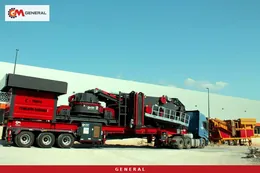
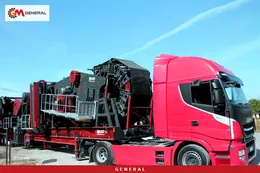
On a linear road project, the distance between the material source and the laying front changes every month. Keeping the crusher close to the front shortens truck cycles, but every relocation is lost production. Transport dimensions and weight of the wheeled chassis then become decision criteria. The General 800 weighs 35,000 kg, the General 640 38,000 kg, the General 01 55,000 kg, the General 944 and 950 70,000 kg and the General 02 76,000 kg. The General 03 sits on a four-axle chassis suited to international transport. Check bridge and road restrictions along the route in advance together with the permits from the relevant highway authority; abnormal-load rules vary from country to country.
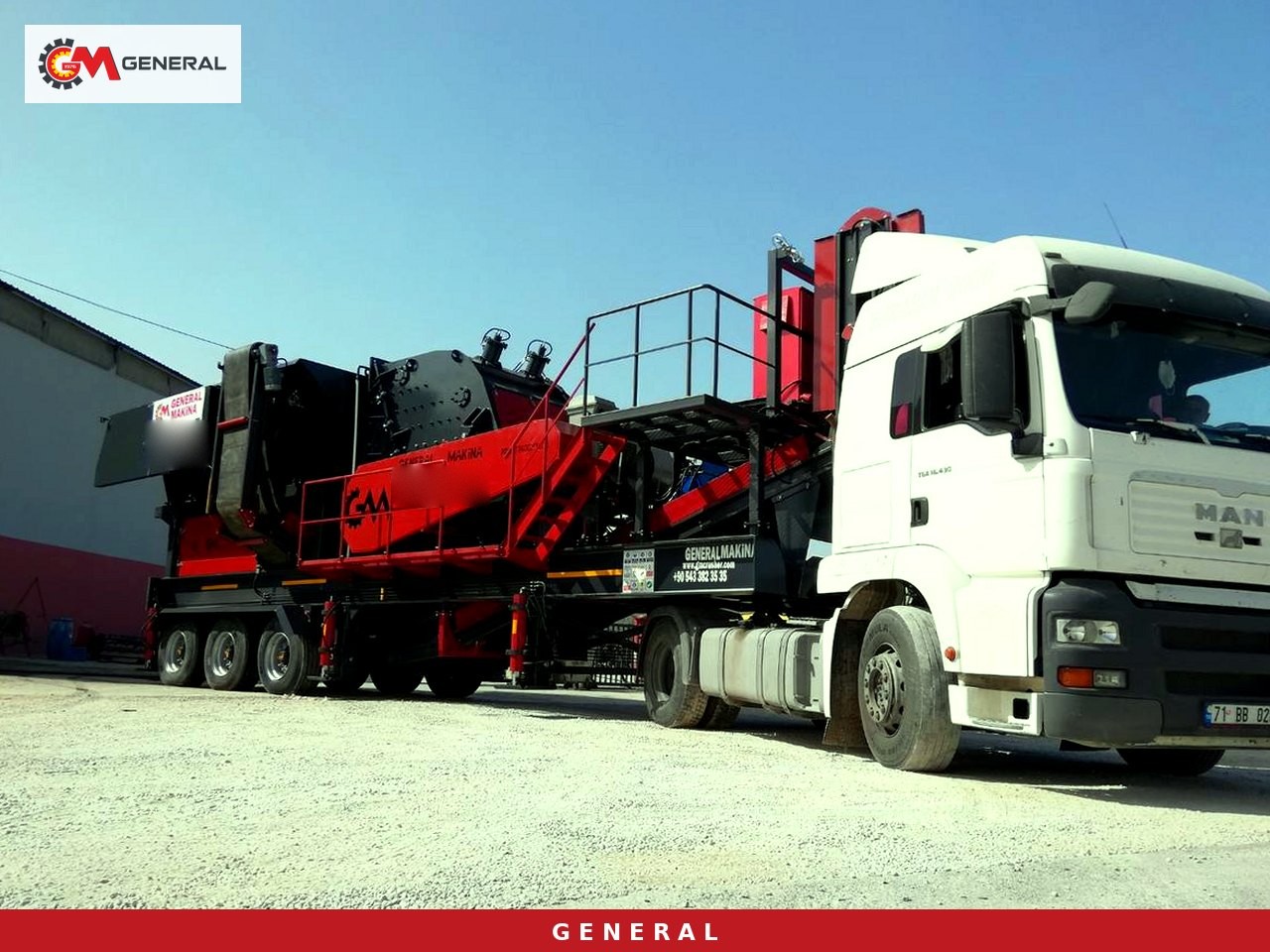
Most road sites have no grid power, so generator rating is part of the configuration. The product tables list 300 kVA (optional) for the General 640, 450 kVA for the 800, 550 kVA for the 01 and 944, 600 kVA for the 950, 660 kVA for the 02 and 750 kVA for the 03. If you plan to add a mixing plant, an extra screen or stockpile conveyors to the crushing line, calculate the total load from the start; every motor added later pushes the generator closer to its limit.
Balancing the crushing plant with the mobile plant-mix unit
On a sub-asphalt material project the crushing plant rarely works alone; its fractions go to a plant-mix unit. General Makina's mobile plant-mix (soil stabilisation) plant runs at 200-600 ton/hour, doses different fractions separately from 3-5 cold bins, and carries a 20×4 = 80 m³ aggregate bunker, a 25 m³ loading bin and a 2×22 kW twin-shaft mixer; total power is in the 79-155 kW range. For a permanent production base the stationary version goes up to 200-750 t/h. Both types are described in the mechanical stabilization plants category.
These figures reveal an important imbalance: the mixing plant's hourly capacity is above that of a single wheeled crushing plant. That is not a flaw; the mixing plant runs short, intensive shifts to match the laying programme, while the crusher produces for longer and builds stock. You can set the balance with a simple relation:
Required crushing capacity (t/h) ≥ (P × Hp) ÷ Hc, where P is the mixing plant's actual hourly output, Hp its daily operating hours and Hc the crushing plant's actual daily operating hours (after maintenance, liner changes and relocation days). If the result exceeds the band of one plant you need a larger model, two crushing plants, or stock built before the mixing plant starts. Track each fraction's stock separately too: if the recipe consumes one fraction faster than the others, the fraction that runs out first sets the pace of the whole line.
Configuration checklist
Answer these points one by one before requesting a quotation. Each can change the model or the plant layout.
- Do you have lab results for the hardest and most abrasive rock on the route?
- Are the total tonnages for subbase, base and plant-mix and the monthly laying programme known?
- How many fractions does the specification allow you to blend, and must the coarse fraction be dosed separately? (The screen-deck decision depends on this.)
- Is the largest block in the pit below the chosen model's maximum feed size?
- Is there a grizzly pre-screen and a separate stockpile plan for overburden and clay bands?
- Will the crusher and the mixing plant share a site, or will material be trucked between them?
- Does the generator rating cover belts and screens that will be added to the line later?
- How many relocations are planned along the route, and who issues the transport permits?
- Has the wear-parts stock been planned according to the rock's abrasiveness?
Frequently asked questions
Can one mobile plant produce both subbase and plant-mix aggregate?
Yes, the same plant can make different products in different periods; but if two products are needed at once, the number of screen decks is decisive. Models with four-deck screens (01, 02, 03) and the four-fraction General 800 give that flexibility more easily. The final decision should come from comparing the specified blend with a sieve analysis of the quarry rock.
Can I process asphalt millings on the same crushing line?
Millings and asphalt slabs behave differently from quarry rock: the bitumen binder brings a risk of sticking and clogging. We cover this in our article on using mobile crushers for asphalt and concrete recycling. The project specification decides in which layer and in what proportion reclaimed material may be used.
Which model guarantees the specified grading?
No crushing plant can guarantee a grading without seeing the rock. Grading depends jointly on rock structure, crusher setting, screen apertures and feed arrangement. The right approach is to come with a quarry sample and the specification values, set the screen meshes accordingly at the order stage and confirm by sieve analysis during commissioning.
How are price and delivery time determined?
Price is driven by choices such as model, crusher layout, screen decks, generator, extra conveyors and plant-mix integration; delivery time also depends on the configuration and the order period. That is why only a quotation based on a defined configuration can show the figure.
Conclusion: the right layout for road work
The right mobile crushing plant for road construction is not the one with the highest capacity; it is the one that crushes the hardest rock on the route, separates the number of fractions the specification asks for, covers the plant-mix unit's consumption from stock and can follow the laying front. Starting points are the 944 for abrasive rock, the 950 where cubical shape comes first, the 800, 01, 02 and 03 for limestone, and the 640 for limited tonnage; the final decision is made with rock and specification data. General Makina, founded in Izmir in 1976, supplies the crushing line and the mixing plant from one source, with CE and ISO 9001 certified equipment and a 1-year warranty excluding wear parts. Share your quarry sample and specification values and contact us for a configuration and price quotation.
Definitions of technical terms: Glossary