EN — English
 TR — Türkçe
 DE — Deutsch
 RU — Русский
 FR — Français
 ES — Español
 AR — العربية
 SR — Српски

Technical Clauses to Include in the Contract When Buying a Mobile Crusher
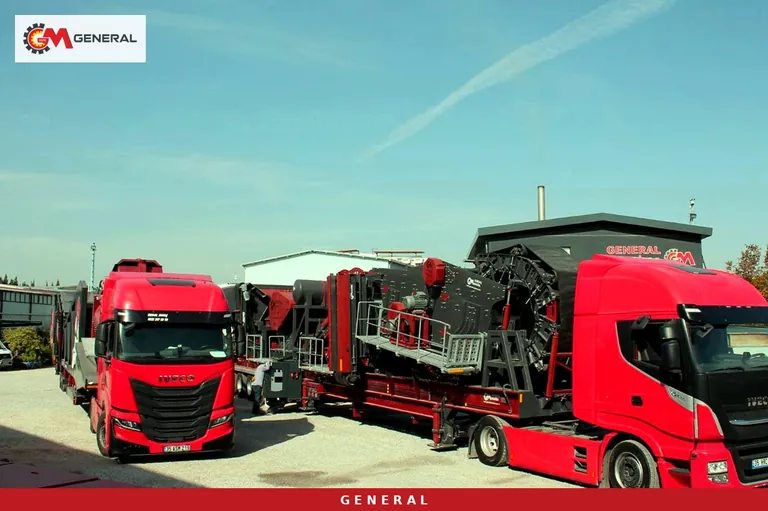
The difference between a quotation letter and a sales contract becomes clear the moment the first dispute arises on site. The quotation says "120-180 tph"; if the contract does not state on which rock, at which feed size and for which product fractions this capacity will be measured, the figure has no binding meaning. This article goes through the clauses that should go into the contract, or into its technical specification annex, when ordering a mobile crusher, in an order you can use at the purchasing table. It is not legal advice; work with your own legal counsel on the commercial and legal framework, and with the competent authorities on import, transport and permits.
Nearly all of these clauses can only be written in full for a new machine. With a new crushing and screening plant bought from the manufacturer, capacity, scope, warranty and acceptance testing are bound by the manufacturer's signature; in a used purchase the seller can rarely commit to any of them. That is why buying a new machine is always the most sensible and correct choice, and the list below is written from that standpoint.
Technical specification annex: pin the model down with figures
Writing only "General 02 mobile crusher" in the body of the contract is not enough. A separate technical annex should define the model by crusher type, feed opening, screen size, power unit, weight and transport dimensions. On delivery, the machine is checked against this page. On the product pages of the mobile stone crushers family, each model has a technical table that can serve as the skeleton of this annex.
The table below shows how a draft annex might look using the values from the product pages. Cells with no counterpart on the product page are left as "—". Your own annex should have no empty cells; ask the manufacturer to confirm missing values in writing at the order stage.
| Item | General 01 | General 944 | General 02 | General 03 |
|---|---|---|---|---|
| Capacity | 120-180 t/h | 120-180 t/h | 250-300 t/h | 250-375 t/h |
| Crusher | GPS 1210 impact (primary + secondary) | GPJ 90 jaw + GM430 cone | GPS 1413 primary impactor | GPS 1415 primary impactor |
| Max. feed size | 700 mm | 800 mm | 1000 mm | 900 mm |
| Screen | 1600×5000 mm, four-deck | 1600×5000 mm, three-deck horizontal | 2000×5000 mm, four-deck | 2400×5000 mm, four-deck |
| Generator | 550 kVA | 550 kVA | 660 kVA | 750 kVA |
| Weight | 55,000 kg | 70,000 kg | 76,000 kg | — |
| Transport dimensions | 4300×18500×4500 mm | 4130×20350×4500 mm | 4340×20600×4500 mm | — |
| Chassis | — | — | 2-axle | 4-axle |
Note: the General 02 has a 1000 mm feed opening, while the higher-capacity General 03 is listed at 900 mm. The assumption that "the bigger model is bigger in every dimension" can therefore mislead. Writing the exact value into the contract forces you to compare it with the largest block size in your quarry.
Output setting and product fractions
The tables of all four models give an output setting of 0-100 mm. The fractions, however, differ: 0-5 / 5-12 / 12-19 / 19-40 mm on the General 01, 02 and 03, and 0-5 / 5-12 / 12-19 mm on the General 944. The product pages state plainly that the final fraction split and screen apertures are set in the project according to the feed material. The contract should therefore list the screen apertures agreed at project stage, and that list should be the reference in the acceptance test.
Capacity clause: test conditions and measuring method
A capacity range is a value that depends on the material. If the following conditions are not written next to the capacity figure, a dispute in which both sides feel they are right is only a matter of time:
- Material type and description: limestone, basalt, granite or mixed demolition waste; ideally backed by a laboratory sample analysis.
- Feed grading: the largest block size and the share of fines; whether fines removed through the bypass of the grizzly feeder count as production.
- Moisture and clay content, and an agreement by both parties that screening efficiency will fall with sticky material.
- Which fractions count as "product", and whether material circulating on the return conveyor is included in the calculation.
- Measuring method: truck weighbridge, belt scale or volume survey.
Put the measuring formula in the text as well: test capacity (t/h) = product tonnage weighed during the test ÷ net operating time. For example, if the test lasts T hours, buyer-caused downtime is D hours and weighed product is Q tonnes, capacity is calculated as Q ÷ (T − D). The same clause should define whether stoppages such as feed interruptions, waiting for trucks or a loader breakdown count towards D.
Scope clause: delivery contents and the responsibility boundary
Most disputes start here, because the quotation says "complete plant" and what arrives on site is a missing cable or a stockpile conveyor shorter than expected. Scope should be written item by item:
- Power unit: is the generator included, and what is its rating in kVA? The General 02 page lists a 660 kVA power unit and control panel as standard equipment, and the General 03 has a 750 kVA power unit as standard. On some models the generator is optional; that difference changes both the price and the need for a grid connection.
- Belt conveyors: number and length of product conveyors, and whether the return conveyor is in scope.
- Control and automation: touchscreen panel, soft starter, frequency control; the General 01 page mentions internet-based remote monitoring as an option. Every optional item should be marked "included" or "excluded" in the contract.
- First-fill oils, the first set of wear parts and special maintenance tools.
- Technical documentation: operating and maintenance manual, electrical diagrams, spare parts catalogue, and the language in which they are supplied.
The boundary clause matters as much as the scope; it lists the work the buyer takes on. Ground levelling and, where needed, a concrete pad, site roads, water and fuel supply, a transformer and main cable if grid power is used, loaders and trucks usually sit with the buyer. The General 03 page states that folding hydraulic conveyors and support legs allow installation without excavation or a concrete foundation; even so, bearing capacity and flatness of the ground remain the buyer's responsibility. Attach the division of work as a responsibility matrix.
Transport, dimensions and delivery terms
The place and form of delivery decide at which point risk passes to the buyer. The contract should say clearly whether delivery is ex works, at the port or on site, and for international sales which Incoterms rule applies. Who carries transport insurance also belongs in this clause.
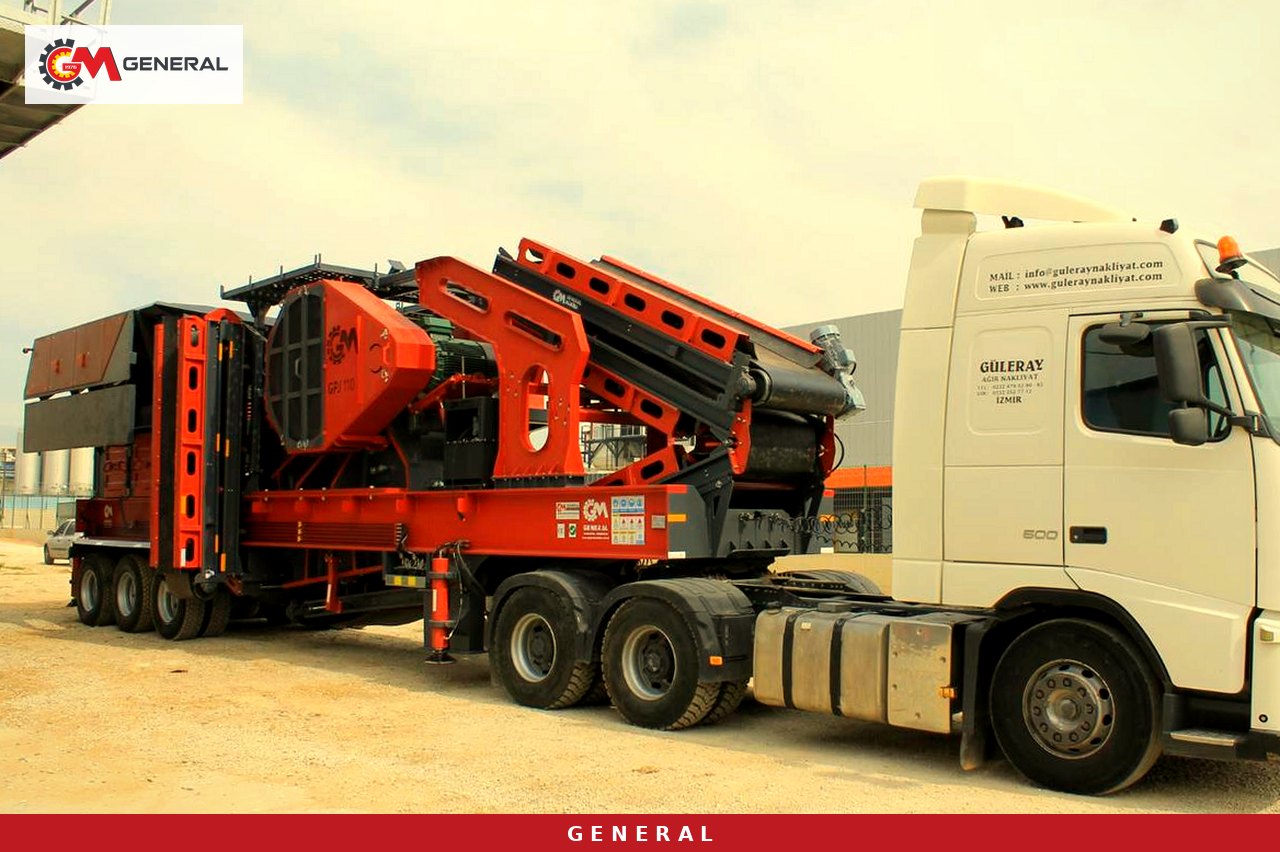
Dimensions and weight take on a technical meaning here. The General 02, at 4340×20600×4500 mm and 76,000 kg, may not travel the same route under the same permit as the General 01 at 4300×18500×4500 mm and 55,000 kg. The General 03 page describes its 4-axle chassis as an international transport standard; axle count is decisive in road permits. Confirm with the competent authorities of each country the machine will cross which dimensions and weights need a special permit, and write into the contract who obtains it.
For export orders the delivery documents should be a separate annex: invoice, packing list, certificate of origin, CE declaration of conformity and any other papers the destination country requires. The certificates General Makina holds are ISO 9001 and CE. If the destination country asks for an additional document, clarify the requirement and who is responsible for it before the order.
Installation, commissioning and acceptance test
The path between "delivered" and "in production" should be defined in the contract as separate stages: mechanical assembly, electrical connection, no-load run, loaded trial and acceptance. The protocol of each stage can be tied to the payment schedule and to the start of the warranty.
The acceptance clause should include the test duration or tonnage, the material to be used, the formula from the capacity clause, verification of product fractions by sieve analysis and the acceptance criteria. It should also state what happens if the test fails: the manufacturer's right to adjust and correct, a repeat test and the method for closing out open items (the punch list). For minor shortcomings, conditional acceptance works better than outright rejection.
Training for operators and maintenance staff also belongs in this section: how many people, which topics (start-up sequence, crusher setting, wear part replacement, safety lock-out) and in which language. Untrained operation is the most common starting point of a warranty dispute.
Warranty, wear parts and spare parts
General Makina machines carry a 1-year warranty, and wear parts are excluded. That sentence alone is not enough in a contract; three more details should be written down:
- Start of warranty: leaving the factory, delivery to site, or the acceptance protocol? Because assembly on a remote site can take a long time, this difference matters.
- Wear parts list: the annex should state which of jaw plates, blow bars, impact plates, cone mantle and concave, screen meshes, grizzly bars, belts and idlers count as wear parts.
- Claim procedure: how a failure is reported, evidence such as photos and operating logs, and the return of replaced parts.
The spare parts clause covers the period after warranty. Defining parts by code number, stating how metallurgy is specified on the order (manganese steel suited to impact loading, or high-chrome parts for clean abrasive material) and attaching the parts list to the contract speeds up later orders. For the part groups, the spare parts page gives a good starting list.
New versus used: how much protection the contract gives
The contract for a used mobile crusher is forced to leave most of the clauses above blank. The difference shows in how far the contract protects the buyer:
| Contract clause | New machine (from the manufacturer) | Used machine |
|---|---|---|
| Technical annex | Written one-to-one with the product table | Often limited to the listing; modification history unknown |
| Capacity and acceptance test | Bound by the manufacturer's signature | Usually sold "as is"; no test commitment |
| Warranty | 1 year (wear parts excluded) | Mostly none |
| Scope and documentation | Listed item by item | Missing conveyors, cables and manuals are common |
| Spare parts support | From the manufacturer, by code number | Source and compatibility may be unclear |
| Certificates | Built under ISO 9001, CE | Validity of the conformity declaration needs separate confirmation |
A contract is only worth as much as the counterparty's ability to commit. With a used machine, the lower initial price shifts the risk of the clauses that cannot be written onto the buyer; with a new machine, those risks are tied to the manufacturer through the contract. For an operation that will produce continuously, the right choice is therefore always a new machine. For inspection details, see our article on the risks of buying a used mobile crusher; to assess the manufacturer before signing, our piece on questions to ask crushing plant manufacturers is a useful starting point.
Checklist before signing
- Does the technical annex contain crusher, feed, screen, power, weight and dimension values?
- Is the capacity figure accompanied by a material description, feed grading, moisture and a measuring formula?
- Does the scope list name the generator, conveyors, controls, oils, first parts set and documents one by one?
- Are responsibilities for ground, power, water, fuel and permits split between buyer and manufacturer?
- Are the acceptance test, conditional acceptance and the punch-list close-out method defined?
- Are the warranty start and the wear parts list in the annex?
If the model is not yet settled, the Design Your Plant helps you make a first shortlist with your material and tonnage data.
Frequently asked questions
Can the quotation replace the contract?
A quotation is a price and intent document; it rarely carries the details of scope, acceptance and warranty. Transfer the technical values from the quotation into the contract annex and state in the text which document prevails if the two conflict. For legal consequences, consult your legal counsel.
What happens if capacity is not reached in the acceptance test?
The contract itself decides. The acceptance clause should set out the possibility of adjustment and correction, a repeat test and the procedure if the result does not change. Defining the test conditions in advance makes it possible to tell whether the problem lies with the machine or with the material.
How should price and delivery schedule be written in the contract?
The price depends on the model, generator and automation options, number of conveyors, delivery terms and documentation scope. Once these items are clear, ask for a project-specific quotation, and write the schedule split into manufacturing, shipment, assembly and acceptance stages.
Can these clauses be written for a used machine?
Partly. A technical annex and an inspection report can be attached; but a manufacturer's warranty, an acceptance test commitment and spare parts support by code number usually cannot be provided. A contract protects fully only with a new machine, which is why our recommendation is always a new machine.
Conclusion
The value of a mobile crusher contract depends on how clearly the figures and conditions in the technical annex are written. Pin the model down with the table, tie capacity to a measuring method, separate scope and boundary item by item, and define the acceptance test and the start of warranty. Because all of these clauses can only be written with a manufacturer's commitment on a new machine, the right investment is always a new machine. Share your material, target tonnage and required fractions; for a quotation that can become your technical annex, contact us.
Definitions of technical terms: Glossary