EN — English
 TR — Türkçe
 DE — Deutsch
 RU — Русский
 FR — Français
 ES — Español
 AR — العربية
 SR — Српски

Senegal Dakar Housing Mobile Aggregate Crusher Plant 100-200 TPH
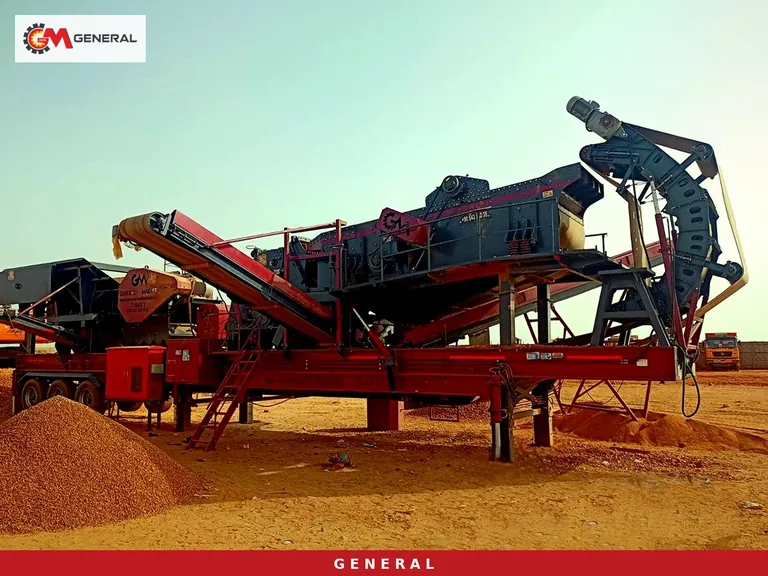
On a housing programme in and around Dakar, the crushing plant never has just one customer. The block yard wants fine material, the ready-mix plant wants two separate chipping sizes, and the internal estate roads want coarse fill. A mobile crushing and screening plant running at 100-200 TPH can serve all three from the same quarry, but the right model depends on whether the rock is basalt or limestone and on which end of the band the daily tonnage actually sits. Below we match real General models to this range using their published figures, explain when two units beat one, and cover the precautions that come with crushing close to a growing city.
One boundary first: specifications, grading limits and schedules for individual Dakar housing schemes belong to the relevant authority and contractor. This article is about machine selection; always confirm the project specification against the authority's or contractor's tender documents.
Which fractions does a Dakar housing site consume?
Housing construction in Senegal combines concrete blocks with a reinforced-concrete frame. That mix sets the product split you need from the crusher. Before choosing a plant, break monthly consumption into four lines:
- 0-5 mm manufactured sand: the main input of the block press; near the coast, where natural sand can be very fine or salty, it also completes the fine part of the concrete.
- 5-12 mm fine chippings: used in the block mix and slab concrete; a cubical particle shape keeps cement consumption under control.
- 12-19 mm chippings: the coarse aggregate for columns, beams and slabs.
- 19-40 mm and coarse material: for sub-foundation layers, estate roads and car-park fill.
Within the General family some models separate all four fractions (0-5 / 5-12 / 12-19 / 19-40 mm) in a single pass, while some jaw-primary models work with three (0-5 / 5-12 / 12-19 mm). A block-heavy job needs a high 0-5 mm share; a frame-heavy job needs more 12-19 mm. Choosing a model without writing this ratio down usually ends with an unwanted fraction piling up in the stock yard.
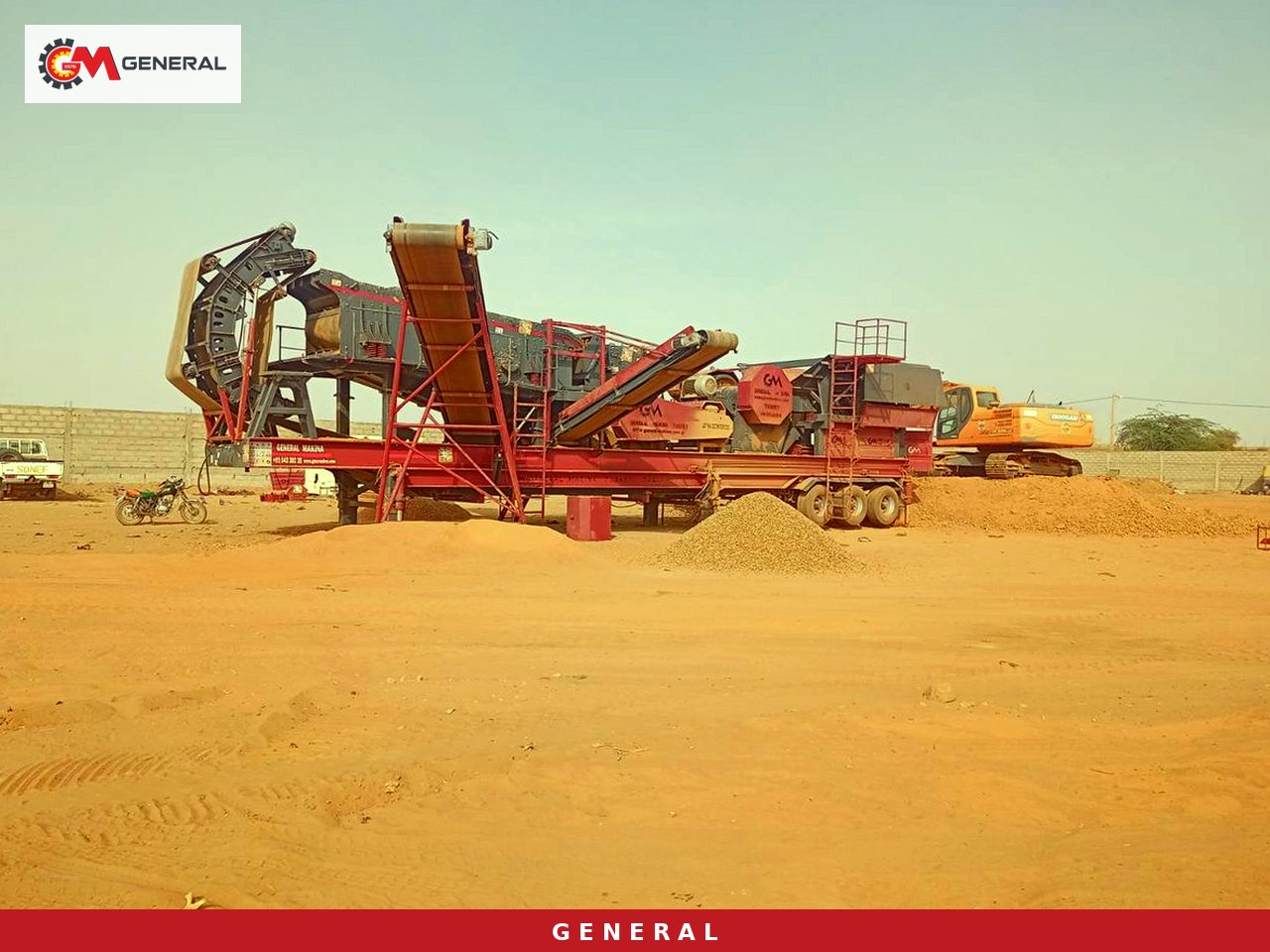
Feed rock: basalt or limestone?
Volcanic basalt is common on the Cap-Vert peninsula where Dakar sits, while limestone formations are more widespread further inland. Even at the same tonnage these two rocks call for entirely different crushers; a wrong match damages either the wear-parts budget or the product shape.
Limestone or low-abrasion rock
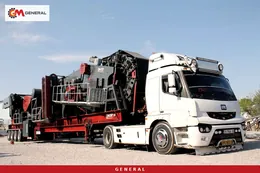
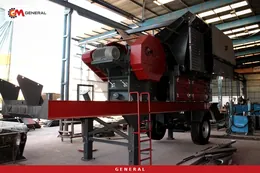
On limestone an impact crusher delivers a high reduction ratio in one stage and a cubical grain, which is exactly what blocks and concrete need. Here the primary-impact General 800 or the General 01, whose GPS 1210 impact crusher handles primary and secondary duty in one body, comes first. Neither needs a separate secondary crusher, so the chassis is shorter and the site layout simpler.
Basalt or siliceous hard rock
Basalt wears impact blow bars quickly. It needs a jaw crusher for coarse reduction followed by a second stage. The General 950 combines a GPJ 90 jaw with a DMK01 impact secondary and gives a cubical product; the General 944 pairs the same jaw with a GM430 cone crusher and extends metal life in abrasive rock. For a closer look at the difference on basalt, see our guide to the best mobile crushing plant for basalt and granite.
Whatever the quarry, abrasiveness and compressive strength are not guessed. Having a few quarry samples tested in a laboratory before the quotation puts every decision, from crusher type to screen mesh, on firm ground.
General models that fall inside the 100-200 TPH band
The table contains only values published on the product pages. Within each range, the achieved capacity varies with rock hardness, moisture and required product size.
| Model | Crusher layout | Capacity | Max. feed | Screen | Generator | Weight | Suitable rock |
|---|---|---|---|---|---|---|---|
| General 800 | PDK 1280 primary impact | 80-150 t/h | 600 mm | 1300×4000 mm, 3-deck | 450 kVA | 35,000 kg | Limestone, low-abrasion rock |
| General 01 | GPS 1210 impact (primary + secondary) | 120-180 t/h | 700 mm | 1600×5000 mm, 4-deck | 550 kVA | 55,000 kg | Limestone, mixed feed |
| General 950 | GPJ 90 jaw + DMK01 impact | 120-180 t/h | 800 mm | 1600×5000 mm, 3-deck | 600 kVA | 70,000 kg | Basalt, granite |
| General 944 | GPJ 90 jaw + GM430 cone | 120-180 t/h | 800 mm | 1600×5000 mm, 3-deck | 550 kVA | 70,000 kg | Basalt, quartz-rich rock |
| GNR-MC110 (twin chassis) | GPJ 110 jaw + DMK03 impact | 200-300 t/h | 900 mm | 2000×6000 mm, 4-deck | 750 kVA | 2 × 55,000 kg | Hard rock, high tonnage |
The table makes one thing plain: demand between 100 and 180 t/h can be covered by a single wheeled plant, but none of the single-chassis models lists a continuous 200 t/h. At that point one of the two routes below applies. To compare every wheeled option on one page, browse the wheeled mobile crushing plants category.
Approaching 200 TPH: two units or a twin chassis?
A housing programme is rarely one site; it is usually several blocks spread across different sides of the city. That spread matters as much as tonnage.
Two independent plants
On a limestone quarry, a General 800 working alongside a General 01 gives a combined nominal capacity comfortably above 200 t/h. The real gain is flexibility: while one unit is under maintenance the other keeps the block yard supplied, and when needed one unit can be towed to a quarry closer to another site. On basalt the same logic is built with two General 950 units, or a 950 paired with a 944.
Twin-chassis GNR-MC110 at one location
If there is a single fixed quarry, the GNR-MC110, rated 200-300 t/h, covers the top of the band with one line. Because its primary chassis can run on its own, the jaw group can start production first and the secondary group can be added later. On large housing programmes where demand is expected to grow over the years, this lets capital be spent in stages.
Whichever route you take, size it this way: target monthly tonnage ÷ (working days per month × net operating hours per day) = required hourly capacity. As a hypothetical illustration, once the monthly target and shift length are fixed, if the result lands very close to a model's upper limit, moving to a two-unit layout is healthier than pushing a smaller model.
Crushing near the city: dust, noise and truck traffic
Housing projects often pull quarries closer to residential areas. In Dakar's dry season, wind-borne dust is a problem both for the neighbourhood and for the machine. Measures that can be selected per project include:
- Water-spray dust suppression at the crusher discharge and conveyor transfer points.
- Enclosed or covered belts on conveyors carrying fine material.
- Pre-filters on generator and engine air intakes, with frequent filter checks.
- Stockpiles placed according to the prevailing wind, and speed limits on site.
- Truck access routed away from residential streets.
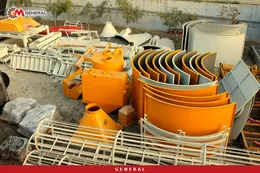
Blow bars and liners on impact crushers and jaw plates on jaw crushers are consumables. On an urban-fringe site, downtime stops crushing and, with it, the block yard and the batching plant. Keeping one set of wear parts on site from the first shipment is therefore recommended; options are listed under crusher wear and replacement parts.
From Dakar port to the quarry: shipping, power and set-up
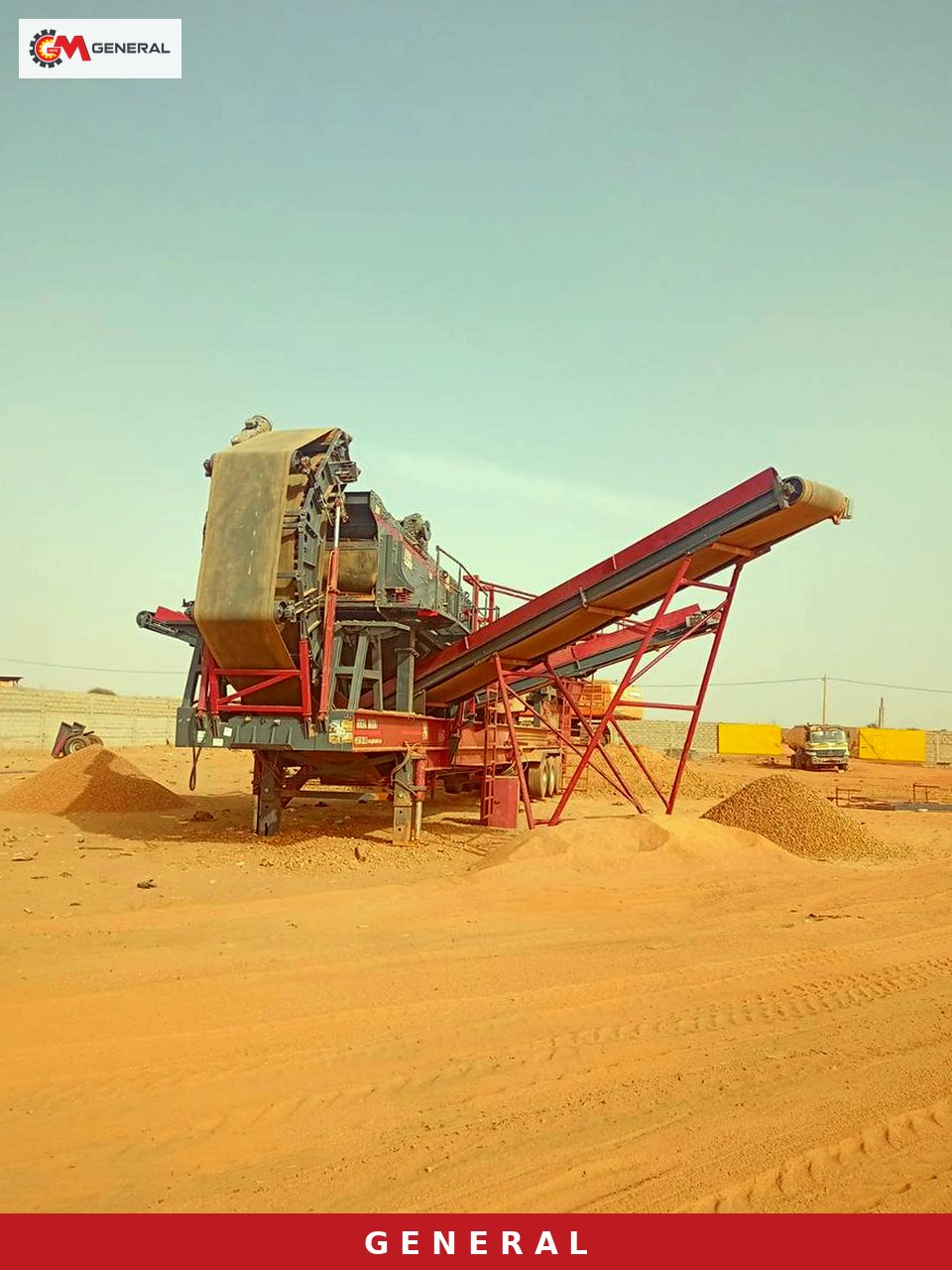
For a wheeled plant coming from Türkiye, the natural entry point is the port of Dakar, from where it is towed to the quarry by road. Transport dimensions and weight are the two figures to check first on that trip. With a transport size of 3600×15500×4500 mm and 35,000 kg, the General 800 is one of the most compact members of the family. The General 01 measures 4300×18500×4500 mm at 55,000 kg, while the General 950 and 944 measure 4130×20350×4500 mm at 70,000 kg. Bridge and clearance limits along the route should be checked in advance with the haulier.
Where the grid does not reach the quarry, the plant runs on its own generator: 450 kVA for the General 800, 550 kVA for the General 01 and 944, and 600 kVA for the General 950. In hot, dusty conditions, placing the generator in shade and with the wind in mind, and checking the radiator and air filter at the start of each shift, prevents most cooling problems.
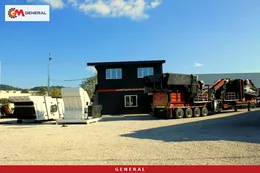
The advantage of a wheeled chassis during set-up is that no concrete foundation is needed: hydraulic legs come down and the folding conveyors are lowered. Even so, the pad should be level and compacted, with a slight fall so that rainwater does not collect under the machine in the wet season.
Frequently asked questions
Is the General 800 enough for a Dakar housing project?
Yes, if the rock is limestone and the hourly requirement stays within 80-150 t/h. It accepts 600 mm feed and delivers four fractions. If the rock is basalt, a jaw-primary General 950 or 944 is the better choice.
Will there be enough 0-5 mm sand for blocks?
Impact crushers raise the fines share, so on limestone the 0-5 mm proportion is usually satisfactory. It still depends on the rock; sample testing and mesh selection settle this share.
Two smaller plants or one large one?
Two plants if the sites are spread across the city and production must not stop completely during maintenance; the twin-chassis GNR-MC110 if high tonnage is drawn continuously from one large quarry.
What determines the price?
Model and crusher layout, number of screen decks, generator, options such as dust suppression, the spare-parts package and shipping method. A figure is given in a project-specific quotation once these are clear.
The file to bring to the quotation table
If you are producing aggregate for a Dakar housing programme, a model recommendation is settled at the first meeting when the following arrives complete:
- Rock type and any laboratory results (abrasion, compressive strength).
- Largest feed size and blasting or excavation method.
- Monthly target tonnage and its split by fraction (block sand, chippings, fill).
- Number of daily shifts and whether grid power is available.
- Quarry location, route from the port and distance to the sites.
- Distance to residential areas and required dust measures.
General Makina has built crushing and screening plants in Izmir since 1976; its plants carry CE and ISO 9001 certification and are delivered with a 1-year warranty excluding wear parts. Send your rock data and tonnage target through our contact page and we will work out the right configuration and quotation for your Dakar project together.
Definitions of technical terms: Glossary