EN — English
 TR — Türkçe
 DE — Deutsch
 RU — Русский
 FR — Français
 ES — Español
 AR — العربية
 SR — Српски

Measuring Cubicity in a 120-180 TPH Stone Crushing Plant
On a stone crushing line running 120-180 tonnes per hour, telling the quality engineer of a concrete batching plant or an asphalt contractor that "our material is cubical" will not convince anyone. What lands on that engineer's desk is a lab sheet: flakiness index, shape index or the percentage of flat and elongated particles. This article explains how cubicity is measured on site, in what order the sample is taken from the belt, how the resulting figure ties back to the crusher setting, and which real machines are used in this capacity band. We do not set the test limits; get written confirmation of the applicable standard and limit from your buyer's specification.
Three different measures on the lab sheet
Cubicity cannot be expressed with a single test. Projects working to European norms usually call for the EN 933-3 flakiness index, and sometimes the EN 933-4 shape index. Specifications based on ASTM ask for the flat and elongated particle ratio under ASTM D4791. All three judge the same stone through a different lens, so a sample that scores well in one can sit right at the limit in another.
Flakiness index: the mass passing the bar sieve
The sample is first split into narrow size fractions (for example 8/10, 10/12.5 and 12.5/16 mm). Each fraction goes over a bar sieve whose slot width is half the upper size of that fraction. Particles thinner than the slot drop through. The flakiness index is the total mass passing the bar sieves divided by the total mass tested, written as a percentage. The formula is simple: FI = (mass passing the bar sieves / total mass sieved) × 100. A hypothetical example: if 0.6 kg of a 5 kg sample of 5-12 mm passes the bar sieves, FI comes out at about 12. The lower the number, the more cubical the material.
Shape index and the ASTM flat and elongated ratio
For the shape index, particles are measured one by one with a caliper: a particle whose length exceeds three times its thickness does not count as cubical. ASTM D4791 uses a proportional caliper, and the specification defines a ratio such as 3:1 or 5:1. Both tests are slower, but they also pick up long, rod-like particles that slip past the bar sieve. That is why asphalt aggregate specifications often add a second shape test.
Sampling rules and the most common mistake
How the bag going to the lab gets filled decides the result just as much as the test itself. A large share of cubicity disputes come from a bad sample, not from the test.
A full cross-section from a stopped belt
The most reliable method is to lock out the product conveyor (with a proper isolation and tagging procedure) and take the full cross-section of material on the belt using a template. Coarse particles that roll to the belt edges and fines that collect in the middle must both go into the bag. A sample scooped from the side with a shovel while the belt is running will systematically under-report coarse and flaky particles. Reduce the material on site with a riffle splitter or by quartering; hand-picking the "nice looking" stones makes the test meaningless.
When the sample has to come from a stockpile
Coarse particles gather at the toe of a pile, while fines stay near the top. If you need a stockpile sample, take increments from at least three different heights and from points spread around the pile, then combine them. Opening a small cut with a loader and sampling from the inside gives a more representative result than the outer surface.
Measuring points and frequency on a 120-180 t/h line
At this tonnage the typical flow is a vibrating feeder, a primary jaw crusher, a secondary crusher and a three-deck screen. On the wheeled General 950 line this chain consists of the GPJ 90 primary jaw, the DMK01 secondary impact crusher and a 1600×5000 mm three-deck horizontal screen, with product fractions of 0-5, 5-12 and 12-19 mm. Three points are enough for cubicity monitoring. The first is the secondary crusher discharge belt, where you see the shaping performance of the crusher itself. The second is the 5-12 mm stockpile conveyor. The third is the 12-19 mm stockpile conveyor, because flaky particles show up most in this coarser fraction.
During commissioning week it makes sense to take one sample per shift, plus an extra sample every time the crusher setting changes. Once the line has settled, repeat the measurement as the quarry face advances, when the run-of-quarry rock type changes, and right after wear parts are replaced. Product shape is not the same with new blow bars as it is with bars near the end of their life; if that difference never shows up on the lab sheet, a dispute with the buyer is only a matter of time.
Keep the records in a date-sorted spreadsheet rather than on paper. Each row should hold the sampling point, fraction, result and the settings in force at that hour. After three months you will have an operating window showing at which feed rate and which setting your own quarry's stone comfortably meets the specification. When a new operator joins, that table is a far more reliable instruction than habits passed on by word of mouth.
Linking the lab figure to the crusher setting
A flakiness index on its own tells you little. Next to every sample, write down the settings in force at the same moment: feed rate, crusher setting, rotor speed or CSS, screen aperture sizes and the running hours of the wear parts. After four or five weeks of records, the table shows which change affected the shape. As noted on our cubicizer product page, flakiness rises as the feed size grows and as the crusher speed drops; your records turn that trend into numbers for your own stone.
Apron gap and feed on a secondary impact crusher
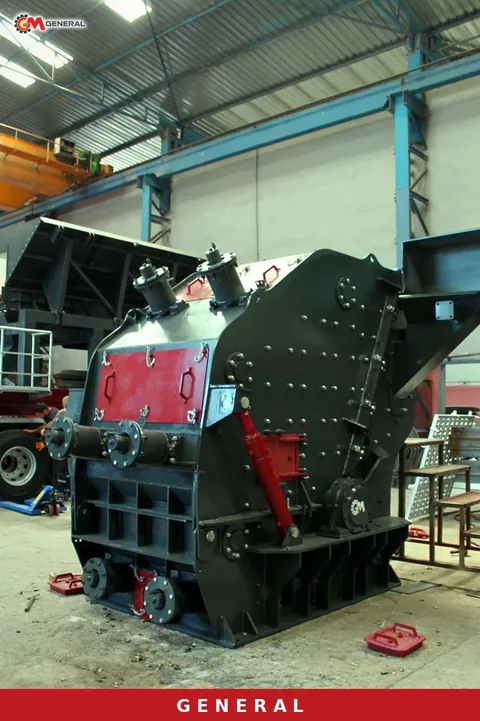
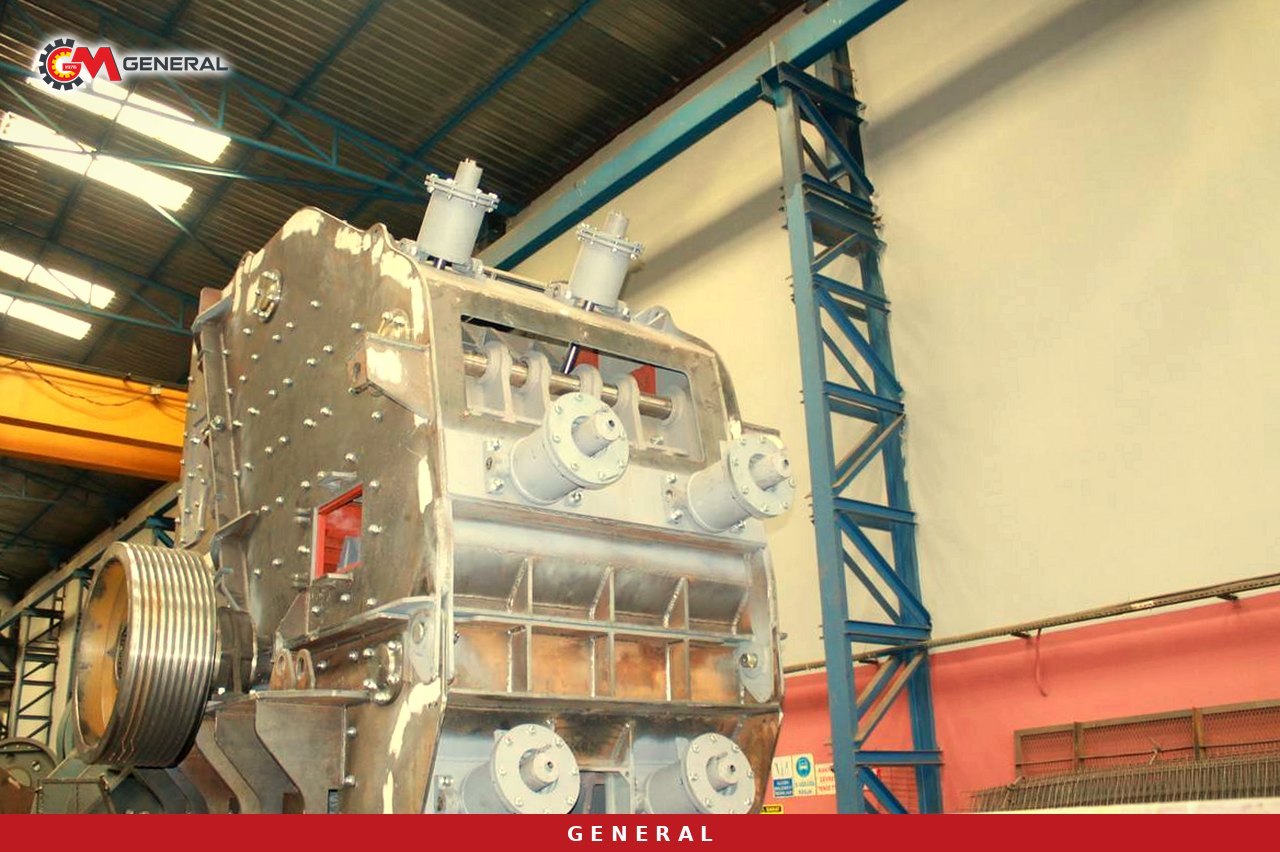
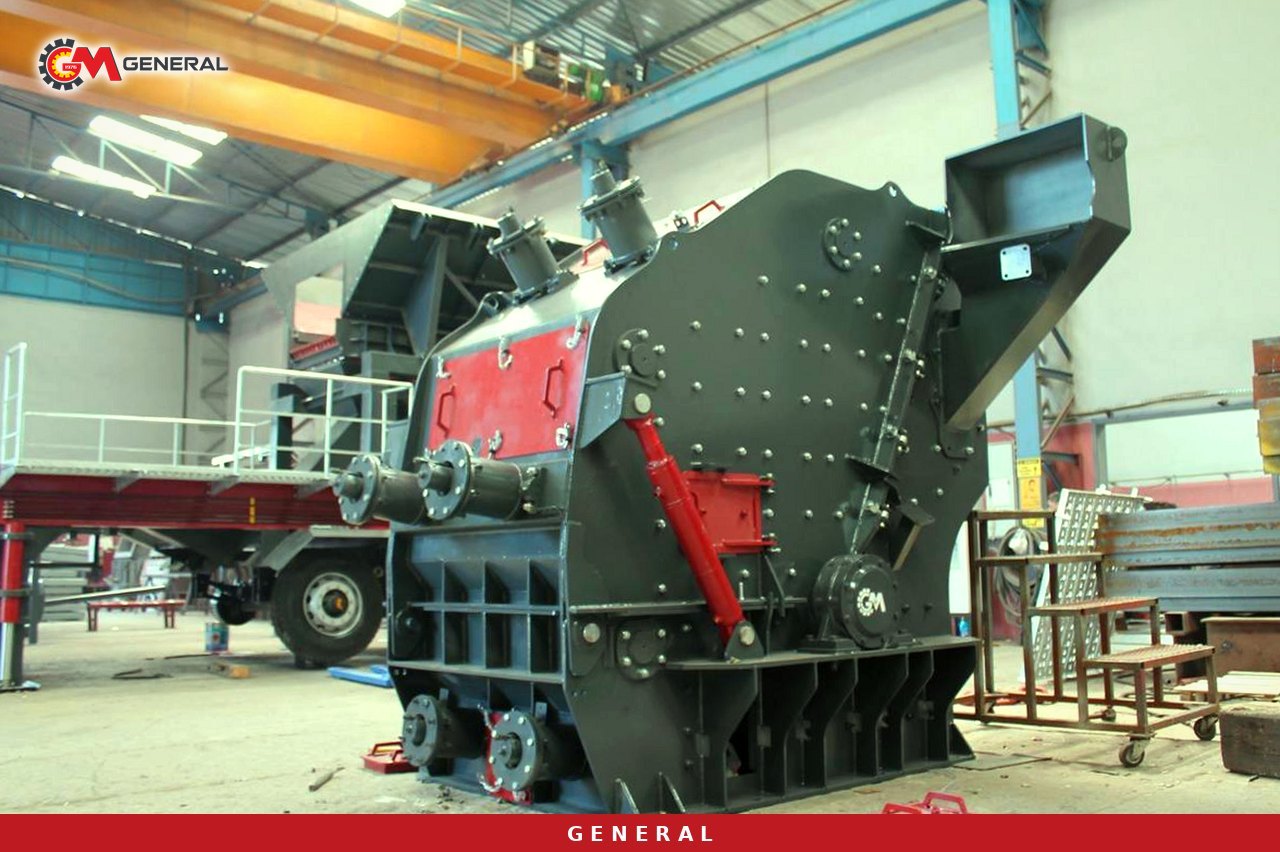
The GNR DMK series impact crusher works on the same principle as a primary impactor, with a smaller inlet and breaker plates set closer to the rotor, which is why it delivers a fine, cubical product. The DMK01 runs at 120-180 t/h with a 1100×1000 mm rotor, 800 mm feed opening and a 160 kW motor. In limestone and dolomite the typical reduction ratio is about 10:1. If FI is climbing, check the feed size first: when the share of oversize coming from the primary increases, the same setting produces a flakier product. Then review the apron gap and blow bar condition against your log. As our product page also states, a secondary impactor can give slightly flakier particles than a vertical shaft crusher; if you are getting close to the specification limit, an extra shaping stage will improve cubicity.
CSS and choke feeding on a secondary cone crusher
For abrasive rock such as granite, basalt and quartzite, the General 944, which pairs the GPJ 90 primary jaw with a GM430 secondary cone, is the usual choice. On a cone crusher two things govern shape: the hydraulic CSS setting and running the crushing chamber full (choke feed). A cone that runs starved lets particles pass without grinding against each other, and flakiness goes up. If you see the lab figure rise whenever the feeder rate drops, the problem lies in the feed, not in the setting.
Configurations used in this capacity band
The values below are taken from our product pages. The table shows where we position each machine in terms of cubicity; the final selection is made after a sample test. For other crusher types see the stone crushers category, and for wheeled lines the mobile crushing and screening plants page.
| Machine / line | Secondary or shaping stage | Capacity (t/h) | Max. feed (mm) | Power | Role in cubicity |
|---|---|---|---|---|---|
| General 950 (wheeled) | DMK01 impact | 120-180 | 800 | 600 kVA generator | High reduction and cubical product through impact crushing |
| General 944 (wheeled) | GM430 cone | 120-180 | 800 | 550 kVA generator | Compression crushing of abrasive rock, cubical product with choke feed |
| GNR DMK01 (stationary) | Secondary impact | 120-180 | 800 | 160 kW | Secondary stage in limestone and dolomite |
| M-DMK 01 (portable) | Secondary impact with by-pass screen | 120-180 | 350 | 160 kW | Second stage added to an existing primary, 0-50 mm product |
| GNR K110 | Cubicizer (shaping) | 160-250 | 210 | 160 kW | No reduction duty, turns flaky particles cubical |
The cubicizer is placed at the end of the line to correct shape; it has no reduction duty and its maximum feed is limited to 210 mm. We cover the general differences between crusher types separately in our jaw, impact and cone crusher comparison. As an example of a stationary line working at this tonnage, take a look at our 120-180 t/h stationary stone crushing and screening plant in Macedonia.
Site checklist for measurement day
- Get the test standard, the fraction to be tested and the limit value from the specification in writing.
- Confirm that the lab uses the same standard and the same set of bar sieves.
- Take the sample as a full cross-section from a stopped belt, following the conveyor lockout procedure.
- Label every sample with date, shift, feed rate, crusher setting and wear part hours.
- Reduce the sample with a splitter and never hand-pick particles.
- Check the screen cloths: a torn or stretched aperture lets coarse, flaky particles slip into the finer fraction.
- Keep the results in a weekly table side by side with the setting changes.
Frequently asked questions
Can I measure cubicity on site without a laboratory?
With a set of bar sieves and an accurate scale you can track the flakiness index at the quarry yourself. That is enough for internal control. The official result handed to the buyer, however, should come from the accredited laboratory named in the specification.
Which fraction needs to be measured?
Whichever fraction the specification defines. For your own monitoring, always track the coarsest sales fraction (12-19 mm on the General 950), since flakiness problems appear there first.
The lab sheet shows a result above the limit. Do I need a new machine?
First check feed continuity, the crusher setting and the condition of the wear parts. If there is a structural problem that settings cannot fix (layered or schistose rock, for instance), adding a cubicizer or a vertical shaft crusher at the end of the line is worth considering.
What determines the price of the line?
Stationary or wheeled installation, secondary crusher type, the need for a shaping stage, the number of screen decks, the generator and conveyor lengths all shape the quote. To pin these down, contact us with a rock sample and your specification details.
Final word
Cubicity is not an impression; it is a value that gets measured and recorded. A correct sample, records matched to settings and a test that follows the specification are how you defend the product of a 120-180 t/h line in front of a buyer. Our team, building crushing and screening plants since 1976, plans the secondary and shaping stages together based on your sample results. Get in touch with us with your rock type, target fractions and specification limits, and we will prepare a quote tailored to your project.
Definitions of technical terms: Glossary