EN — English
 TR — Türkçe
 DE — Deutsch
 RU — Русский
 FR — Français
 ES — Español
 AR — العربية
 SR — Српски

Choosing a Mobile Crusher for River-Bed Aggregate Production
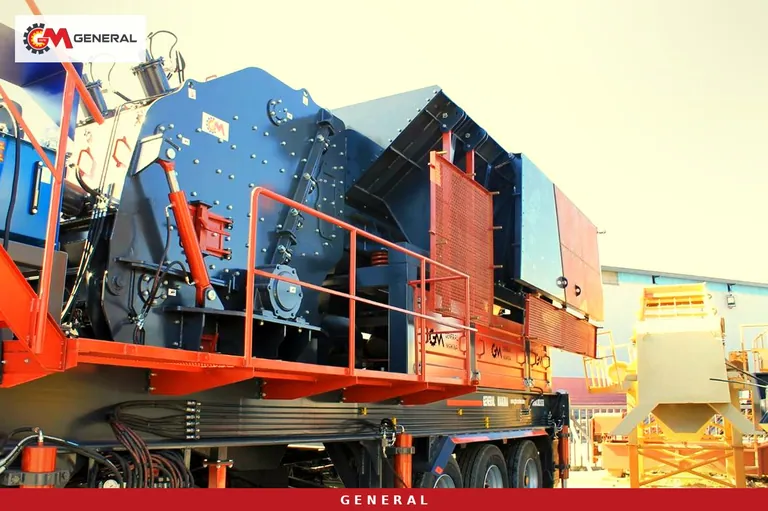
Material dug from a riverbed behaves nothing like blasted quarry rock. The particles have been rounded by water, the sand share is often higher than the market needs, coarse cobbles and clay lumps arrive in the same bucket, and moisture changes with the season. So when you look for a machine to produce aggregate from a river deposit, the first question is not "how many tonnes?" but "does this material need crushing, washing, or only screening?" This article walks from the sample to the decision through four site scenarios and matches each one to the technical tables of General Makina mobile models.
Four traits that set river material apart from quarry rock
Particle shape. River gravel is rounded. It does not hurt workability in concrete, but asphalt mixes and some concrete specifications call for crushed faces. Screening rounded gravel alone will not meet that requirement; at least one crushing stage is needed.
Gaps in the grading. River deposits usually carry plenty of fine sand and coarse gravel while the intermediate sizes are short. If your sales plan depends on producing the missing size by crushing, a crusher becomes mandatory. If your market already buys natural sand and gravel, screening may be enough.
Clay and silt. Fine layers deposited during floods get mixed into the material. Clay blinds screen meshes and weakens the sand's performance in concrete. Dry screening does not remove this contamination; it only moves it to another stockpile.
Water and moisture. Working next to the river helps with wash water, but wet material balls up on a dry screen. Whether enough water is available on site is the first condition that decides if a washing plant can be installed at all. Settling ponds and wastewater handling belong in the plan from day one.
The decision starts with a sample: three tests, three answers
Before discussing models, take a representative sample. Collect what the loader will actually dig, from several points and depths of the deposit; a single bag from the surface is misleading. The sample should answer three questions:
- Sieve analysis: What is the largest particle size? How much of the material is already saleable? The answer shows whether you need a crusher and how large a feed opening is enough.
- Clay test: A Sand Equivalent (SE) or Methylene Blue (MBV) test reveals how severe the clay is. The result decides between dry screening and a washing line.
- Product target: Will you sell to a concrete batching plant, to asphalt, or for fill and sub-base? A crushed-face or cubical requirement brings in a crushing stage; a clean-sand requirement brings in a washing stage.
The combination of these answers places you in one of the four scenarios below. Picking the wrong scenario costs more than picking the wrong capacity: a dry plant cannot produce clean sand from clayey material at any setting, and a washing plant cannot give rounded gravel a crushed face.
Four site scenarios and the matching machine setup
Scenario 1: Clean sand and gravel, no crushing required
If clay is low, oversize is limited and the market wants natural sand and gravel, splitting the material into fractions is enough. The GNR ME1650 dry screening plant accepts 0-100 mm feed, runs at 120-180 t/h and sits on a single 18,000 kg chassis. Its limit is clear: there is no washing unit. On a wet or clayey batch the mesh blinds and the product misses the specification.
Scenario 2: Fine but dirty material
If the material is already below 100 mm and the problem is clay and silt, a wash-and-screen plant is the right tool. The GNR YM1650 mobile washing and screening plant suits high-tonnage river sand washing with 120-180 t/h capacity and a 21,000 kg chassis. For tighter sites and lower tonnage, the GNR YM1240 applies the same washing logic at 60-100 t/h and 18,000 kg. Both accept 0-100 mm feed and run on mains power or a generator.
Scenario 3: Large river stone and clay in the same bucket
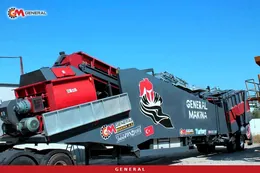
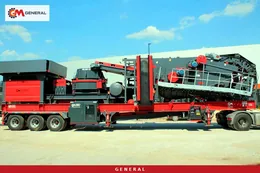
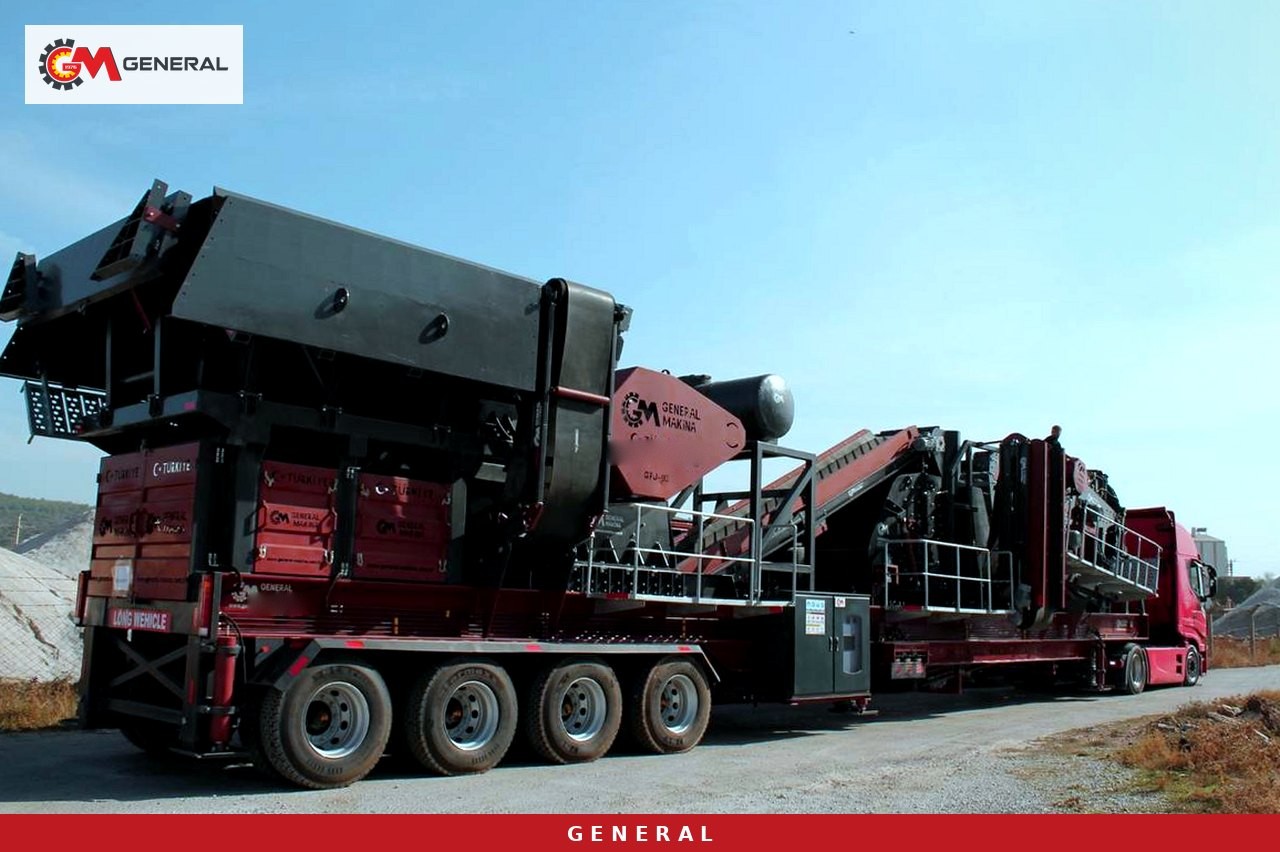
This is the most common picture on river sites: boulders, gravel, sand and clay all arrive together. Crushing and washing must sit in the same line. The Mobil 90 crushing, washing and screening plant combines a GPJ 90 primary jaw crusher, a 1600×5000 mm 3/4-deck washing screen and a 600×6000 mm twin screw washer on one wheeled chassis. It takes feed up to 800 mm, produces 0-5 / 5-20 / 20-60 mm fractions at 90-150 t/h and runs on a 350 kVA generator. Because no separate washing plant is needed, site layout and conveyor transfers are simpler too.
Scenario 4: Crushed sand and cubical aggregate from rounded gravel
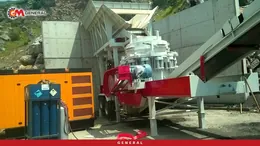
If the market wants manufactured sand or cubical fine aggregate, screened gravel has to go through a shaping stage. The GNR-MVSI 900 mobile plant with a vertical shaft impactor accepts at most 50 mm feed, delivers 0-3 / 3-5 / 5-12 mm products at 90-180 t/h and carries an 850 kVA power unit. It is not a primary machine; screening or primary crushing must come first. If the river stone is quartz-rich and abrasive, a jaw + cone setup is worth considering for the coarse gravel: the General 944 takes 800 mm feed, runs at 120-180 t/h and uses a 550 kVA generator. The compression principle of the cone secondary extends metal part life on abrasive rock.
Decision matrix: which model for which job?
| Model | Task | Capacity (t/h) | Max. feed (mm) | Washing | Power | Weight (kg) |
|---|---|---|---|---|---|---|
| GNR ME1650 | Dry screening | 120-180 | 0-100 | No | Mains or generator | 18,000 |
| GNR YM1240 | Washing and screening | 60-100 | 0-100 | Yes | Mains or generator | 18,000 |
| GNR YM1650 | Washing and screening | 120-180 | 0-100 | Yes | Mains or generator | 21,000 |
| Mobil 90 | Crushing + washing + screening | 90-150 | 800 | Yes | 350 kVA generator | 45,000 |
| GNR-MVSI 900 | Manufactured sand / shaping | 90-180 | 50 | No | 850 kVA generator | 42,000 |
| General 944 | Jaw + cone crushing and screening | 120-180 | 800 | No | 550 kVA generator | 70,000 |
Read the table with two points in mind. First, capacity ranges shift with rock hardness, moisture and the required product size; do not treat the upper value as a guaranteed figure for your site. Second, the same capacity band does not mean the same job: ME1650 and YM1650 both sit in the 120-180 t/h band, but only one of them can separate clay with water. You can compare every crusher-based option on the mobile stone crushers page and the dry and wet screening models on the washing and screening plants page.
Site conditions: sand loss, water, power and flooding
Keeping fine sand out of the overflow
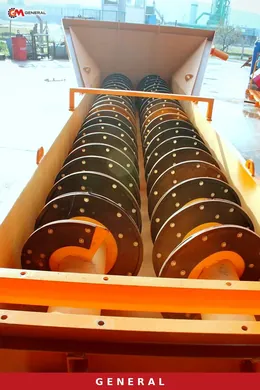
On river material, sand is often the best-selling product, and every fine particle lost with the wash water is lost revenue. A screw washer scrubs the fine sand along the bottom of the tank and carries it to the discharge end while silt- and clay-laden water leaves over the weir. The twin screw on the Mobil 90 is built into the line to recover 0-5 mm sand without letting it escape with the water.
Moisture: will the sand sit in stock or go straight to the batching plant?
According to the product data, moisture at the screw discharge is typically in the 15-30% band. If the sand goes straight to a concrete plant or is sold without time in stock, a hydrocyclone and a dewatering screen are added to the chain, pulling moisture down to 8-20%. When requesting a quotation, ask separately whether this equipment is in scope.
Water, permits and settling
A washing line has to be planned together with a clean water intake, a settling pond and handling of return water. Extraction from a riverbed, water use and wastewater discharge may each need separate permits. Confirm the local regulations with the relevant authority and finalise the machine choice together with the outcome of the permit process.
Power, ground and flood risk
River sites are usually far from the grid. YM1240, YM1650 and ME1650 can run on mains or a generator; a 350 kVA generator is specified for the Mobil 90, 550 kVA for the General 944 and 850 kVA for the GNR-MVSI 900. If the line has two machines (for example Mobil 90 followed by MVSI 900), size generators and fuel logistics on the total connected load. Alluvial ground is soft, so install the plant on a compacted platform above flood level. The wheeled chassis lets you tow the plant to safety when a flood warning comes; on a river site this is the real advantage of a mobile plant over a stationary one. For transport, check weight and dimensions against the access road: the Mobil 90 weighs 45,000 kg and measures 3600 × 15700 × 4500 mm.
Checklist before you request a quotation
- Sieve analysis of samples from several points and the largest particle size
- SE or MBV result, and whether the clay comes as lumps or a fine coating
- Products to be sold and their size ranges (concrete, asphalt, fill)
- Whether crushed faces or cubical shape are required
- Hourly and daily target tonnage and shift pattern
- Water source, settling pond location and discharge permit status
- Mains power available, or the required generator kVA
- Flood level, platform ground and load limit of the access road
- Target sand moisture and the need for a hydrocyclone or dewatering screen
Once the list is complete, you can make a first match yourself with the product selection wizard and then consult the engineering team with your sample data.
Frequently asked questions
Can I sell river material washed but not crushed?
Yes, if most of the material is below 100 mm and the market accepts natural sand and gravel; the YM1240 or YM1650 is enough for that job. If the oversize share is high or buyers want crushed faces, a line without a crusher leaves part of the product worthless.
Mobil 90 or YM1650?
Feed size decides. The YM1650 takes 0-100 mm and washes at 120-180 t/h; the Mobil 90 crushes stone up to 800 mm with its GPJ 90 jaw and washes and screens it on the same chassis at 90-150 t/h. If the bucket carries large river stone, choose the Mobil 90; if the material is already fine, the YM1650 makes sense.
What drives the price of the plant?
Crusher type, washing scope (screw washer, hydrocyclone, dewatering screen), number of screen decks, generator, an added secondary or VSI stage and transport. A quotation prepared with your sample data pins these items down for your site.
What warranty and certificates apply?
General Makina has been manufacturing in Izmir since 1976; machines carry ISO 9001 and CE certification and a 1-year warranty excluding wear parts.
Conclusion
On a riverbed the right machine follows from three answers: does the material need crushing, does it need washing, and what product will you sell? ME1650 fits clean, fine material; YM1240 or YM1650 fits dirty sand; the Mobil 90 fits sites where boulders and clay come together; and the GNR-MVSI 900 joins the line when crushed sand is the target. Contact us with your sample's sieve analysis and clay test, and together we will define the right crushing and screening plant and quotation for your site.
Definitions of technical terms: Glossary