EN — English
 TR — Türkçe
 DE — Deutsch
 RU — Русский
 FR — Français
 ES — Español
 AR — العربية
 SR — Српски
New-Generation Energy-Saving Technologies for Mobile Crushing and Screening Plants
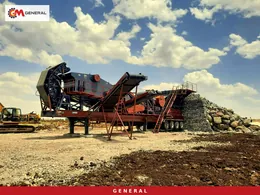
On a mobile crushing and screening plant, the power bill or the generator's fuel tank does not shrink because one machine is "efficient". Consumption is set by the whole chain: how well the generator matches the plant load, how much motor power is installed on the crusher relative to its tonnage, how much of the material entering the crusher never needed crushing, how large the recirculating load from the screen is, and how long the line runs empty. This article promises no savings percentages. Using General Makina catalogue data, it walks through the mechanisms that genuinely drive energy use and shows, for each one, which choice makes sense under which conditions.
Sizing the generator to the plant's real load
At a quarry far from the grid, every motor on the plant is fed from a single power unit, so the first energy decision is made before the crusher: generator size. An undersized unit causes voltage dips and tripped protection when the largest motor starts; an oversized unit spends the whole shift running at a small fraction of its rating. A diesel engine at low load burns more fuel for every unit of electricity it produces. The right target is a rating that comfortably covers the continuous running load, with the start-up peak handled by sequential starting.
The catalogue figures show that generator rating does not grow with tonnage alone. In the table below, plants in the same capacity band come with different power units; the difference comes from the crusher combination and how fine the crushing stage is.
| Model | Capacity (t/h) | Crusher arrangement | Generator (kVA) |
|---|---|---|---|
| General 640 | 60-100 | GPJ 60 jaw + GNR 50 impact | 300 (optional) |
| General 800 | 80-150 | PDK 1280 primary impact | 450 |
| General 944 | 120-180 | GPJ 90 jaw + GM430 cone | 550 |
| General 950 | 120-180 | GPJ 90 jaw + DMK01 impact | 600 |
| General 02 | 250-300 | GPS 1413 impact | 660 |
| GNR-MC110 | 200-300 | GPJ 110 jaw + GS1215 / DMK03 impact | 750 |
| GNR-MVSI 900 | 90-180 | VSI 900 vertical shaft | 850 |
Two rows are particularly instructive. General 944 and General 950 work in the same 120-180 t/h band; the 944 with a cone secondary is supplied with 550 kVA, the 950 with an impact secondary with 600 kVA. The GNR-MVSI 900, at 90-180 t/h, has one of the lowest tonnages in the table yet carries the highest power unit in the group at 850 kVA, because it is the tertiary stage that turns 50 mm feed into 0-20 mm sand. Power demand is decided as much by "how fine am I crushing" as by "how many tonnes". The GNR-MC110 twin-chassis mobile jaw crushing plant adds a specific flexibility here: the primary and secondary groups can run independently, so the secondary chassis can be switched off during periods when only primary crushing is needed. If the site is close to the grid, note that screening plants such as the GNR ME2060 are listed in the catalogue as running on "generator or mains".
Crusher motor power versus capacity: how many kW per tonne?
Dividing installed crusher power by hourly tonnage is the simplest way to put different models on the same scale. The ratio is not consumption; it shows how much motor power a crusher carries per tonne, and it makes plain that a plant running at the bottom of its band spends the same motor on less product. The ratios below are calculated from catalogue data (kW divided by the lower and upper ends of the capacity band, rounded to two decimals).
| Model | Crusher | Motor (kW) | Capacity (t/h) | kW per t/h, lower end | kW per t/h, upper end |
|---|---|---|---|---|---|
| GM 90JP | GNR 90 jaw | 95 | 70-180 | 1.36 | 0.53 |
| GM 100 | GNR-01 impact | 160 | 100-180 | 1.60 | 0.89 |
| GM 125 | GNR PDK02 impact | 200 | 150-250 | 1.33 | 0.80 |
| M-PDK01 | Primary impact | 315 | 250-500 | 1.26 | 0.63 |
| M-DMK 03 | Secondary impact | 250 | 175-300 | 1.43 | 0.83 |
The decision rule from the table is clear: running the same motor at the bottom of the band nearly doubles installed power per tonne. The GM 100 tracked mobile impact crusher carries 1.60 kW per t/h at 100 t/h, and the ratio drops to 0.89 at 180 t/h. Choosing a plant far larger than the job "in case we need it later" therefore means the motor and generator turn at low load for long periods. Conversely, a small model pushed to its limit runs permanently overloaded and produces downtime and wear. The right point is where the real daily production target falls in the middle-to-upper part of the chosen model's band.
Feeder and grizzly: keeping material that needs no crushing out of the crusher
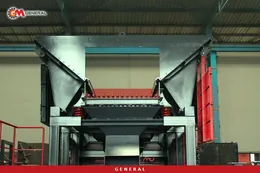
Run-of-mine material contains fines as small as the crusher product, plus soil and clay. If that fraction enters the crushing chamber, the motor spends power moving and compressing material that is already finished, and the liners wear for nothing. A vibrating grizzly feeder passes these fines through the grizzly so they bypass the crusher; the catalogue text describes this function explicitly as cutting unnecessary crushing energy. The same feeder delivers large rock evenly to the crusher mouth and keeps it choke-fed.
The feeder's own motor power is small: 2x3 kW on the GNR 60 rock feeder, 2x9.2 kW on the GNR 140. Set against the load on the crusher side, this explains why pre-separation is the first place to look. The same logic is standard on the tracked models: the GM 100 has a 900×2400 mm feeder (2×2.6 kW) with a 1000×1500 mm grizzly, and the GM 125 a 1100×2600 mm feeder (2×3.2 kW) with a 1360×2160 mm grizzly. Where material is clayey and sticky, a grizzly blinds and loses its pre-separation function; for such sites the catalogue points to the GWB1136 wobbler feeder (18.5 kW) with a motor-gearbox-chain drive. At the secondary stage, the DMK type with pre-screen applies the same principle one step down, separating finished fines before they reach the crushing chamber.
Matching crusher to rock, and the recirculating load of a closed circuit
The wrong crusher type quietly consumes energy. In limestone and low-abrasive rock, an impact crusher gives high reduction and cubical product in one stage; in hard, abrasive rock such as basalt and granite, a jaw primary with a cone secondary works with a longer metal life. Putting an impact crusher on hard rock means frequent part changes and falling tonnage; installing a heavy jaw-cone train on soft rock means carrying more installed power than needed. For the detail of this choice, see our article on impact versus jaw crusher selection criteria.
In a closed circuit, oversize material retained on the screen is sent back to the rotor and crushed again until it reaches the target size. The loop guarantees product quality, but every returned tonne is load that the crusher and belts carry a second time. Three causes inflate the recirculating load: a crusher setting too open for the target product, blinded screen apertures, and a screen area too small for the tonnage. On sites with blinding problems the GNRTK controlled-vibration screen is a good example: its triple-shaft drive produces an adjustable oval stroke, and the catalogue states that it reduces blinding and keeps recirculating load low. The GNRTK-1550 runs a 1500×5000 mm deck with a 22 kW motor, the GNRTK-2060 a 2000×6000 mm deck with 30 kW.
Automation: sequential starting and motor-load monitoring with PLC/SCADA
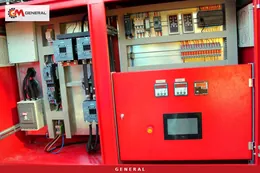
In this article, the technologies that earn the label "new generation" are the control solutions clearly described in the catalogue. The automation and control system defines start-up order, interlocks and shutdown scenarios on a PLC; on the SCADA screen in the cabin, the running state, current draw and alarms of every machine are displayed live. In the motor control centre, starters, variable frequency drives (VFD) and protection relays automatically balance feeder speed and crusher load.
Why does sequential starting matter for energy?
Equipment is started against the material flow, from the stockpile conveyor back to the feeder. This way not all motors draw starting current at once, and the generator does not have to be oversized for a brief peak. When one machine stops, all stages upstream stop automatically, preventing starts on loaded belts and conveyor blockages. The touch panel, soft starter, frequency control and remote monitoring offered as options on the General 01 are the single-machine version of this approach.
How does motor-load monitoring manage the feeder?
When crusher current approaches its threshold, feeder speed is reduced automatically; when current returns to normal, feed is increased again. This prevents the crusher from stalling under overload and the empty-and-restart cycle that follows. The same data works in reverse: if current stays low for long periods, the crusher is starved and motor power is turning for nothing. Automation can also be retrofitted to existing plants.
Reducing idle running; belt and screen maintenance
The part of a plant's energy that does not become product is mostly equipment turning empty: a crusher running while trucks are awaited, belts running without material, a screen running when the stockpile is already full. The most practical way to measure this is the current log in SCADA. On the maintenance side, conveyor capacity is set by width, inclination and speed; the wrong inclination or width leads to spillage, slipping, wear and stoppages. Seized idlers, a drifting belt and dirty scrapers make the motor work against needless resistance.
Apply this checklist at shift start and during weekly maintenance:
- Mark the periods in the SCADA current history when the crusher ran at low current; these are feed interruptions or truck scheduling problems.
- Check the feeder grizzly for blinding and clay build-up; a blocked grizzly sends fines into the crusher.
- Check screen apertures for blinding and torn wire; blinding increases the recirculating load.
- Verify the crusher setting against the target product; a worn-open setting returns more oversize from the screen.
- Confirm carrying and return idlers turn freely and scrapers keep the belt clean.
- Test belt misalignment and speed switches; safe sequential stopping depends on them.
- Log the generator's continuous load through the shift; if low load is persistent, reassess the unit size.
Frequently asked questions
Which machine uses the most energy on a mobile plant?
By installed power, the crusher motor is by far the largest item, for example 200 kW on the GM 125 and 315 kW on the M-PDK01. Any measure that reduces the load reaching the crusher, namely grizzly pre-separation, a correct setting and a low recirculating load, is therefore the intervention with the most direct effect on total consumption.
Isn't a large generator the safe choice?
It gives start-up margin, but a diesel unit running at low load throughout production burns more fuel per unit of electricity. The right approach is to start from the kVA rating listed per model in the catalogue and control the peak current with sequential starting and start-up management.
Can automation be added to my existing plant?
Yes. The automation and control system can be retrofitted to existing crushing and screening lines. For a quotation, the plant type, equipment list and capacity are enough.
How much investment does energy saving require?
It depends on the existing equipment, what is added and the scope of automation, so it cannot be answered with a single figure. Once you share your flow sheet and production target, scope and price are prepared for your project.
Conclusion and quotation
On a mobile plant, energy is brought under control by sizing the generator correctly, running the crusher in the right part of its band, keeping fines out of the crusher altogether, keeping the recirculating load small and managing the line sequentially with PLC/SCADA. General Makina has been building crushing and screening plants since 1976 and delivers them with a 1-year warranty. Send us your material, target products and daily tonnage through our contact page, and we will prepare a quotation matched to the model and power unit.
Definitions of technical terms: Glossary