EN — English
 TR — Türkçe
 DE — Deutsch
 RU — Русский
 FR — Français
 ES — Español
 AR — العربية
 SR — Српски
VSI Rotor Maintenance
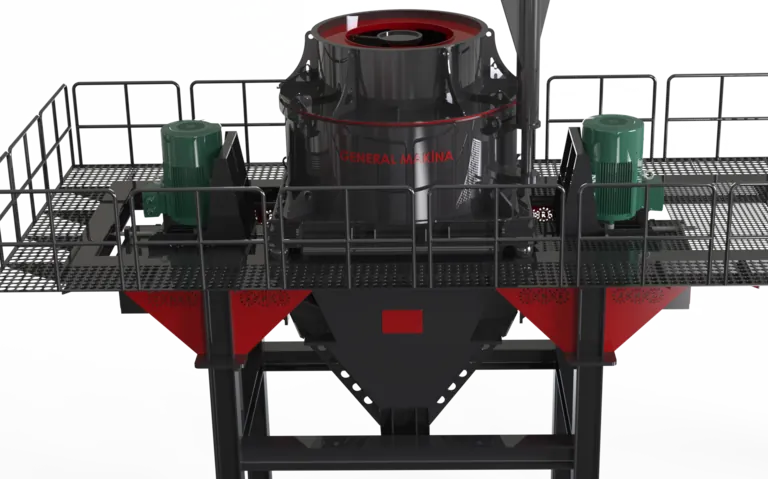
The rotor is the heart of a VSI — and the centre of its maintenance. Even wear across the tip set is normal; premature thinning of a single tip signals feed distribution problems or imbalance, which directly attacks bearing life.
Why rotor size matters
In the GNR series, capacity and tip-set size grow with the rotor; the GNR 900 runs twin motors:
| Model | Rotor Ölçüsü(mm) | Beslenebilecek Max. Malzeme Ebadı(mm) | Kapasite(t/s) | Motor(kW) |
|---|---|---|---|---|
| GNR 700 | 700 | 25-35 | 45~135 | 90-132 |
| GNR 800 | 800 | 40-50 | 55~160 | 132-160 |
| GNR 900 | 900 | 50-55 | 80~210 | 2x200 |
When to replace tips
Replace when the hardfacing layer thins, before wear reaches the parent body — body wear scraps the rotor. Always fit tips as a set, with matched weights on opposite pockets.
Feed size discipline
Exceeding the max feed sizes in the table shortens tip life sharply and destroys the dead-bed in rotor pockets. Guaranteeing feed size with a screen is the cheapest rotor maintenance there is.
Balance checks
If vibration persists after tip replacement, pocket build-up may be uneven; clean the rotor and let the dead-bed rebuild.
How to run the rotor inspection
After lockout (LOTO), open the top cover and check tips, pocket build-up and the distributor plate in one pass. If the dead-bed is hard and even, leave it — it is part of the design, protecting the body with the material itself.
Effect on sand quality
A rotor running on worn tips loses impact energy: fines ratio drops and cubicity degrades. A silent drift in the product curve is more often the rotor than the screen — tip life cannot be managed without watching the curve.
Twin-drive GNR 900 note
On twin-drive bodies keep belt tensions equal on both sides; one-sided tension puts axial load on the bearing and shows up as a single rising frequency in vibration readings.
Three settings that extend tip life
First, keep the distributor plate centred: an offset plate channels material into one pocket and finishes that tip early. Second, choose rotor speed for the product target — raising speed needlessly does not improve cubicity, it burns tips. Third, keep the feed continuous at moderate rate: a rotor filled in bursts loses its dead-bed at every emptying and body protection weakens. All three cost nothing but discipline. Log tip changes with date and tonnage and your model's real life curve emerges within a few replacements.
Final note: keep every part removed at rotor service (tips, pocket plates, distributor) labelled with model and date — a shift in the wear pattern also reveals a shift in the material source. When the quarry face changes, the first signal usually comes from tip life.
Maintenance recommendations depend on the model and operating conditions — contact us for a plan specific to your machine.
Definitions of technical terms: Glossary