EN — English
 TR — Türkçe
 DE — Deutsch
 RU — Русский
 FR — Français
 ES — Español
 AR — العربية
 SR — Српски
Choke Feeding Crusher Productivity
Why choke feeding crusher productivity arrives without new equipment
When a plant misses its tonnage target, the first instinct is to buy a bigger crusher. On most sites, however, choke feeding crusher productivity is recovered without turning a single bolt, purely by correcting the feed regime. Choke feeding means keeping the crushing chamber full of material, which in a cone crusher means keeping the head nut buried. A full chamber lets particles break against each other as well as against the liners. An empty chamber does the opposite: the machine runs below its rating and eats its liners in one narrow band.
What changes when rock breaks against rock
The mechanism a full chamber unlocks is interparticle comminution. Material in the gap between mantle and bowl liner is not only struck by steel; it is also squeezed by its neighbours. That regime breaks flat and elongated grains and produces a shape close to cubical. Concrete and asphalt specifications cap flakiness and elongation, so the same crusher at the same setting can deliver product that passes or fails a specification purely because the chamber level changed. On plants fighting a shape problem, the first place to look is therefore the feed level, not the liner profile.
The second effect is wear. In a starved crusher the feed drops into the chamber at one point and wear concentrates there, while the manganese surface never sees enough pressure to work-harden fully. In a full chamber the crushing force is distributed around the circumference, wear advances more evenly, and product shape drifts less over the life of the liner.
Comparing the feed regimes
| Criterion | Starved feed | Choke feed | Overfilled / packed |
|---|---|---|---|
| Chamber level | Partial; liner face visible | Continuously full; head nut buried | Full and compacted; fines have closed the voids |
| Dominant breakage | Steel to particle contact | Particle against particle | Attrition and grinding |
| Product shape | High share of flat and elongated grains | Close to cubical | Excess fines generation |
| Liner wear | Concentrated in one zone | Spread around the circumference | High and rapid |
| Power draw | Erratic, low average | Steady, close to rating | At the limit; protection trips |
| Capacity | Below rated tonnage | Close to rated tonnage | Falls because of stoppages |
| Main risk | Lost shape and liner life | Needs continuous level control | Packing, shaft and bearing stress |
The three pieces of hardware that hold the level
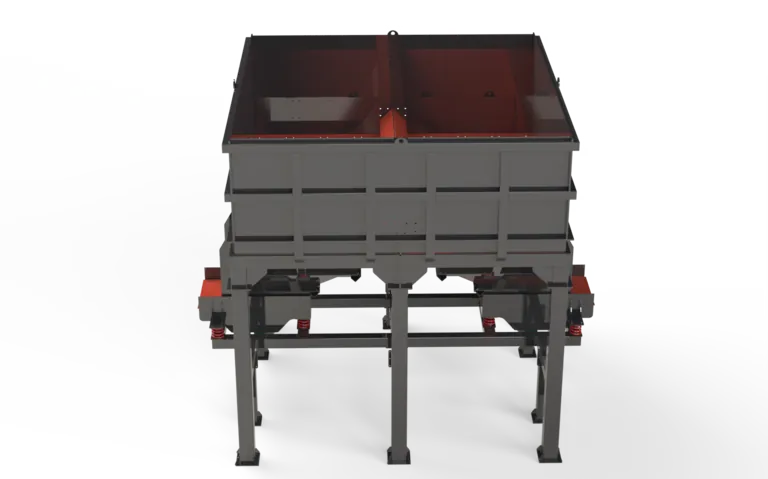
Choke feed is not an intention; it is a regime built with hardware. The first item is the feeder: the flow arriving at the crusher inlet must not surge. Without an adjustable unit under the hopper, such as a vibrating rock feeder, the chamber fills and empties with every truck that tips. The second item is level measurement: a sensor watching material height in the feed box lets the control system trim feeder speed automatically. The third is distribution. If material enters from one side, coarse and fine segregate, fines pack on one side while the liner runs empty on the other.
Fines and moisture: the enemies of a full chamber
Keeping the chamber full is not the same as filling it with fines. If the fine fraction is not scalped ahead of the secondary and tertiary stages, the voids that coarse grains need in order to break are gone. Material is then ground rather than crushed, power draw climbs and the pressure protection intervenes. With wet, clayey feed the same problem appears as packing and build-up. The practical order is scalping first, level second. Raising chamber level without pre-screening buys stoppages, not tonnage.
Commissioning and monitoring order
After new liners are fitted, a crusher is not thrown straight into full-load choke operation. To let the manganese surface work-harden, the chamber is kept full while load is raised in steps; those first hours set the whole service life of the liner. After that, three indicators are tracked. First, the variation of power draw over time: a flat trace is the proof of a stable level. Second, the product curve: at an unchanged setting, a rising fines share points to packing and a rising coarse share points to starvation. Third, the liner profile: wear advancing evenly at the measuring points shows the distribution is right.
How it enters the shift routine
Whether the regime survives on site depends on operator habit. Three lines go into the shift instruction. First, a visual reference level is defined in the feed box and the level is not allowed to fall below it. Second, the chamber is emptied before the crusher is stopped; a machine left full loads the drive train with breakaway torque on a cold start. Third, every feeder speed change is logged, because a regime whose speed and product curve were never paired cannot be measured. None of the three needs capital, and their effect shows within the first week.
Two points that are often confused
First, choke feed does not mean the same thing at every stage. In a primary jaw crusher the aim is not to fill the inlet to the brim but to hold a continuous column of material down the jaw; blocking the inlet costs capacity. Second, a full chamber does not replace the setting. Closed side setting still governs the top size of the product; level does not change that size, it delivers more cubical and fewer flaky grains at the same size.
Definitions of technical terms: Glossary