EN — English
 TR — Türkçe
 DE — Deutsch
 RU — Русский
 FR — Français
 ES — Español
 AR — العربية
 SR — Српски

Performance and Energy Analysis of Electric and Diesel-Hybrid Mobile Crushers
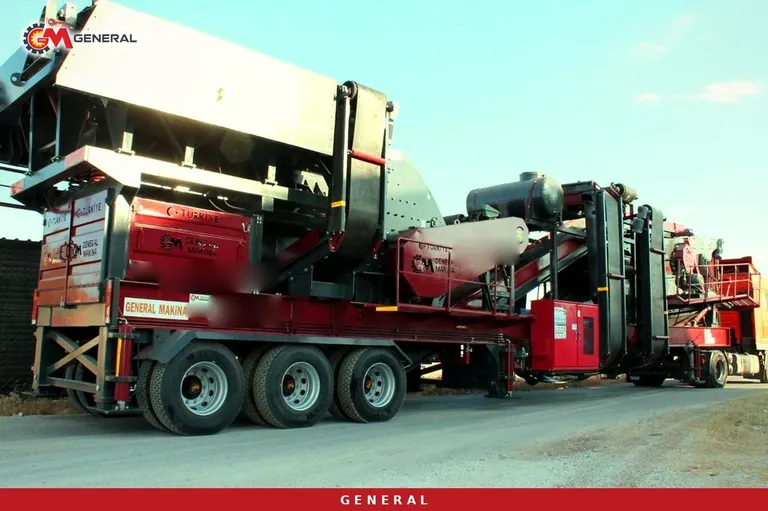
Calling a mobile crusher "electric" says nothing about where its energy comes from; it only says that the crusher, screen and conveyors are turned by electric motors. The same motors can be fed from a grid transformer one week and from the diesel generator on the chassis the next, and the energy cost per tonne will be completely different in each case. "Diesel-hybrid" is just as loose a term, used differently from one manufacturer to the next. This article separates the drive architectures, shows what the power data on General Makina product pages does and does not tell you, and explains how to compare grid supply and a generator with the same formula. We give no fuel consumption figures or savings percentages; those are measured on site, not read from a catalogue.
Naming the drive train correctly: four different architectures
In mobile crushing and screening equipment, energy travels from fuel or the grid to the crushing chamber in four basic ways. Before comparing quotations, pin down which one the machine in front of you belongs to, because performance and maintenance behaviour follow from this classification.
- Direct mechanical diesel: the diesel engine drives the crusher through a clutch and belts; auxiliary consumers run on hydraulics or a small alternator. Crusher speed is tied to engine speed.
- Diesel-hydraulic: the engine turns hydraulic pumps; crusher, belts and tracks run on hydraulic motors. Flexible, but every energy conversion loses some power as heat.
- Diesel-electric (genset-driven): the diesel engine only turns a generator; every consumer on the plant is an electric motor. The motors are electric, the energy source is still fuel.
- Grid-fed electric: the same electric motors are supplied straight from the grid through an on-site transformer and switchboard; there is no fuel tank on site.
In the industry, "hybrid" usually means a combination of the third and fourth architectures: the machine can run on its own generator, and on a site with grid access it switches to an external supply inlet and shuts the generator down. Some manufacturers also use the term for machines that combine an electric crusher drive with hydraulic tracking. This is a description of the principle; no model on General Makina product pages is described as hybrid. When a quotation says hybrid, ask in writing which consumer is fed from which source.
What the catalogue data says: power source by model
Across General Makina's wheeled mobile stone crushers and its track-mounted mobile crushers, power is given as a generator or power-unit rating in kVA. For the screening plants, the power line simply reads "generator or mains". The table below brings together only the values that appear in the product tables; a dash means the product page gives no figure.
| Model | Class | Crusher / screen motor | Power unit | Power source stated for the product |
|---|---|---|---|---|
| General 640 | Wheeled, jaw + impact | — | 300 kVA (optional) | Optional generator for off-grid sites |
| General 01 | Wheeled, GPS 1210 impact | — | 550 kVA | Generator |
| General 950 | Wheeled, GPJ 90 jaw + DMK01 impact | — | 600 kVA | Generator |
| GNR-MVSI 900 | Wheeled, VSI 900 vertical shaft | — | 850 kVA | Generator |
| GM 90JP | Tracked, GNR 90 jaw | 95 kW | 250 kVA | Power unit; generator feed on off-grid sites |
| GM 100 | Tracked, GNR-01 impact | 160 kW | 450 kVA | Power unit |
| GM 125 | Tracked, GNR PDK02 impact | 200 kW | 550 kVA | Power unit |
| GNR ME2060 | Wheeled screening | Screen motor 22 kW | — | Generator or mains |
| GNR ME1650 | Wheeled dry screening | — | — | Generator or mains |
Three concrete conclusions follow. First, the plants' power is stated in kVA and the crusher motor in kW; the two cannot be divided into each other directly. The real power a generator can deliver is its kVA rating multiplied by the load power factor (P = S × cos φ), and that power is shared by every consumer — feeder, belts and screen as well as the crusher. Second, on the General 640 mobile crushing and screening plant the generator is optional, which means a generator-free configuration for a grid-connected site can be discussed at quotation stage; on the other wheeled models the generator is listed in the product table as part of the equipment. Third, the GNR ME screening plants are defined as open to both sources, so a mixed layout is possible on one site: crusher on a generator, screening line on the grid.
Performance differences: speed stability, start-up and product quality
An electric motor turns at a speed set by the frequency of its supply. Grid frequency stays practically constant under heavy load; on a generator, a sudden load causes a brief frequency and voltage dip until the diesel governor recovers. In an impact crusher, rotor tip speed is one of the main factors shaping the product curve. The GNR-01 impactor on the GM 100, for example, is specified at 1500 rpm; how well that speed holds under load affects the share of cubical product and the amount of material recirculating from the screen. On a jaw crusher, speed fluctuation affects the product less, but start-up and re-acceleration with a full chamber are still the heaviest moments for a generator.
There are three ways to manage start-up: soft-starter, frequency control (drive) and sequenced start. The product page of the General 01 mobile crushing plant mentions a touchscreen panel with soft-starter, frequency control and remote monitoring; confirm the scope of this equipment for your model in the quotation. In a sequenced start, belts and screen are started against the material flow, from the stockpile belt backwards; the crusher is run up empty and the feeder is switched on last. This keeps the generator from having to carry the inrush current of several large motors at once, and on the grid it eases fuse and transformer sizing.
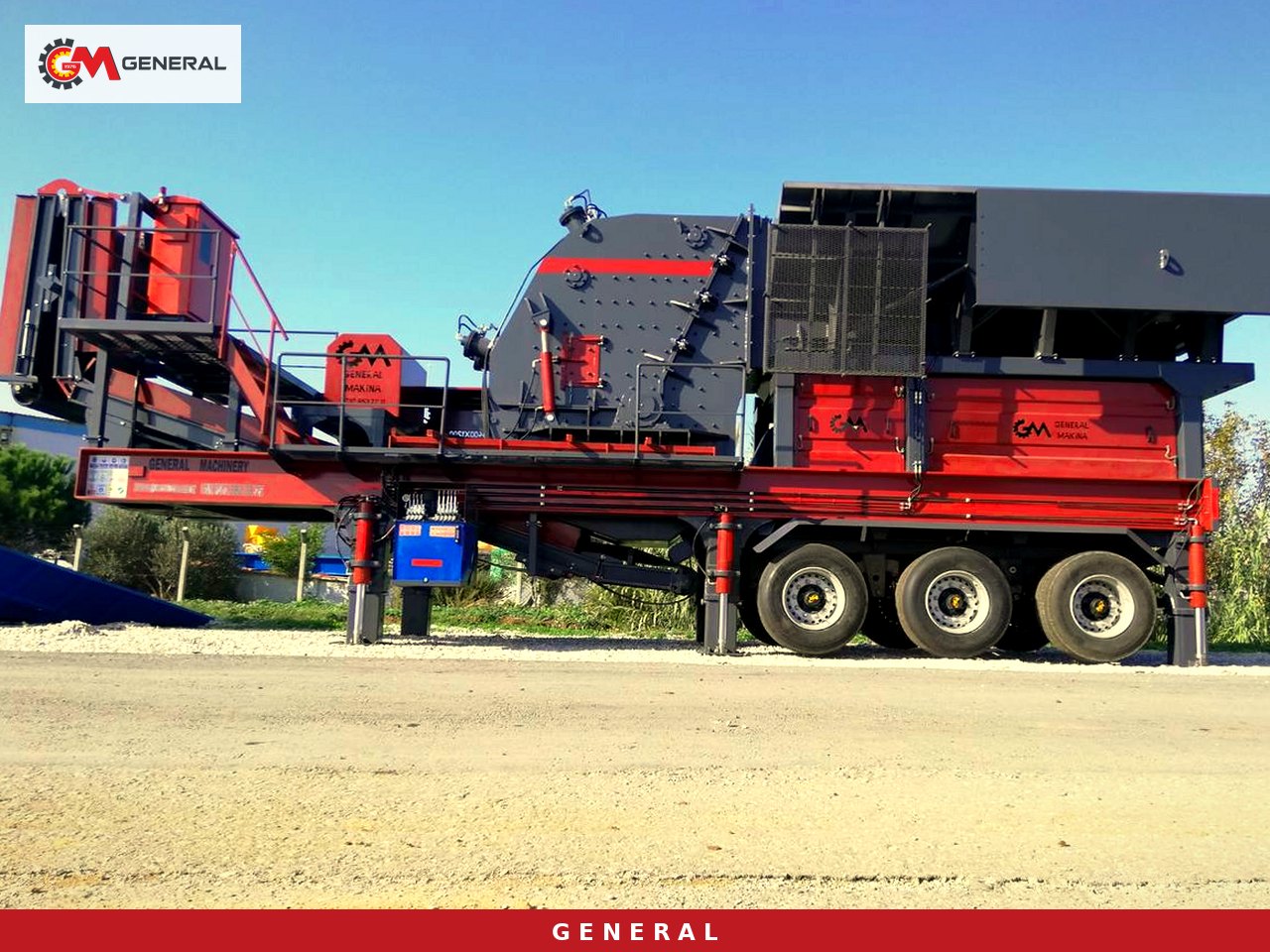
This is where the hybrid principle pays off on the performance side: in a diesel-electric machine the engine is not exposed directly to the crusher's instantaneous load; it turns the generator at constant speed, and the electrical side absorbs swings in crusher speed. With a grid inlet those swings almost disappear. In a direct mechanical diesel, every load on the crusher feeds back into engine speed and therefore into rotor speed.
Energy cost: comparing grid and generator with one formula
The only honest way to compare the two sources is to convert both to cost per tonne. You enter the hourly consumption and prices; the formula stays the same.
- Grid: energy cost per tonne = (average power drawn, kW × electricity unit price) ÷ net hourly output (t/h) + (connection investment ÷ total tonnes to be produced at this site).
- Generator: energy cost per tonne = [(fuel consumption, l/h × fuel unit price) + hourly generator service and oil allowance] ÷ net hourly output (t/h).
The second term of the grid formula is forgotten in most calculations. Transformer, cable run and distribution board are installed once; their weight per tonne depends on how long you stay on site and how much you produce. On a long-life quarry the term shrinks; on a road job lasting a few months, this is usually where the generator's advantage comes from. In the generator formula, idle running hides: while the plant waits for material the generator keeps burning fuel but adds no tonnes to the denominator. You can turn your own figures into cost per tonne with the energy and wear cost calculator.
To fill the formula with real data, record the following during the trial period:
- Daily fuel top-up and hour-meter reading (generator operation).
- Electricity meter reading at the start and end of each shift (grid operation).
- Saleable product tonnage per shift from a weighbridge or belt scale.
- Idle time, split into waiting for feed, breakdowns and relocation.
- Rock type and moisture; the same plant draws different power on different stone.
Which source for which site: decision criteria
Choosing the energy source is a site decision, not a machine decision. The matrix below shows which questions settle it.
| Site condition | Grid | Generator | Hybrid principle (two sources) |
|---|---|---|---|
| Grid line close by, long-life quarry | Strong candidate | As back-up | Grid as main, generator as back-up |
| Off-grid, short job | Connection cost hard to recover | Strong candidate | Makes no difference |
| Frequent relocation inside the quarry | Cable handling becomes a burden | Independent movement | Grid at fixed points, generator while moving |
| Crushing and screening at separate points | Suits the screening line | Suits the crusher | Mixed layout |
One reason tracked equipment is preferred for jobs with frequent moves inside a quarry is that it carries its energy with it. The GM 90JP product page states plainly that generator feed is sufficient on quarries and sites without a grid connection. A screening line that stays in one spot for a long time, on the other hand, is the link best suited to a grid connection; the GNR ME and YM models in the washing and screening plants group are listed to run on mains or generator.
Checklist before requesting a quotation
- Is there grid power on site, and if so, how much transformer capacity is available and how far away is it?
- How long will the job last: does the connection cost make sense spread over that period?
- Is the generator part of the scope or optional? Is its rating given in kVA in the table?
- Start-up management: which motors have soft-starters, frequency control or sequenced start?
- If the quotation says "hybrid", is the supply source of each consumer stated in writing?
- Do you plan to feed the crusher and the screening line from separate sources?
- Who will keep fuel, meter and tonnage records during the trial period, and how often?
For the mechanisms that reduce energy demand (grizzly pre-screening, crusher-to-rock matching, closed-circuit recirculation), see our article on energy-saving technologies; this piece focuses on the source itself.
Frequently asked questions
Does an electric mobile crusher use no fuel?
Its motors may be electric, but on an off-grid site a diesel generator produces the energy, so fuel consumption continues. What removes fuel consumption is the grid connection, not the electric motor.
Does General Makina have a diesel-hybrid model?
No model is described as hybrid on the product pages. For wheeled and tracked crushers the power unit is given in kVA; the GNR ME screening plants are defined to run on generator or mains. Clarify the supply layout for your site in writing at quotation stage.
Can a generator's kVA rating be compared with a crusher motor's kW?
Not directly. kVA is apparent power; usable power depends on the power factor, and the generator also feeds the feeder, belt and screen motors besides the crusher. Starting current must be accounted for separately.
How do I know which source is cheaper?
Fill in the two formulas above with your own electricity and fuel unit prices, measured consumption and job duration. Pricing and configuration are given in a quotation prepared for your site.
Conclusion
An electric drive gives more predictable performance than a mechanical diesel in terms of speed stability and start-up control; energy cost, however, is set by the source that feeds the motor, not by the motor. Once the grid's connection cost and the generator's idle running are both in the formula, the decision becomes clear. Send us your site conditions, rock type and target tonnage, and contact us for a quotation covering the right model and supply layout.
Definitions of technical terms: Glossary