EN — English
 TR — Türkçe
 DE — Deutsch
 RU — Русский
 FR — Français
 ES — Español
 AR — العربية
 SR — Српски

How to Increase Cubical Product in a Mobile Crushing and Screening Plant
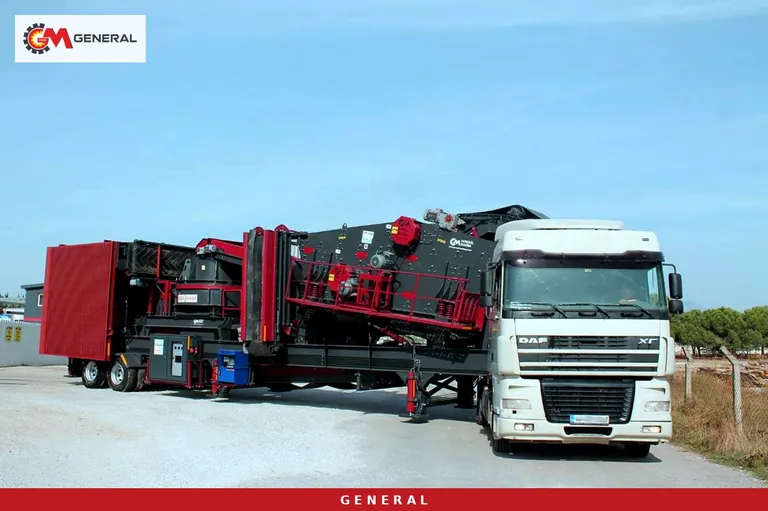
When the aggregate going to a concrete batching plant or an asphalt mixer carries too many flaky and elongated particles, the cause rarely sits in a single machine; it usually lies across the whole line. Raising the share of cubical product in a mobile crushing and screening plant means reading feed size, reduction per stage, crusher type, rotor speed and the screening circuit together. This article sets out what to check on site and in what order, how far adjustment alone can take you, and when it is time to add a dedicated shaping stage.
Start with the yardstick: "cubical" by whose definition?
Particle shape is measured by the test named in the specification, not by eye. Projects working to European standards ask for a Flakiness Index and a Shape Index; specifications based on ASTM C33 and related American methods ask for a flat and elongated particle ratio. Which test applies, on which fraction and with which limit value is set by your client's or the authority's technical specification. So before touching any plant setting, the first job is to confirm the limit in writing and make sure the laboratory uses the same method.
The second step is to measure the current situation fraction by fraction. Particle shape in 0-5 mm sand and in 12-19 mm chippings is spoiled by different mechanisms. A result from one mixed sample does not tell you which crusher or which screen deck is causing trouble. Taking a separate sample from each stockpile and logging the results next to the crusher settings of that day is the basis for every later decision.
Where do flaky particles come from? Reading the line backwards
As our cubicizer product page notes, flakiness increases as feed size grows and as crusher speed drops. On site this shows up in three practical ways:
- Too much reduction per stage: when one crusher is asked for a very high reduction ratio, stones split rather than break and come out as slabs. Trying to take large run-of-quarry rock down to fine product in one blow is the most common source of flaky particles.
- The rock itself: laminated, schistose or bedded rock breaks flaky by nature. Here adjustment helps only so much; a shaping stage is needed.
- Starved or uneven feed: when the crusher runs half-empty, particles pass through without rubbing against each other. Less rock-on-rock contact means worse shape.
Work backwards from the final product: identify the problem fraction, then trace which crusher it comes from and at what size and rhythm material enters that crusher. More often than not, the fix sits one stage before the point where the problem shows.
Adjustment levers by crusher type
Cone crusher: choke feed and the right closed side setting
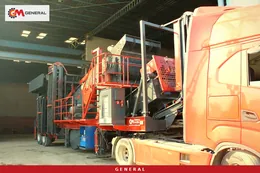
In a cone crusher, feed condition is the main driver of cubicity. When the chamber is choke-fed, particles crush each other and corners get rounded off; in a half-empty chamber stones are nipped one by one and come out flaky. The hydraulic closed side setting (CSS) should be kept close to the top size of the required product. Open it too far and large flaky pieces pass unbroken; close it too much and reduction per stage climbs, which again produces slabs. For abrasive basalt and granite, General 944 among our mobile stone crushers uses this compression principle (GPJ 90 jaw primary + GM430 cone secondary, 800 mm feed, 120-180 t/h).
Impact crusher: rotor speed and apron gap
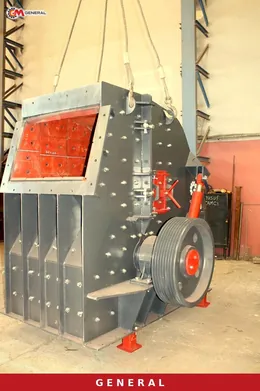
A horizontal shaft impactor gives a well-shaped product on its own in soft, low-abrasion rock such as limestone. Because flakiness rises as speed falls, worn blow bars reduce tip speed and impact energy; a rotor running on worn bars starts making flakier product even though nothing in the settings has changed. The apron gap also directly controls top size and particle shape. That said, a secondary impactor is known to produce slightly flakier particles than a VSI, and an added VSI stage improves cubicity. The General 950 mobile jaw and impact plant (GPJ 90 jaw + DMK01 impact, 120-180 t/h) is the mobile example of this approach.
Jaw primary: its job is steady feed, not shape
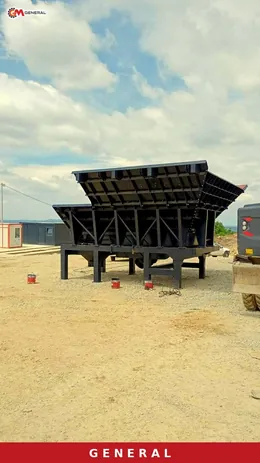
Expecting cubical product from a jaw crusher is the wrong target; the primary's task is to send the secondary a consistent size range without interruption. If primary output is coarse and scattered, the secondary either has to over-reduce or runs starved, and both spoil shape. Grizzly pre-screening that lets fines and soil bypass the primary corrects both crusher load and the size distribution reaching the secondary.
When adjustment is not enough: a shaping stage at the end of the line
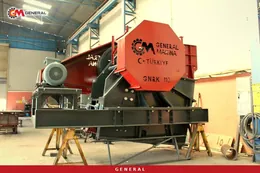
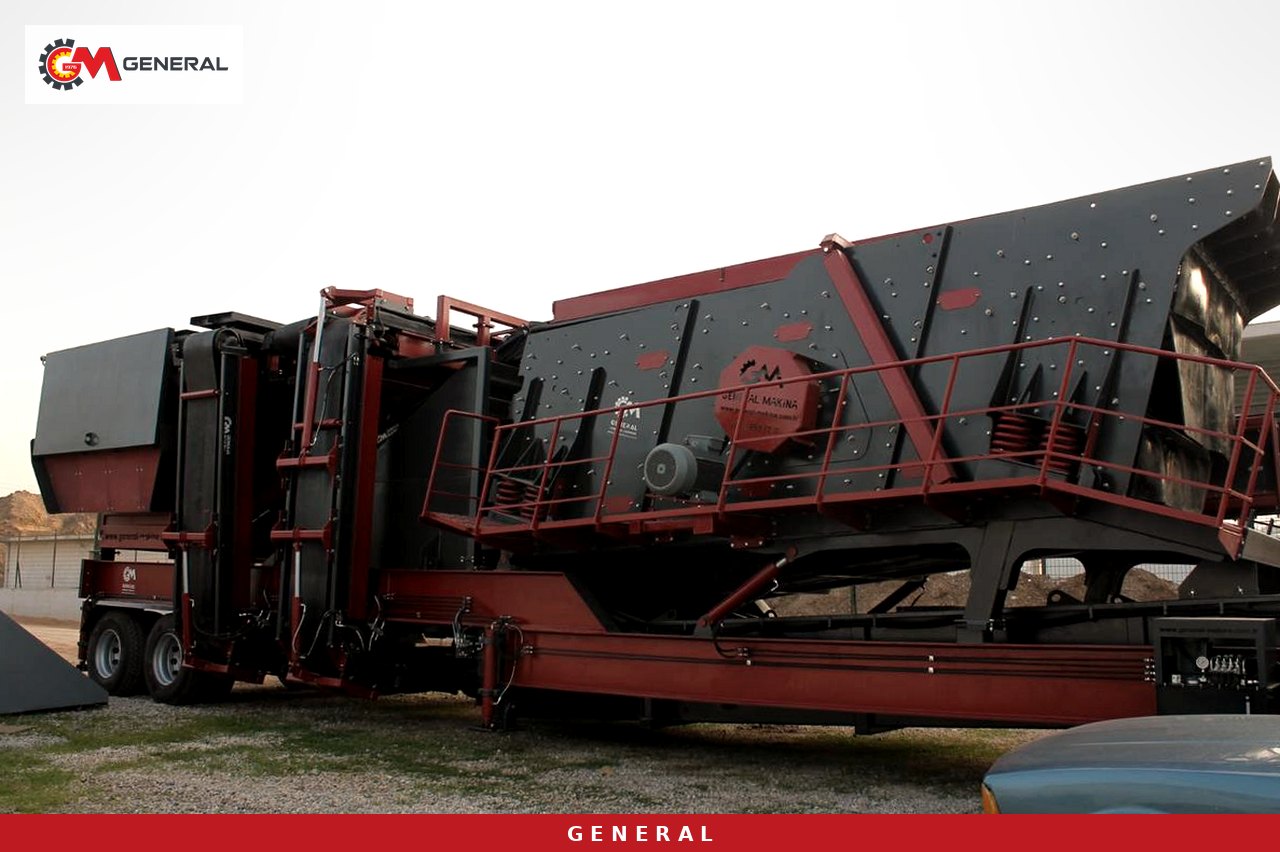
If the rock is laminated or the current line simply cannot meet the specification limit, adding a separate shaping stage gets results faster than chasing settings. A cubicizer is built to correct particle shape, not to reduce size, so its reduction is low; it does not take load off the secondary, it reworks its product. Two routes stand out for mobile lines: the GNR MK series mobile cubicizer working after the primary, and the GNR-MVSI 900 wheeled VSI plant shaping sand and fine aggregate.
| Model | Role | Max. feed | Capacity | Power | Best fit |
|---|---|---|---|---|---|
| GNR MK50 (mobile cubicizer) | Post-primary shaping | 150 mm | 45-80 t/h | 75 kW | Small-tonnage basalt line |
| GNR MK100 (mobile cubicizer) | Post-primary shaping | 250 mm | 90-130 t/h | 132 kW | Mid-tonnage basalt line |
| GNR MK110 (mobile cubicizer) | Post-primary shaping | 350 mm | 160-250 t/h | 200 kW | High-tonnage basalt line |
| GNR-MVSI 900 | Tertiary sand and fines shaping | 50 mm | 90-180 t/h | 850 kVA generator | Cubical sand, 0-3 / 3-5 / 5-12 mm fractions |
| General 944 | Complete jaw + cone plant | 800 mm | 120-180 t/h | 550 kVA generator | Cubical product by compression in abrasive rock |
| General 950 | Complete jaw + impact plant | 800 mm | 120-180 t/h | 600 kVA generator | High reduction and cubical product |
The MK series delivers 0-25 mm final product and its liners are Hardox 500 wear-resistant steel. It performs best in moderately abrasive basalt; in very abrasive rock with high free quartz, liner life must be watched closely and a cone alternative should be considered. The MVSI 900, by contrast, is a tertiary stage that accepts feed only up to 50 mm, so it always needs a primary and secondary crusher ahead of it. The full range of standalone units is listed under portable rock crushers.
The screening circuit: the overlooked half of cubicity
However well a crusher is set, flaky particles will slip into the stockpile if the screening circuit is wrong. In a closed circuit, oversize returns to the crusher; this recirculation helps keep the chamber full and gives large flaky pieces a second chance to break. In an open circuit every particle that passes the crusher once goes straight to stock.
The relationship between screen aperture and crusher setting also matters. If the aperture is clearly larger than the crusher setting, slabs that are thin in one direction and long in another slip through the mesh into the product. Bringing the aperture closer to the product top size and keeping the deck clean can improve shape results without touching the crusher. Worn wire mesh with enlarged openings has the same effect, so regular aperture checks belong on the maintenance list.
Step-by-step site checklist
- Confirm in writing the shape test, the fractions and the limit value in the specification.
- Sample each stockpile separately; record results with the crusher and screen settings of that day.
- Mark on the flow sheet which crusher the problem fraction comes from.
- Check feed size and chamber fill on that crusher; if it runs starved, correct feeder speed or hopper level.
- Review reduction per stage; if one crusher carries too much, redistribute the work.
- Measure blow bar and liner wear on impact and cubicizer rotors; worn parts spoil shape.
- On the cone crusher, check closed side setting and choke feeding.
- Measure screen apertures and wire wear; if the plant runs in open circuit, consider switching to closed circuit.
- Change only one parameter at a time and resample; changing three settings at once hides which step worked.
The cost side: wear parts versus product value
A shaping stage consumes extra energy and wear parts. In return, cubical product that meets the specification sells into concrete and asphalt markets without rejection and often finds buyers at a better price. To decide, compare both sides on the same per-tonne basis:
Extra cost per tonne = (extra power kW × operating hours × energy unit price + wear part consumption) ÷ tonnes produced
Extra revenue per tonne = (quantity of in-spec product × price difference + reduction in rejected or downgraded material) ÷ tonnes produced
Because these variables change with rock, site and market, a general figure would be misleading. To run the numbers with your own data, use the energy and wear cost calculator. Liner alloy choice feeds straight into this calculation: high-chrome or ceramic-reinforced parts for clean, abrasive rock; manganese parts for recycling material with tramp metal risk.
Frequently asked questions
What cubicity value should I aim for?
The specification sets the target, not the plant. Confirm the flakiness or shape index limit and the test method in your concrete or asphalt project specification with the authority or your client, then set the plant to that limit.
Can a cubicizer be added to my existing mobile plant?
Yes. A cubicizer works as a standalone portable unit and can be positioned after the primary. The model is chosen by the top size of incoming material (150 mm for MK50, 250 mm for MK100, 350 mm for MK110) and the required tonnage. Connection points and conveyor layout are planned to suit the site.
Cubicizer or VSI?
Both belong to the same shaping family but work at different points. The cubicizer shapes coarse and medium aggregate after the primary; the VSI produces cubical sand and fine aggregate from feed up to 50 mm. If the problem is in chippings, a cubicizer is the right step; if it is in sand, a VSI.
What determines the price?
Model and capacity, required fractions, power unit, and any additional conveyors and screens. Send us rock type, tonnage and specification details and we will prepare a project-specific quotation.
Raising the cubical share comes down to confirming the specification, measuring by fraction, balancing feed and reduction per stage, tracking wear and setting up the screening circuit correctly. When that is not enough, a mobile cubicizer or VSI stage is the lasting fix. Share your rock sample, capacity target and specification limit, and we will work out the right line configuration together. For a quotation or technical discussion, reach us through our contact page.
Definitions of technical terms: Glossary