EN — English
 TR — Türkçe
 DE — Deutsch
 RU — Русский
 FR — Français
 ES — Español
 AR — العربية
 SR — Српски

Gabon Manganese & Road Mobile Crushing & Screening Plant 100-200 TPH
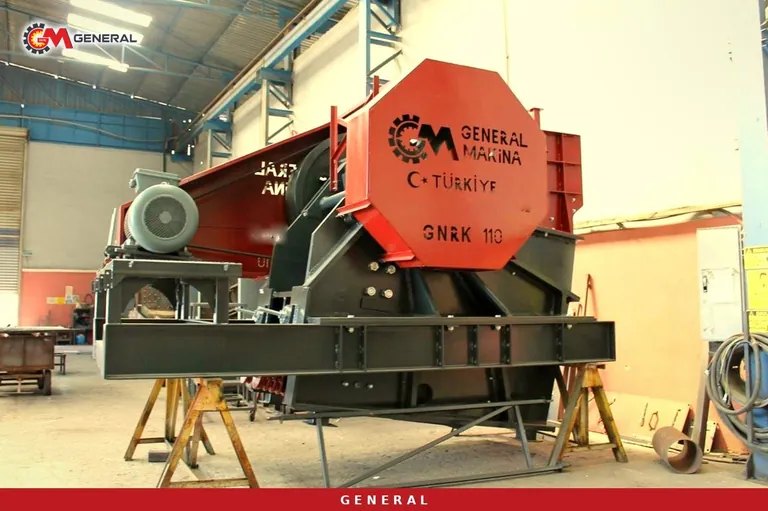
A buyer looking for a crushing plant in Gabon usually has two separate jobs on the table: crushing and sizing ore at the manganese sites of the Haut-Ogooué region, and producing sub-base and surfacing aggregate for the roads that run into the interior. A 100-200 TPH band suits both jobs, yet crushing ore and crushing road stone ask different things of the same machine. This article looks at what manganese ore and Gabon's common hard rocks demand from a crusher, which real mobile models fall within this band, and how one investment can be made to carry both workloads.
The scope, volume and schedule of any mining concession or road tender around Moanda, Franceville or Libreville are outside this article. For product size, grading limits and environmental conditions, always confirm the project specification with the relevant authority, the mine operator or the tender documents.
Define the product first: ore lump size or road fraction?
A crushing line should be selected backwards from the product required at discharge, not from a model name. The products wanted at a manganese site and at a road job differ clearly:
- Manganese ore: beneficiation or shipping usually calls for coarse and medium lumps; excess fines mean lost value. Reduction is therefore kept under control and over-crushing that generates fines is avoided.
- Road sub-base: crushed material that sits on a defined grading curve and interlocks well; the balance of fine and medium fractions matters here.
- Asphalt and concrete chippings: cubical particle shape and narrow fractions (e.g. 0-5, 5-12, 12-19 mm) with a low share of flaky grains.
- Clayey run-of-mine: in the wet season, quarry feed gets contaminated with laterite and clay; washing or pre-screening may be needed to hold product quality.
This list makes it clear from the outset that a single crusher character will not serve every job equally well. Compression crushing keeps fines down in ore, while a stage that produces cubical shape comes to the fore in road chippings.
What do manganese ore and Gabon's rocks ask of a crusher?
Much of Gabon's interior lies on old crystalline basement rocks, so road projects frequently meet hard, siliceous stone such as granite, gneiss and quartzite. Manganese ore, by contrast, arrives dense, heavy and often in a clayey matrix. Exact values vary by deposit, so the right course is to have abrasiveness and crushability tests run on a representative sample before ordering.
Density, tonnage and wear
A heavy ore means more tonnes in the same volume; crushers and belts carry volume, while capacity is stated in tonnes. Catalogue capacity can therefore shift with the material and should be confirmed with a sample. In abrasive siliceous rock and ore, impact blow bars wear quickly, whereas jaw and cone crushers that break by compression extend metal life. The curious part is that the jaw plates crushing manganese ore are themselves cast in austenitic manganese steel (Mn13/Mn18): this steel work-hardens at the surface under impact and resists the blows of large lumps. The alloy notes on the crusher wear and spare parts page help with choosing replacement castings.
Clay, laterite and sticking
During the long rainy seasons of the equatorial climate, the quarry floor turns to mud. Wet clay sticks in the jaw cavity and on screen meshes and cuts throughput. Countermeasures work on three levels: removing fines and soil with a grizzly feeder before they enter the crusher, washing the material if needed, and building a drained stockpile area. Which of these is necessary becomes clear only when dry-season and wet-season samples are examined separately.
Real models for the 100-200 TPH band
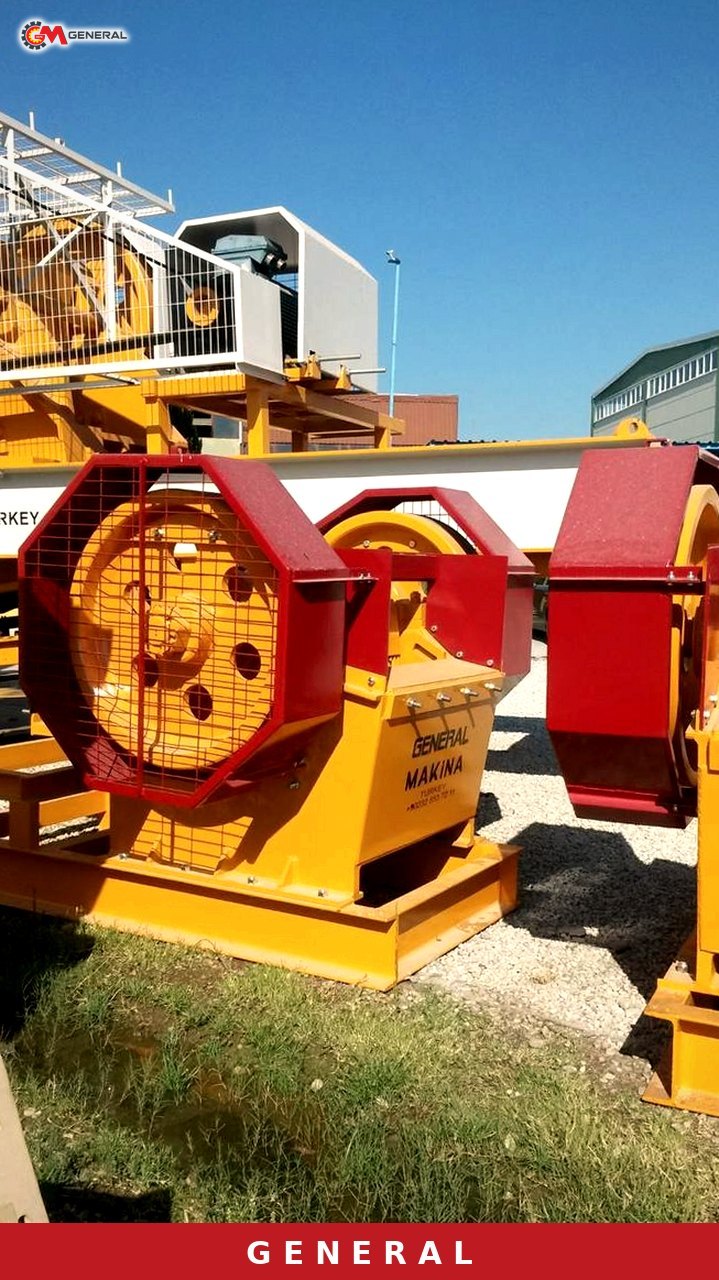
The table below brings together manufacturer data for mobile units that can cover the two Gabon tasks in this capacity band. Complete wheeled lines are detailed in the wheeled mobile crushing plants category, and single-chassis stage units in the single-chassis mobile crusher units category.
| Model | Crusher arrangement | Capacity | Max. feed | Generator | Weight | Role in this project |
|---|---|---|---|---|---|---|
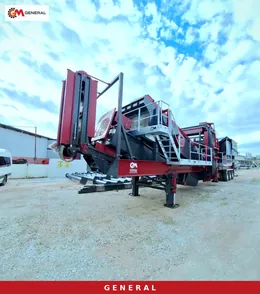
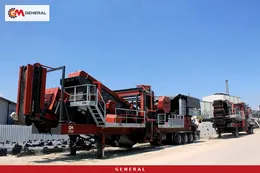
| General 944 | GPJ 90 jaw + GM430 cone | 120-180 t/h | 800 mm | 550 kVA | 70,000 kg | Hard, abrasive road stone and ore |
| General 950 | GPJ 90 jaw + DMK01 impact | 120-180 t/h | 800 mm | 600 kVA | 70,000 kg | Cubical asphalt and concrete chippings |
| GNR 90 mobile primary jaw unit | GNRK 90 jaw + feeder hopper | 70-180 t/h | — | — | 25,000 kg | Primary crushing of ore only |
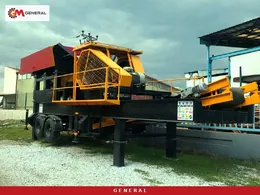
| Mobil 90 | GPJ 90 jaw + washing screen + twin screw | 90-150 t/h | 800 mm | 350 kVA | 45,000 kg | Clayey ore and laterite-coated stone |
The 944 and 950 share the same size and weight; what separates them is the character of the secondary crusher. The General 944 keeps wear low in siliceous stone and ore with its cone secondary. The General 950 gives higher reduction and cubical product with its impact secondary and is the pick when the shape requirement of surfacing chippings dominates. The GNR 90 mobile primary jaw unit is not a complete line: it brings ore down to 0-250 mm and feeds the screening or beneficiation set-up already on site.
If a single unit is expected to run continuously above 180 t/h, the next class in this family is needed: the twin-chassis GNR-MC110 with 200-300 t/h capacity, 900 mm feed and a 750 kVA generator. In most cases, though, the top end of the band is covered more flexibly by two separate units working in parallel.
Two jobs from one investment: campaign operation
For many operators in Gabon the most sensible scenario is to assign the machine to sites in campaigns. This is where a mobile chassis earns its value: the plant works one period at the mine and another along the road alignment.
Ore campaign
During the ore campaign the priority is keeping fines low. The primary jaw setting stays open, the cone secondary is used only for the size actually required, and screen apertures follow the lump range the buyer asks for. If the clay load is high, a unit like the Mobil 90, which crushes, washes and screens on one chassis, separates clean product from dirty feed and recovers the 0-5 mm fraction with its screw washer.
Road campaign
During the road campaign the same 944 produces 0-5, 5-12 and 12-19 mm fractions over its three-deck 1600×5000 mm screen; sub-base blending is done from separate stockpiles. A broader discussion of line configuration for asphalt and compacted base is in our article on mobile plant configuration for road construction and base material. Between the two campaigns the screen meshes and crusher setting are changed; planning that switchover keeps production loss to a minimum.
Operating in a humid equatorial climate and forest sites
Gabon's interior has many sites far from the grid and surrounded by dense forest, which directly affects power, access and maintenance. Measures that can be selected per project:
- Power: without a grid, generator capacity is planned per model (550 kVA for the 944, 600 kVA for the 950, 350 kVA for the Mobil 90). In humid air the generator's air and fuel filters need checking more often.
- Electrical panel: a sealed panel and cable glands can be specified against high humidity and condensation.
- Belts and screens: fines stick to belts in the rain; daily cleaning of belt scrapers and screen meshes belongs in the maintenance plan.
- Ground: the area under the hydraulic legs must be compacted and drained; muddy ground upsets chassis stability.
- Spare parts on site: at remote locations, keeping a set of jaw plates and cone liners on site shortens stoppages.
Shipping from Owendo port to the interior, and the quote file
A mobile plant leaving Izmir reaches Gabon by sea; Owendo port near Libreville is the main gateway to the interior. Evaluate road or rail options from port to site together with your forwarder. The transport dimensions are 4130×20350×4500 mm for the 944 and 950 and 3600×15700×4500 mm for the Mobil 90; a route survey should check whether bridges, bends and forest roads allow them. Preparing the following speeds up a quotation:
- Separate representative samples of ore and road stone, plus any lab results
- Target hourly tonnage and daily operating hours
- Maximum lump size and required product fractions
- Clay and moisture conditions in the wet season
- Power source: grid or generator
- Route restrictions between port and site
Frequently asked questions
Is a cone or an impact secondary better for manganese ore?
For abrasive ore where fines must stay low, the cone-secondary 944 makes more sense; compression crushing protects the metal and does not generate unnecessary fines. An impact secondary has the edge in cubical chippings but wears faster in siliceous material.
Can the same plant work at both the mine and the road?
Yes. By changing screen meshes and crusher setting it can serve both jobs in campaigns. If ore and road work must run at the same time, planning two separate units is more efficient.
Which certificates and warranty apply?
The machines carry ISO 9001 and CE certification, with a 1-year warranty excluding wear parts. Local permits and environmental conditions should be discussed with the relevant authority in Gabon.
What determines the price?
Model, secondary crusher type, washing requirement, whether a generator is included, screen and conveyor configuration and shipping scope all set the price. An exact figure comes with a quotation prepared for your sample and target product.
Decision summary
In Gabon's 100-200 TPH band, the right choice starts with defining the product: the jaw-and-cone 944 for abrasive ore and hard road stone, the 950 for cubical surfacing chippings, the Mobil 90 for clayey ore and the GNR 90 unit for primary crushing alone. Our team, building crushing and screening plants in Izmir since 1976, will propose a configuration for your sample and site; request a quote with your sample details via our contact page.
Definitions of technical terms: Glossary