EN — English
 TR — Türkçe
 DE — Deutsch
 RU — Русский
 FR — Français
 ES — Español
 AR — العربية
 SR — Српски

15 Questions Before Buying a 100-300 TPH Mobile Crushing & Screening Plant
Most mistakes made when buying a 100-300 TPH mobile crushing and screening plant happen in the two weeks before signing: a model is picked before the rock is tested, nobody asks how many screen decks it has, and generator power ends up in a footnote of the quotation. The 15 questions below come from the points buyers skip most often on lines we have installed and commissioned. For each one we show which technical figure the answer depends on and what changes between General models.
The questions are grouped under five headings. Work through them in order, because rock type drives tonnage, tonnage drives the chassis, and the chassis drives transport and power planning.
Rock, samples and the products you will sell
1. Which rock will I crush, and has a sample been tested in a lab?
Limestone and basalt push two machines with the same capacity label to very different results. In low-abrasive limestone a primary impact crusher gives high reduction and cubical grains in a single stage. In hard, silica-rich rock such as granite, basalt or quartz the blow bars of an impact rotor wear out fast; a jaw primary followed by a cone secondary gives much longer metal life. Abrasion and compressive strength tests on samples from different benches of the quarry are the first document a model choice should rest on. Any recommendation made without test results is a guess.
2. Which fractions will I sell, and in what proportion?
If you supply 0-5 and 5-12 mm to a concrete batching plant and 19-40 mm to road works, the number of screen decks directly affects revenue. General 01, 02 and 03 use a four-deck screen that separates 0-5 / 5-12 / 12-19 / 19-40 mm in one pass. General 944 and 950 use a three-deck horizontal screen giving 0-5 / 5-12 / 12-19 mm. If 19-40 mm is a large share of your sales, a three-deck line either needs an extra screen or sends that size back to be recrushed in closed circuit. Screen apertures are defined for each order according to the rock; ask for them in writing in the quotation.
3. What is the largest block size in the run-of-mine feed?
When the blast pattern and the crusher opening do not match, the loader operator spends the day sorting oversize blocks or the crusher bridges. In this range the maximum feed size runs from 600 mm (General 800) to 1000 mm (General 02). If blocks above 900 mm come up often, either look at General 02 with its 1000 mm opening or tighten the blasting pattern. The second option is usually cheaper, but decide it together with your drilling crew.
4. How much clay and soil is in the material?
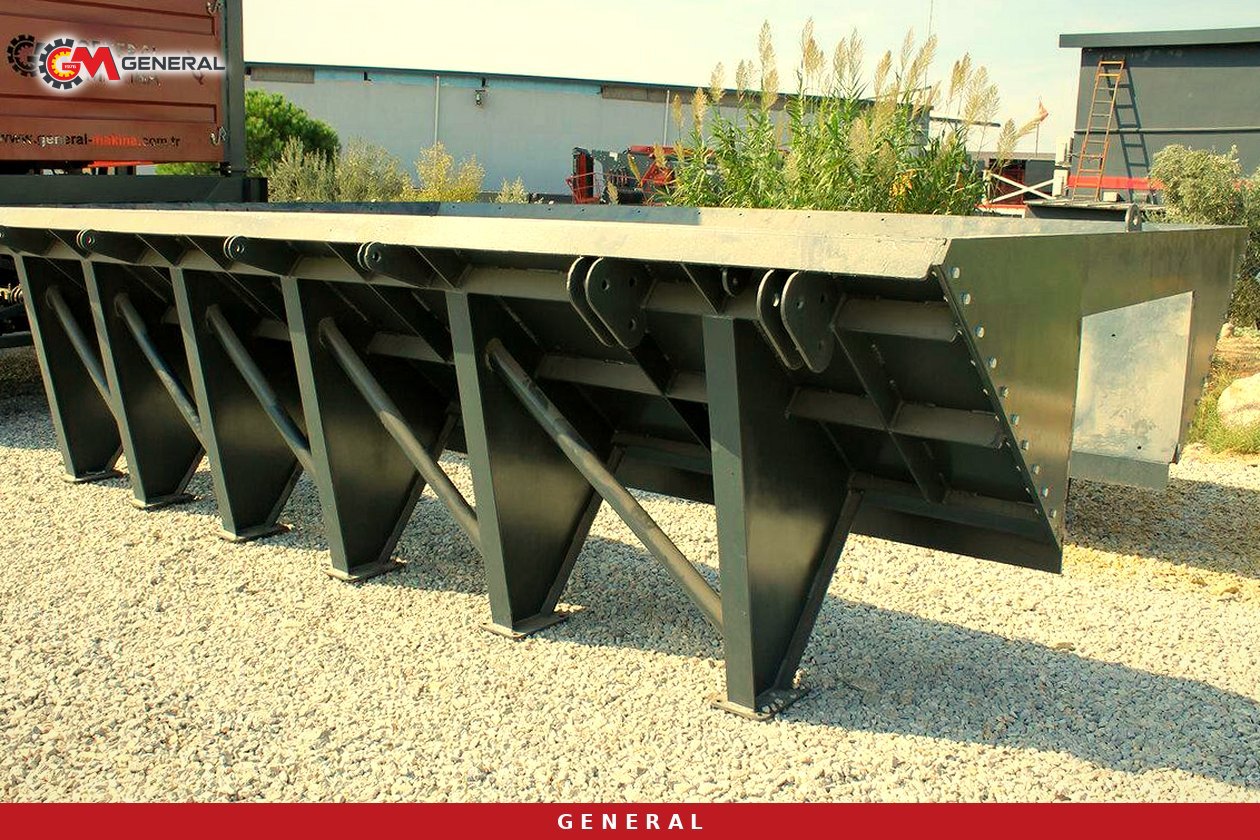
Run-of-mine rock mixed with overburden goes straight into the crusher when the feeder has no grizzly; crushing energy is wasted and the 0-5 mm product gets dirty. A vibrating grizzly rock feeder bypasses the fines through its bar spacing and takes load off the crusher. If the material is wet, sticky clay, the grizzly blinds; in that case a different feeder type or a washing stage has to be discussed. Have the clay content measured when you take samples.
Tonnage calculation and model matching
5. Which end of the 100-300 TPH range is my real need?
Catalogue capacity is a range given for a certain rock and crusher setting. Calculate your own target with this formula: required hourly tonnage = annual sales target / (working days per year × net operating hours per day). Hypothetical example: 250 days a year, 8 net hours a day and a 500,000 t target give 250 t/h. Maintenance stops, weather and shift changes reduce net hours, so a model whose range has your figure in the middle, not at the ceiling, gives easier operation on site.
6. One unit now, or step-by-step growth?
An operator aiming at 150 t/h today and 300 t/h in three years has two routes. The first is to buy a high-capacity single-chassis plant from the start. The second is to begin with a two-chassis line such as the GNR-MC110: the GPJ 110 jaw primary chassis can run on its own, and the second chassis carrying the DMK03 impact secondary and the 2000×6000 mm four-deck screen can be added later. Complete, it produces 200-300 t/h and accepts 900 mm feed. The table below sets the models in this range side by side with the technical data published on the site; full details are on the mobile crushing plants page.
| Model | Crusher set-up | Capacity (t/h) | Max. feed (mm) | Screen (mm) | Generator (kVA) | Weight (kg) |
|---|---|---|---|---|---|---|
| General 800 | PDK 1280 primary impact | 80-150 | 600 | 1300×4000, 3-deck | 450 | 35,000 |
| General 01 | GPS 1210 impact (primary+secondary) | 120-180 | 700 | 1600×5000, 4-deck | 550 | 55,000 |
| General 944 | GPJ 90 jaw + GM430 cone | 120-180 | 800 | 1600×5000, 3-deck | 550 | 70,000 |
| General 950 | GPJ 90 jaw + DMK01 impact | 120-180 | 800 | 1600×5000, 3-deck | 600 | 70,000 |
| GM 125 | GNR PDK02 impact, 200 kW, tracked | 150-250 | 700 | — | 550 | 48,000 |
| GNR-MC110 | GPJ 110 jaw + DMK03 impact, two chassis | 200-300 | 900 | 2000×6000, 4-deck | 750 | 2 × 55,000 |
| General 02 | GPS 1413 primary impact | 250-300 | 1000 | 2000×5000, 4-deck | 660 | 76,000 |
| General 03 | GPS 1415 primary impact | 250-375 | 900 | 2400×5000, 4-deck | 750 | — |
Cells marked with a dash have no published figure; those values are set in the quotation for the project.
Chassis, transport and site layout
7. Wheeled or tracked?
For a plant that will stay in the same quarry for years, a wheeled chassis is enough: it is towed by truck and fixed on hydraulic legs. If you want the crusher to follow the face as it advances, a tracked machine makes life easier. The strongest tracked option in this range is the GM 125: GNR PDK02 impact crusher (200 kW), 6 m³ hopper, 700 mm feed and 150-250 t/h. You can compare the tracked range on the track-mounted mobile crushers page.
8. Can the access road take these dimensions?
General 02 has a transport size of 4340×20600×4500 mm and weighs 76,000 kg. General 03 runs on a four-axle chassis. Have the road to the quarry checked in advance for bridges, bend radii and height limits. If the plant ships through a port, ask for the packing list and dimensions at quotation stage, because they are used for vessel planning.
9. What has to be prepared for ground and installation?
The wheeled General series needs no concrete foundation; it still needs a compacted, drained, level pad and a ramp where trucks or loaders can reach the hopper easily. Do not start earthworks before you see on the layout drawing where the stockpiles will fall at the conveyor ends.
Power, controls and operating set-up
10. Is grid power available, or will I need a generator?
At remote quarries the plant runs on a generator, and its kVA rating should be stated clearly in the quotation. Published figures: 550 kVA for General 01 and 944, 600 kVA for General 950, 660 kVA for General 02, 750 kVA for General 03 and GNR-MC110. If a grid connection is possible, transformer capacity and cable distance are planned as a separate item.
11. What do the control panel and remote monitoring offer?
General 01 has a touch panel, soft-starter and frequency control; remote monitoring over the internet is optional. When the operator sees crusher current and belt status on one screen, overload stops drop. You need to see item by item in the quotation which functions are standard and which are options.
12. Does the plant run in closed circuit?
In closed circuit, oversize that does not pass the screen returns to the crusher on a return conveyor and circulates until it reaches the target size. General 02 works this way; with its GPS 1413 primary impact crusher, 2000×5000 mm four-deck screen and 660 kVA power unit it produces 250-300 t/h. On an open-circuit line, oversize goes to a stockpile and has to be processed separately.
Wear parts, warranty and the quotation file
13. How should I plan wear parts?
Jaw plates, blow bars and cone liners are among the largest operating costs of the first year, and replacement intervals depend entirely on how abrasive the rock is. For hard rock, a jaw-and-cone line such as the General 944 uses less metal than an impact secondary. Ordering one spare set of wear parts with the first order stops the plant from standing idle while parts are on the way. See the spare parts page for the parts list.
14. What does the warranty cover?
General Makina plants carry a 1-year warranty; wear parts are excluded. The products hold ISO 9001 and CE certification. Have the contract state clearly whether the warranty starts at shipment or at commissioning.
15. What should the quotation file contain?
A good quotation is a technical document before it is a price. If the items below are missing, comparing offers becomes hard:
- Plant layout drawing with conveyor ends and stockpile positions.
- Crusher type and setting range, screen size, number of decks and apertures.
- Generator kVA rating or grid connection power.
- Transport dimensions, weights and shipping packing list.
- Separate lists of standard and optional equipment.
- Warranty scope and the first spare set of wear parts.
- Commissioning scope and who prepares what on site.
Frequently asked questions
Can I get a quotation without answering these 15 questions?
Yes, but it will stay a general model suggestion. Once rock type, target tonnage and product list are given, the configuration, screen and generator are chosen for your project.
What if I want to go above 300 TPH?
General 03 reaches 250-375 t/h in the wheeled series. For higher, permanent tonnage a stationary plant configuration is evaluated separately.
What determines the price?
Crusher type, number of screen decks, generator, chassis type, optional automation and transport scope set the price. The figure is given in a quotation once these points are clear.
The last step before deciding
When this list is filled in, you hold a file that justifies the model choice: tested rock, calculated tonnage, a measured transport route and a written power plan. Send us your sample results and product list, and our engineers will work out the right configuration. For a quotation, reach us through our contact page or on WhatsApp.
Definitions of technical terms: Glossary