EN — English
 TR — Türkçe
 DE — Deutsch
 RU — Русский
 FR — Français
 ES — Español
 AR — العربية
 SR — Српски

Morocco Basalt Cone Mobile Crushing & Screening Plant 120-180 TPH
For a contractor planning basalt aggregate production in Morocco, the cone crusher is the most expensive part of the plant and also the one that earns the most. The dark, fine-grained basalt of the Middle Atlas volcanic plateaus is a sought-after stone for motorway wearing courses and high-strength concrete; fed to the wrong crusher, the same rock eats wear parts far sooner than expected. This article explains, from the point of view of a crushing and screening engineer who has worked on site, where the cone crusher belongs in a Moroccan 120-180 TPH line, how it should be set, and which real General models cover that range. The goal is to make clear which questions you need answered before you sit down at the quotation table.
Where basalt occurs in Morocco and what kind of rock reaches the crusher
When people speak of basalt in Morocco, the first region that comes to mind is the Middle Atlas: the plateaus around Azrou and Timahdite are broad areas covered by young volcanic flows. Volcanic outcrops exist in other parts of the country too, yet the character of the rock can change even within one quarry licence. The core of a flow may be dense and hard while its upper part is vesicular, scoriaceous and lighter. For the crusher this difference is critical: dense basalt abrades metal and wants to be broken by compression, whereas the vesicular part breaks easily but can generate excess dust and flaky particles.
Before choosing a machine, representative samples should therefore be taken from the face and tested in a laboratory for abrasiveness (Bond Ai), compressive strength and Los Angeles abrasion. The end use of the aggregate (asphalt wearing course, concrete, sub-base or ballast) defines the product specification, and the specification itself should be confirmed with the relevant authority or the project documents. Every assessment below rests on these two inputs: the rock test results and the product specification.
What a cone crusher does well in basalt, and what it cannot tolerate
Compression crushing and wear economics
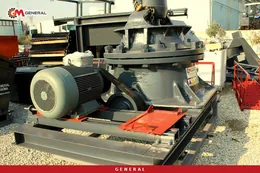
In a cone crusher the material is squeezed repeatedly between the eccentrically gyrating head (mantle) and the fixed bowl liner (concave) and moves downward by gravity. Because the stone is not thrown at high speed as in an impact rotor, wear part consumption stays markedly lower in high-silica basalt. Liners are usually manganese steel; for very high-silica rock a high-chrome liner option is considered. Typical reduction is 6:1-8:1 in the secondary stage and about 10:1 in the tertiary stage. Product size is changed through hydraulic CSS adjustment, and a hydraulic cylinder protects against sudden blockage. The General cone crusher page describes this working principle in detail.
Feed a cone crusher dislikes
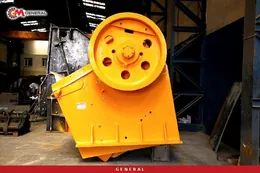
A cone crusher does not accept everything. Feed size is generally 50-250 mm, up to 300 mm in some settings; larger blocks must first be reduced in a jaw crusher. A feed full of clayey, wet or very fine material packs the crushing chamber, wastes power and leaves uneven wear on the liners. In soft, low-abrasion limestone an impact crusher gives a higher reduction, so the cone's advantage shrinks. An operator in Morocco who will alternate between a basalt quarry and a limestone quarry should take this distinction into account from the start.
Working back from the product specification: CSS, reduction and screen mesh
A well-designed cone crushing plant is planned from the final product, not from the crusher. First write down which fractions will be sold and in what proportions, then define the screen decks, then the cone's CSS, and finally the primary's discharge setting. Reverse that order and the plant either produces too much dust or piles up unsellable coarse stock.
Asphalt and surface dressing chippings
For basalt chippings destined for a wearing course, particle shape (the flakiness index) is a decisive item in most specifications. When the cone runs choke-fed, with a full chamber, the stones break against one another and the output is more cubical. If the shape limit is very tight, a cubicizing stage is added after the cone; the GNR MK series mobile cubicizer is designed for this job, delivers a 0-25 mm final product and has Hardox 500 inner liners.
Concrete aggregate and sub-base
In concrete aggregate, fractions such as 0-5, 5-12 and 12-19 mm and the fines content of the sand fraction gain importance. For sub-base and fill a wider grading is enough; the cone can then run at a more open CSS to raise throughput. To check reduction roughly, use this relation: reduction ratio = feed F80 / product P80. Hypothetical example: if 80% of the material entering the cone is below 90 mm and 80% of the product must be below 15 mm, the ratio is 6, which falls within the 6:1-8:1 range of a secondary cone. If the ratio exceeds 10, one cone stage is not enough and a second stage or a closed-circuit return is needed.
Real cone crusher layouts for the 120-180 TPH range
The table below relies only on values published on our product pages. Cells without a firm value are left as "—"; these figures are settled in the project-specific quotation.
| Layout | Crushing chain | Capacity (t/h) | Max. feed (mm) | Screen | Power / motor | Weight (kg) |
|---|---|---|---|---|---|---|
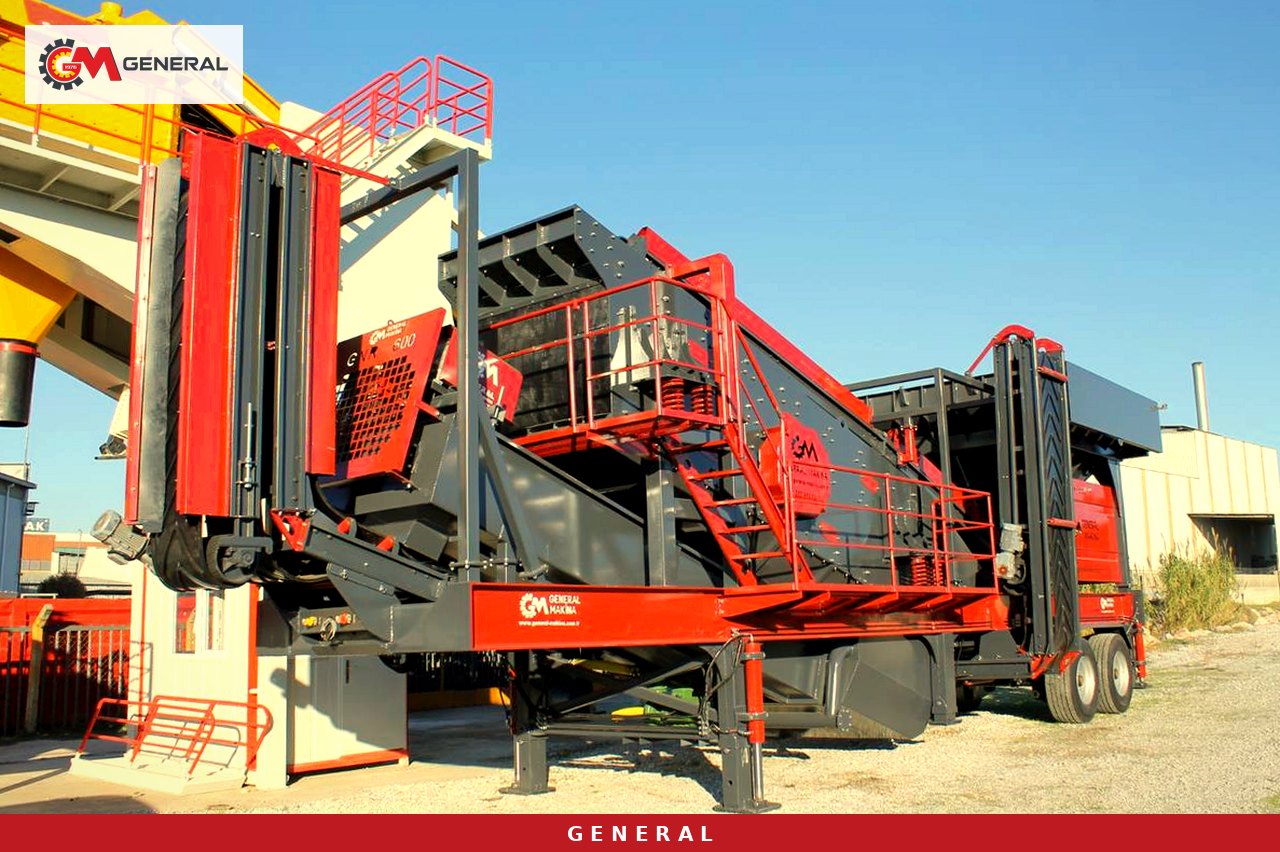
| General 944 (single chassis) | GPJ 90 jaw + GM430 cone | 120-180 | 800 | 1600×5000 mm, 3-deck horizontal | 550 kVA generator | 70,000 |
| General 944 + GNR MK100 | 944 line + rotor cubicizer (chippings stream) | 120-180 (MK100: 90-130) | 800 (MK100: 250) | 1600×5000 mm, 3-deck horizontal | 550 kVA + 132 kW (MK100) | 70,000 + |
| Modular line | GNR 110 mobile primary jaw + General cone + GNR 1650 screen | GNR 110: 180-300 | — | 1600×5000 mm (GNR 1650, 15 kW) | Cone: 90-500 kW range | 55,000 +, + 6,400-8,100 |
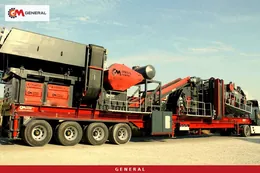
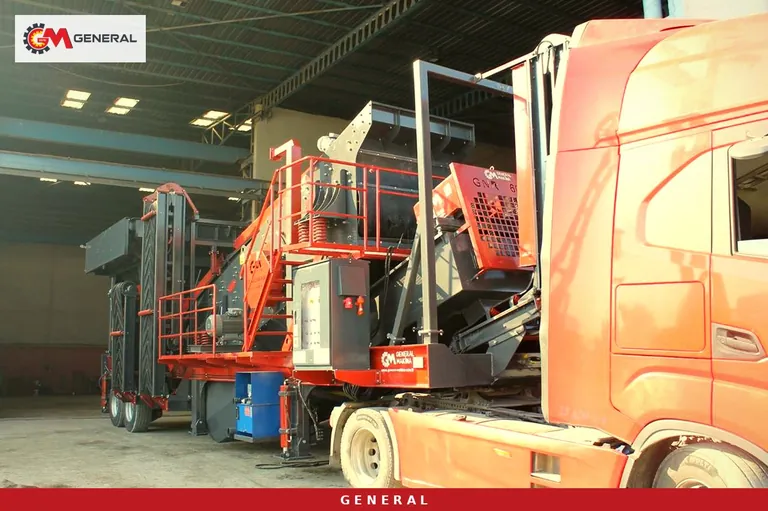
The first layout is the simplest solution for Morocco: the General 944 takes 800 mm feed in its GPJ 90 jaw primary, performs the second stage with the GM430 cone secondary and, with a 0-100 mm discharge setting, delivers three fractions: 0-5 / 5-12 / 12-19 mm. The second layout comes in when the shape requirement for wearing-course chippings is strict; the MK100 unit, with a 1550×1200 mm rotor and 250 mm maximum feed, processes only the chippings fractions rather than the whole line. If a larger share is needed, the MK110 (1550×1800 mm rotor, 350 mm feed, 160-250 t/h, 200 kW) is chosen. The third layout suits quarries with a long life where a later capacity increase is planned; the GNR 110 unit has a 1100×4750 mm feeder, while the cone's model-specific capacity and power are given per project and are therefore left open in the table. All wheeled options are collected on the mobile crushing and screening plants page, and crusher types on the crushers page.
A 120-150 t/h hard-stone application built with the General 944 at a site in Africa is published on our website as a project page. That example is not in Morocco; it is given to show how the same jaw + cone arrangement performs in hard rock.
Site rules for running a cone crusher efficiently
The same machine can give two different results in two quarries; the difference usually comes from operating discipline. Go through this list with the operator and site manager before commissioning:
- Keep the chamber full: a cone gives the most cubical product and the most even wear when the feed level is steady and the hopper full; stop-start feeding wears the liner in steps.
- Do not send fines to the cone: if material already below target size is removed on the screen after the primary, the cone works only on stone that actually needs crushing.
- Measure the CSS at the start of each shift: as the liner wears the gap opens and the product coarsens; hydraulic adjustment exists to correct that drift.
- Change liners by wear profile: mantle and concave are replaced according to measured thickness and the shift in the product curve, not by calendar; keep a spare liner set on site.
- Keep tramp metal out of the line: if drill bits or bucket teeth turn up at the face, a metal separator on the feed conveyor can be added as a project option.
- Choose screen meshes by product: apertures are set at order stage according to the specified fractions; a torn mesh means off-spec product straight away.
Wear parts are outside the 1-year warranty, so liner and jaw plate consumption should be planned as a separate line in the operating budget. To track wear cost per tonne with your own data, record the tonnage processed and the remaining weight of the removed liner at each change; from the second year this gives the most reliable forecast.
Site preparation in Morocco: port, road, power and dust
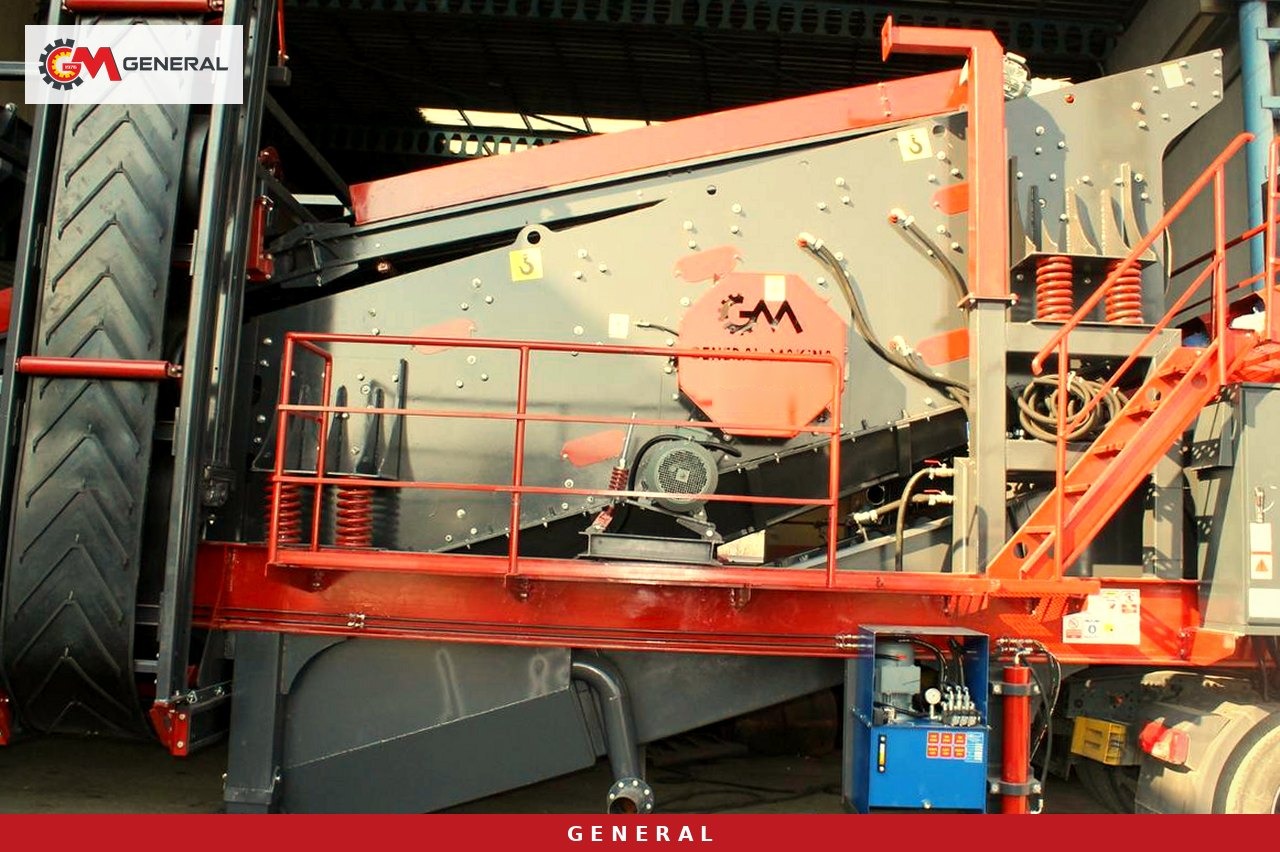
A mobile plant leaving Izmir usually reaches Morocco by sea and travels from a major port such as Casablanca or Tanger Med to the site by road. The General 944 measures 4130×20350×4500 mm and weighs 70,000 kg; these values are the basis for route planning, bridge and bend clearances and, if needed, an abnormal-load permit application. For mountain roads in the Middle Atlas, the route should be inspected on the ground with a local haulier before shipment.
Many quarries are far from the grid, so the plant runs on a generator; the technical table of the 944 lists a 550 kVA generator. In summer, hot and dusty air calls for more frequent checks of the generator and hydraulic unit coolers and air filters; in winter, cold starts and oil selection matter on the high plateaus. Water-spray dust suppression at transfer points and conveyor covers are measures that can be selected per project; near residential areas they should be discussed at quotation stage.
The technical file prepared before the contract should include:
- Test results of rock samples (Bond Ai, compressive strength, Los Angeles)
- Target fractions and the annual sales share of each
- Largest block size after blasting
- Site levelness, feeding method (truck or loader) and stockpile area
- Power source: generator, or a grid connection later
- Arrival port and road route to the site
Frequently asked questions
Can an impact secondary be used instead of a cone for Moroccan basalt?
It can; the General 950 carries a DMK01 impact secondary behind the same GPJ 90 jaw primary and is rated at 120-180 t/h. In dense basalt, however, the impact crusher's wear parts are consumed faster. If the rock is mainly hard basalt, the cone-secondary 944 is considered; if the quarry alternates between basalt and softer stone, the 950 is evaluated.
Does a cone crushing plant alone meet an asphalt chippings specification?
In most cases it does, with the right CSS and a full chamber. If the flakiness limit is very low, a GNR MK series cubicizer is added after the cone. The decision should be based on laboratory results from a trial crushing sample.
Can the plant work at a quarry without grid power?
Yes. The General 944 is specified with the 550 kVA generator in its technical table to operate independently of the grid. Fuel logistics and generator maintenance should be part of the site operating plan from the start.
What determines price and delivery time?
Price depends on the layout (single chassis, with cubicizer or modular), number of screen decks, liner material, options such as dust suppression, and the arrival port. Delivery time is stated in writing in the quotation according to the scope of the order. ISO 9001 and CE certificates and a 1-year warranty (excluding wear parts) are part of the offer.
Conclusion
Choosing a cone mobile plant for basalt aggregate in Morocco comes down to three decisions: rock test results, product specification and site logistics. In the 120-180 TPH range the General 944 is the straightforward solution with its own power; where the shape requirement is strict, a GNR MK series cubicizer is added, and on a long-life quarry the modular line comes into play. To share your quarry data with our team, which has been building crushing and screening plants in Izmir since 1976, and to receive a project-specific quotation, reach us through our contact page.
Definitions of technical terms: Glossary