EN — English
 TR — Türkçe
 DE — Deutsch
 RU — Русский
 FR — Français
 ES — Español
 AR — العربية
 SR — Српски

0-4 mm Crushed Sand Grading in a 90-180 TPH Crushing and Screening Plant
The complaint from the batching plant is usually one sentence: "The sand has changed again." When the lab runs the sieve analysis, the curve has normally drifted one of two ways. Either the fraction below 0.063 mm has gone up and the concrete needs more water for the same slump, or the 0.25 to 1 mm range has thinned out and the fresh concrete segregates and gives trouble in the pump. In both cases the crusher is the same machine; what changed is the settings, the screen media and the feed. This article explains which controls are adjusted on site, in what order, and with which measurement they are checked, to bring the grading curve of 0-4 mm crushed sand onto target in a 90-180 TPH crushing and screening plant.
The limits the sand has to meet are set by the specification, not by you. EN 12620, ASTM C33 or the client's own technical specification states which range is accepted on which sieve. The method below is how you reach those limits; get the actual limit values in writing from the specification and the concrete lab on every project.
Stone dust and clay are not the same fines
In a sieve analysis, everything passing 0.063 mm shows up on a single line as "fines". How concrete reacts to those fines depends entirely on what they are. Stone dust produced from the rock itself during crushing fills voids in the aggregate up to a certain content, improves cohesion and reduces bleeding. Clay coming from the overburden on the quarry face or from joint fillings absorbs water and admixture and hurts setting and strength.
So before deciding to cut the fines, find out what the fines are. The methylene blue test (MBV) or the sand equivalent test (SE) makes that distinction. If MBV is low and fines are high, the problem is mostly stone dust and it is solved at the crusher and the screen. If MBV is high, washing comes into play; however often you change the screen media, the clay stays in the sand. The most common mistake on site is trying to fix a clay problem with rotor speed.
Three zones that decide the 0-4 mm curve
A crushed sand grading curve cannot be managed with one number. In practice the curve is split into three zones, and each zone is controlled by a different piece of equipment.
Below 0.063 mm: the fines
This zone is set by the crusher's operating mode and by washing. A VSI running rock-on-rock generally makes more fines than one running on anvils, because a large share of the breakage happens through particle-to-particle attrition and abrasion. The difference is more pronounced in limestone than in basalt.
0.25-2 mm: the middle zone and fineness modulus
This is where the concrete technologist looks first. If the middle zone empties, the fineness modulus rises, the mix gets harsh and workability drops. This zone is largely controlled by rotor tip speed and by the size distribution of the material entering the VSI. Fineness modulus is the sum of cumulative percentages retained on the standard sieve series (0.125 / 0.25 / 0.5 / 1 / 2 / 4 mm) divided by 100. Calculating it the same way on every shift is worth more than the absolute value.
Above 4 mm: oversize
If particles above 4 mm remain in the sand, the cause is almost always the screen itself: a torn panel, an overloaded deck, too steep an angle or blinded apertures. This zone is fixed with screen maintenance, not with crusher settings.
The raw curve is formed in the crusher
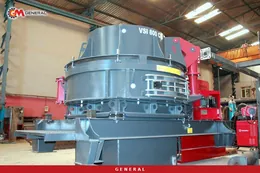
A VSI is more of a shaping machine than a size reduction machine. The vertical rotor accelerates material to around 80 m/s and throws it either against anvils or into its own rock bed. The raw sand curve depends on the intensity of that impact and on the size structure of the feed. The settings used on site to shift the curve are rotor speed (higher speed fills the fine and middle zones), operating mode (rock-on-rock or anvil), cascade feed, meaning part of the material bypasses the rotor and drops straight into the crushing chamber, and feed size. As the cascade ratio goes up, the product gets coarser and fines drop; treat it as the fastest way to shift the curve without changing throughput. Confirm how the cascade arrangement is implemented on a given model at the order stage.
The feed deserves attention too. If the material entering the VSI already contains 0-4 mm, part of those particles get even finer as they pass through the rotor and end up below 0.063 mm. Pre-screening ahead of the crusher to pull out the ready sand and sending only the coarse part to the VSI is the cheapest way to reduce fines.
| Model | Type | Max. feed (mm) | Capacity (t/h) | Motor / power |
|---|---|---|---|---|
| GNR 700 | VSI crusher, 700 mm rotor | 25-35 | 45-135 | 90-132 kW |
| GNR 800 | VSI crusher, 800 mm rotor | 40-50 | 55-160 | 132-160 kW |
| GNR 900 | VSI crusher, 900 mm rotor | 50-55 | 80-210 | 2×200 kW |
| GNR-MVSI 900 | Wheeled mobile VSI sand plant, 1600×5000 mm triple-deck screen | 50 | 90-180 | 850 kVA generator |
| GNR 100 | Tertiary impact crusher, 1200×1000 mm rotor | 150 | 90-160 | 160 kW |
| GNR 130 | Tertiary impact crusher, 1200×1300 mm rotor | 150 | 130-200 | 200 kW |
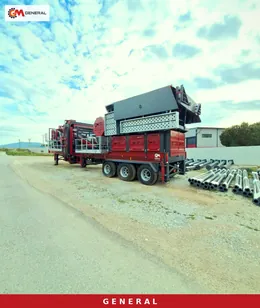
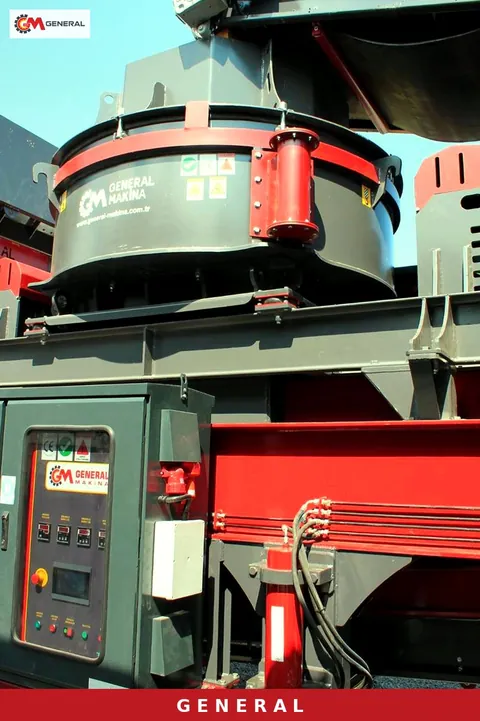
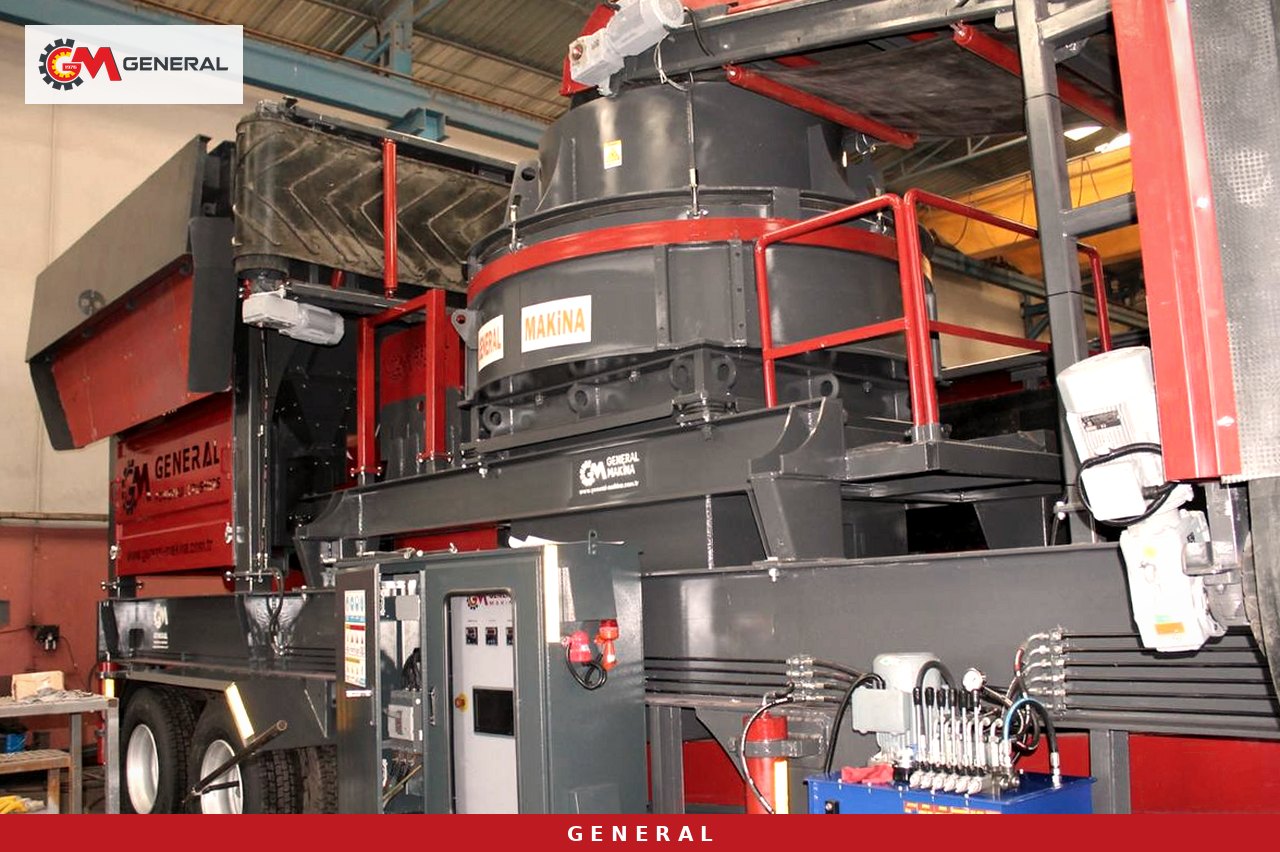
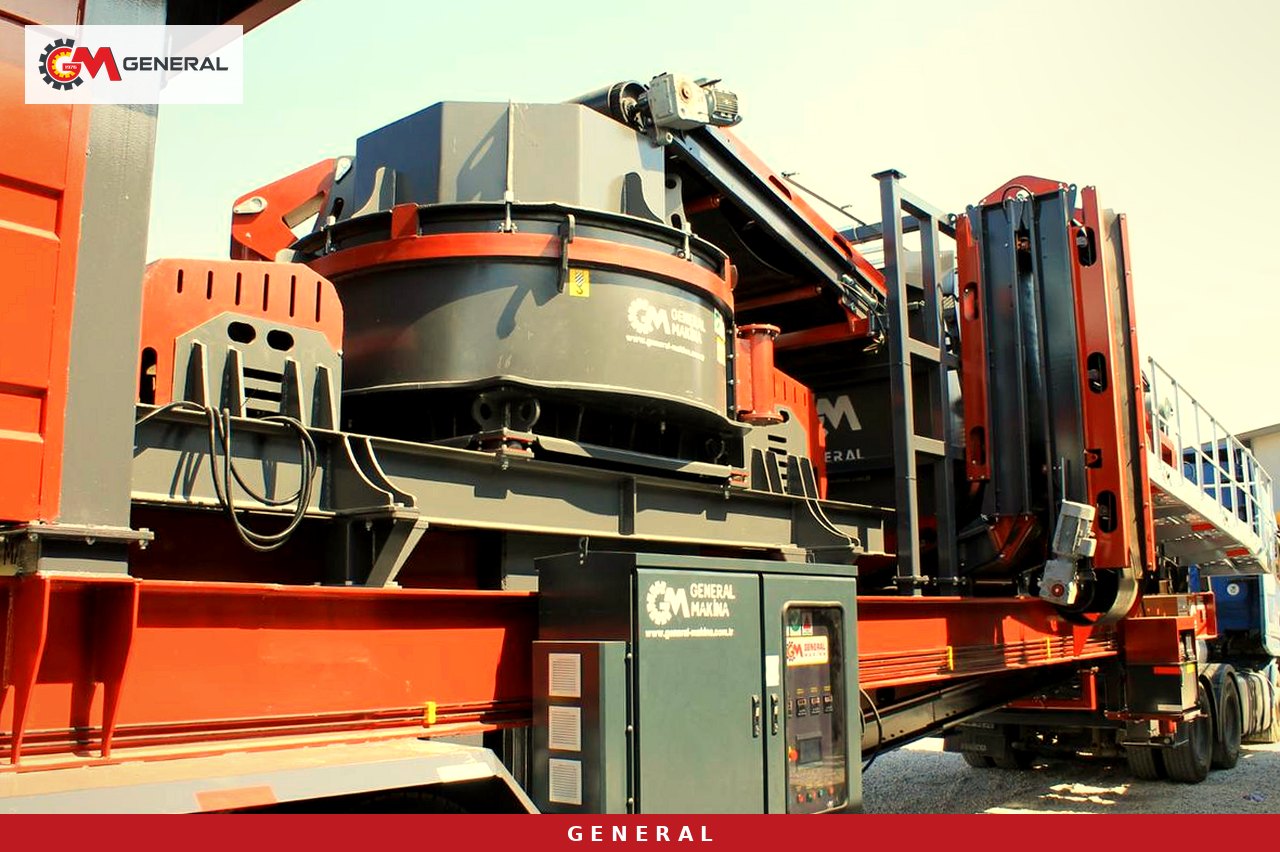
The model that covers the 90-180 TPH range on a single chassis is the GNR-MVSI 900 wheeled VSI sand plant: it takes 50 mm feed, works with a 0-20 mm setting range and splits the product into three fractions, 0-3 / 3-5 / 5-12 mm. It weighs 42,000 kg and its transport dimensions are 4100 × 16200 × 4500 mm. For a stationary line, the GNR 900 from the GNR series vertical shaft impact crushers covers the same band at 80-210 t/h. A VSI is the usual choice for siliceous material such as granite, basalt and river gravel. In low-abrasion limestone a tertiary impact crusher (GNR 100 or GNR 130) also produces 0-5 mm sand, but the decision should be made on the material, taking particle shape and wear cost into account.
The screen's share: aperture, angle and deck load
The crusher delivers the raw curve; the screen trims it. For 0-4 mm sand the top cut is 4 mm, but the screen panel is usually not chosen at exactly 4 mm. On an inclined screen a particle sees the aperture at an angle rather than square on, so the effective opening is smaller than the nominal one. To hit the cut point, aperture, angle and media type are considered together and confirmed with a trial sieve analysis.
On conventional circular-motion vibrating screens the angle is typically 15-30°. A steeper angle raises capacity but narrows the effective opening. Each extra deck lowers capacity by roughly 10%. Near-size particles between 75% and 125% of the aperture reduce efficiency; commercial screening efficiency is around 90-95%. What this means in practice: if you load the screen beyond its capacity, part of the sub-4 mm material carries over to the oversize without passing through, so you get less sand and its curve shifts toward the coarse side.
The 1600×5000 mm triple-deck screen on the GNR-MVSI 900 separates 0-3 / 3-5 / 5-12 mm fractions in its standard layout. If 0-4 mm is the target, the media arrangement is specified in the order according to the sand and the feed. On a stationary line, the GNR 1650 (1600×5000 mm, 15 kW) from our aggregate and sand vibrating screens can be selected, or the GNR 2060 (2000×6000 mm, 18.5 kW) if more area is needed. Blinding on the sand deck can come from damp material, the wrong media type or insufficient vibration; in that case changing the media type is a better route than opening up the aperture.
Cutting fines, and adding some back when needed
The third tool for holding the curve is splitting the flow and recombining it where necessary. If fines are above the specification limit there are three routes. The first is the cascade and pre-screening settings described above. The second is washing: the screw sand washer works with 0-50 mm feed and 50-250 t/h capacity. The rotating screw scrubs the sand along the bottom of the tank and carries it to the discharge, while the light water carrying clay and silt overflows the weir. Moisture at the screw discharge is typically 15-30%. Adding a hydrocyclone and a dewatering screen brings moisture down to 8-20% and recovers fine sand that would otherwise be lost in washing. If lower clay, water and energy use are the priorities, a bucket wheel sand washer works in the same feed and capacity band, though it scrubs less than a screw. You can compare the options on the sand washing and mining washers page.
The third route is blending. If the 0-3 and 3-5 mm fractions are stockpiled separately and mixed in the required ratio with a loader or a metered conveyor, the middle zone and the area near 4 mm can be tuned precisely. The reverse also works: if too much fine material has been lost in washing, part of the dry 0-3 mm can be added back to the washed sand to give the cohesion the concrete lab is asking for.
Take a hypothetical case: the lab reports that the sub-0.063 mm content of the 0-4 mm sand is a few points above the specification limit, and MBV comes out low. Here the cascade ratio is raised first, then pre-screening is used to cut the ready sand going into the VSI. If the limit is still exceeded after those two steps, the washing line comes in. If MBV comes out high, the order reverses: washing first, crusher settings second.
In-shift sampling and control routine
Once the curve is on target, the real work is keeping it there. As rotor tips and anvils wear, as the rock from the quarry changes and as screen panels age, the curve slowly drifts. The routine below catches that drift before a complaint arrives:
- Take a sample from the same point on every shift (from the belt, not the stockpile) and analyse it with the same sieve series.
- Log fineness modulus and the sub-0.063 mm content on a chart; look at the trend, not a single result.
- Run an MBV or sand equivalent test once a week, and more often when the quarry face changes.
- Record rotor tip and anvil wear in the maintenance plan, and note how the product curve shifts as wear progresses.
- Check screen panels for tears and blinding at the start of every shift; when particles above 4 mm appear, the screen is the first place to look.
- Keep sand stockpiles separate by fraction and protected from rain and wind; sand that segregates in the stockpile gives one result in the lab and another at the batching plant.
The value of this routine is that it shows early which zone of the curve is moving. If the sub-0.063 mm content rises, look at the crusher or the washing; if the middle zone empties, look at rotor speed and feed; if oversize above 4 mm appears, look at the screen.
Frequently asked questions
What fines content should 0-4 mm sand have?
That value is set by the project specification and the applicable standard, and it can vary with concrete class and end use. Before building the line, get the grading envelope and the fines limit from the specification in writing and design to those limits.
Can I produce both 0-4 mm sand and chips with one VSI?
Yes. Thanks to its triple-deck screen, the GNR-MVSI 900 splits the product into 0-3 / 3-5 / 5-12 mm, and a 0-4 mm cut can be defined in the order by changing the media layout. Stone above 50 mm should not be fed to this machine, though; it needs primary and secondary crushing stages ahead of it.
Can I get concrete sand without washing?
If most of the fines are stone dust and MBV is low, dry production is possible with crusher and screen settings. If the clay content is high, sand that meets the specification is hard to achieve without washing. Base the decision on lab results from a sample taken at the quarry.
What warranty and certificates apply?
Our machines are manufactured at our factory in Izmir with ISO 9001 and CE certification. The warranty period is 1 year; wear parts are not covered by the warranty.
Short assessment and quotation
The curve of 0-4 mm crushed sand is held on target by setting up crusher settings, screen layout and, where needed, a washing line together, not by a single machine. For a mobile solution in the 90-180 TPH range the GNR-MVSI 900 is the candidate; for a stationary line, the GNR 900 VSI with a matching screen and washer combination. For the other crushing stages, see our wheeled mobile crushing and screening plants. Contact us with the sieve analysis of a sand sample from your quarry, the MBV result and the specification limits, and we will size the line to that data and prepare your quotation.
Definitions of technical terms: Glossary