EN — English
 TR — Türkçe
 DE — Deutsch
 RU — Русский
 FR — Français
 ES — Español
 AR — العربية
 SR — Српски

Nile Delta Sand Washing, Crushing and Screening Plant 100-200 TPH
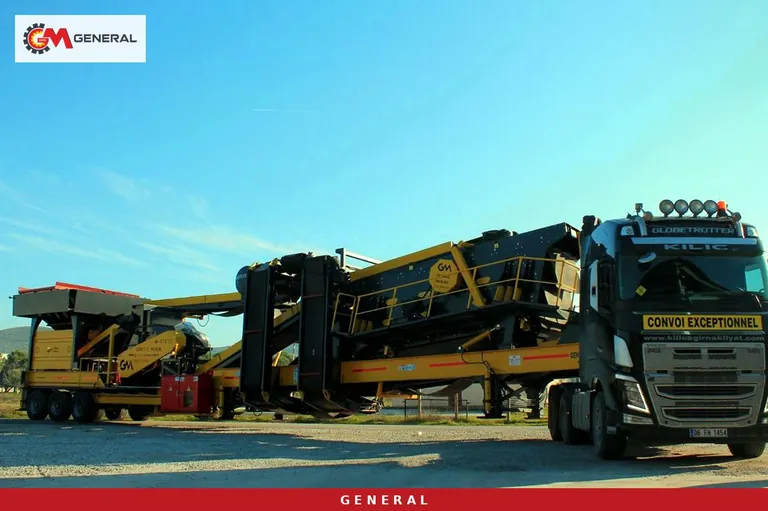
The Nile Delta, stretching from north of Cairo to the Mediterranean coast, is a plain built from sediment the river has carried for thousands of years. Its sand is plentiful and easy to dig, yet when it goes straight to a ready-mix plant two complaints follow: the mix demands too much water and strength results drift. The cause is usually not the sand grain itself but the silt and clay stuck to it; near the coast, salt and shell fragments join the list. This article explains, with published model figures, which washing, screening and, where needed, crushing equipment a delta operation targeting 100-200 TPH of concrete sand should choose, in what order, and on which sample data.
Why delta sand cannot go straight into the batching plant
Delta sediment is fine material that settles where the current slows. Its grading therefore leans toward the fine side, with mud-like layers of silt and clay between the grains. A dry screen cannot strip this fine contamination off the particles; it only splits by size. For concrete the outcome is predictable: fine dust absorbs cement paste, the water/cement ratio shifts and the risk of shrinkage cracking rises.
Silt, clay and organic matter
A clay film on sand grains weakens the bond between aggregate and cement paste. The amount and type of clay are measured with the Sand Equivalent (SE) and Methylene Blue (MBV) tests. Material taken close to irrigation canals may also carry roots and organic mud, so the specification should call for a separate organic impurity test.
Salt and shell toward the coastline
In the northern delta the sea makes itself felt. Chlorides in sand are a risk for reinforcement corrosion, while shell fragments are flat and brittle and spoil particle shape. Chlorides can be reduced with water in a washing line, but only a laboratory can tell by how much. Saying "washing will fix it" without a pit-specific chemical analysis is not sound; sampling and testing come first.
Real model layouts for 100-200 TPH
The 100-200 TPH in the title is a target range, not the nameplate of one machine. Within the General Makina range, the layouts that fit this band depend on whether the deposit contains stone and how fine the sand is. The table below lists only values published on the product pages; unpublished cells are marked "—".
| Configuration | Capacity | Max. feed | Weight | Power | Best fit in the delta |
|---|---|---|---|---|---|
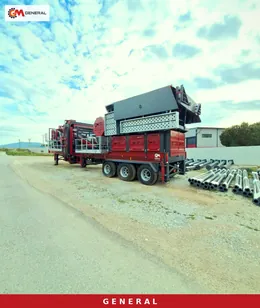
| GNR YM1650 mobile washing-screening | 120-180 t/h | 0-100 mm | 21,000 kg | Grid or generator | Silty, stone-free sand on one line |
| 2 × GNR YM1240 | 2 × 60-100 t/h (120-200 t/h total) | 0-100 mm | 2 × 18,000 kg | Grid or generator | Two digging faces, line redundancy |
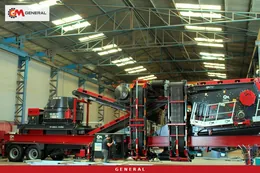
| Mobil 90 (GPJ 90 jaw + washing screen + twin screw washer) | 90-150 t/h | 800 mm | 45,000 kg | 350 kVA generator | Gravelly, bouldery, clayey run-of-pit |
| Mobile tertiary crusher (VSI sand maker) | 60-250 t/h | 0-200 mm | — | — | 0-10 mm crushed sand from oversize |
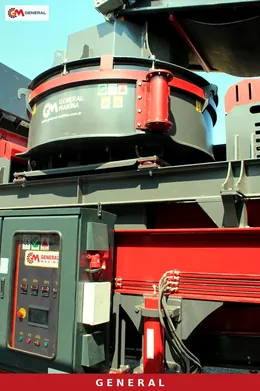
| GNR-MVSI 900 | 90-180 t/h | 50 mm | 42,000 kg | 850 kVA generator | Cubical sand, 0-3 / 3-5 / 5-12 mm |
Stone-free, silty delta sand: one YM1650 or two YM1240s
If most of the material stays within 0-100 mm and silt is the only problem, the GNR YM1650 delivers 120-180 t/h on a single chassis, with sand hopper, washing screen and screw washer on one frame. Its transport dimensions are 4200 × 13600 × 4500 mm. If the pit is worked at two separate points, or output must continue while one line is under maintenance, two GNR YM1240 units (each 60-100 t/h, 18,000 kg, 10.8 m chassis) cover a combined 120-200 t/h. The second option needs two loaders and two stockpile layouts.
Material with gravel and clay lumps: Mobil 90
Where older channels at the delta margin yield gravel and hardened clay lumps along with the sand, washing alone is not enough; size reduction comes first. The Mobil 90 accepts feed up to 800 mm with its GPJ 90 jaw crusher, washes and splits the material into 0-5 / 5-20 / 20-60 mm on a 1600×5000 mm washing screen, and recovers 0-5 mm sand with a 600×6000 mm twin screw washer. If its 90-150 t/h falls short of 200 t/h, a YM series unit added downstream gives the fines a second wash.
The washing chain: from screw washer to dewatering
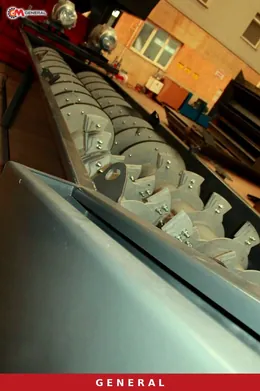
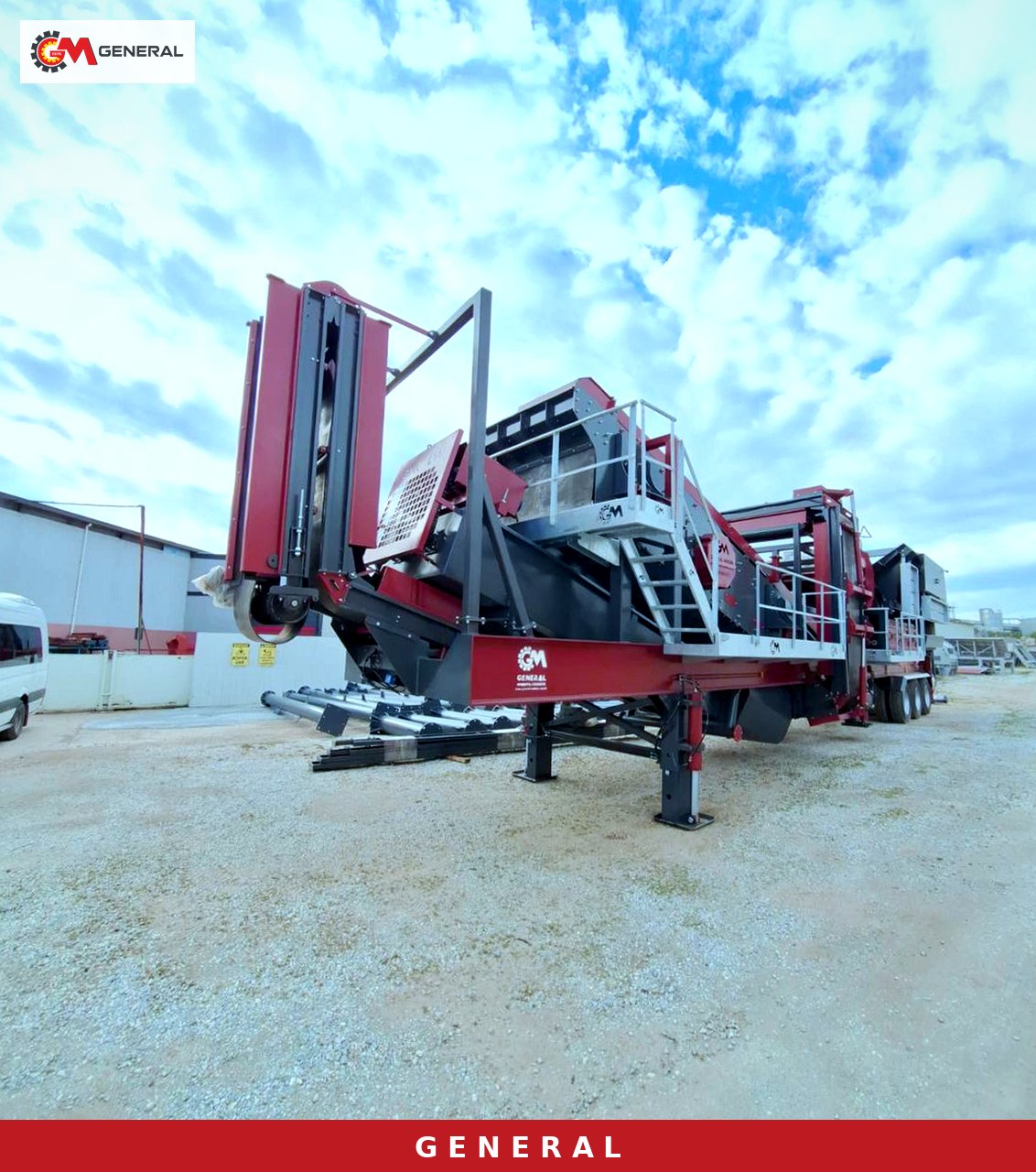
The main loss in the delta is the most valuable fine sand fraction leaving with silty water for the pond. The end of the chain therefore matters as much as the start. The washing screen strips clay from the grains; the screw washer scrubs sand up an inclined trough while silt-laden water spills over the weir. The screw washer family runs on 0-50 mm feed in a 50-250 t/h range; the twin GNR 800 measures 800×8000 mm with 2×11 kW motors.
- Washing screen: separates clay and silt from the grains and splits sand from coarse fractions.
- Screw washer: scrubs the sand and overflows light muddy water. Discharge moisture is typically 15-30%.
- Hydrocyclone: recovers fine sand from the overflow at d50 ~45-150 µm; the aggregate target is ~150 µm.
- Dewatering screen: lowers moisture to 8-20%, so the sand can be stockpiled and enter the batching recipe.
Given how fine delta sand is, the hydrocyclone and dewatering screen are not extras; they decide the saleable tonnage. Without them, wet sand from the screw drips water in the truck and the batching plant keeps adjusting its moisture correction. For laboratory work or fine classification, the IME-GM155 fine material screen, separating down to 600 µm (5-10 t/h, 5 decks), can run on a side stream; it does not carry main-line capacity.
When the sand is too fine: adding VSI crushed sand
Washing solves silt but cannot coarsen the grading. If the fineness modulus of delta sand sits near the lower limit of the concrete specification, coarser crushed sand must be blended in. There are two routes. The first is to send oversize from the Mobil 90 or another crusher to the mobile tertiary crusher (VSI sand maker): it takes 0-200 mm feed, produces 0-10 mm crushed sand on the rock-on-rock principle and runs at 60-250 t/h. The second is to turn crushed stone brought in from outside into cubical 0-3 / 3-5 / 5-12 mm fractions with the GNR-MVSI 900, which accepts a maximum 50 mm feed and runs on an 850 kVA generator.
The blend ratio is never guessed. Separate sieve analyses of natural and crushed sand are taken, blending follows the target grading curve, and trial concrete confirms it. VSI crushed sand helps particle shape against concrete sand requirements such as ASTM C33; even so, if moisture and clay are high, the VSI output should also pass through washing and dewatering.
Water, power and hot-climate operation
Water source and recycling
A washing line needs water. Even though water looks close at hand in the delta, industrial use of canal or groundwater requires a permit and quota confirmation from the relevant authority. For the screw washer the order of magnitude is about 190 L/min per t/h of silt. Hypothetical example: if 10% of a 150 t/h feed is silt, plan around 15 t/h × 190 ≈ 2,850 L/min. The real figure is calculated from the silt test. Recovery measures such as settling ponds or a water treatment unit, chosen per project, cut fresh water demand and should be part of the site layout from the start.
Generator, dust and heat
The YM series can run on the grid or a generator. At pits far from the grid, generator size must reflect the total load of pumps, conveyors and any VSI, not just the washing unit. In a region with hot, dusty summers, radiator and air filter cleaning intervals are shortened and the electrical panel is shaded. The washing line itself makes no dust, but dust suppression sprays for the dry stockpile area and loader traffic are a measure that can be added per project.
Data to gather before requesting a quote
The right delta layout is settled at the desk before anyone reaches site. With this information in your request, the model proposal rests on data rather than assumption:
- Sieve analysis of representative samples (grading within 0-100 mm)
- SE and MBV results, organic matter and chloride analysis
- Whether gravel or clay lumps are present, and the largest particle size
- Target products: concrete sand, plaster sand, coarse fraction and expected stockpile moisture
- Daily operating hours and a realistic tonnage within 100-200 TPH
- Water source, permit status and area available for ponds
- Grid connection or generator
- Port of entry and road route to site (YM1650 width 4200 mm, Mobil 90 width 3600 mm)
Our plants are built under an ISO 9001 quality system and carry CE marking; a 1-year warranty applies, wear parts excluded. North Africa, Egypt included, is one of the export regions of General Makina, manufacturing in Izmir since 1976. For any specific pit, canal dredging job or public project in the delta, confirm the applicable specification values with the relevant authority or tender documents.
Frequently asked questions
Can delta sand become concrete sand with dry screening alone?
It may, if silt and clay are low, but that is rare in the delta. If SE and MBV fall outside specification limits, washing is mandatory. You can compare the YM and ME series on the mobile washing and screening plants page.
Is a screw washer enough for very hard clay lumps?
The screw washer handles a light clay load in fine sand well. With coarse stone and plastic, sticky clay, a more aggressive unit such as a log washer is needed. Options are listed under mining washers.
Does washing remove all salt from coastal sand?
Washing reduces chlorides, but only a laboratory analysis of the washed sample shows whether it is enough. A retest after a trial wash is recommended.
What determines the price?
The number of units, the need for a hydrocyclone and dewatering screen, whether a VSI is added, generator size and shipping method all set the price. A figure is given in the quotation once sample data and layout are clear.
Conclusion
The key to concrete sand in the Nile Delta is to wash rather than merely screen, to dewater without losing the fine fraction and, where needed, to correct the grading with VSI crushed sand. For 100-200 TPH, a GNR YM1650 or two GNR YM1240 units form the core crushing and screening plant line; the Mobil 90 handles stony material and a VSI unit steps in for fine sand. Send your sample results and target product list through our contact page and we will prepare a layout and quotation for your pit.
Definitions of technical terms: Glossary